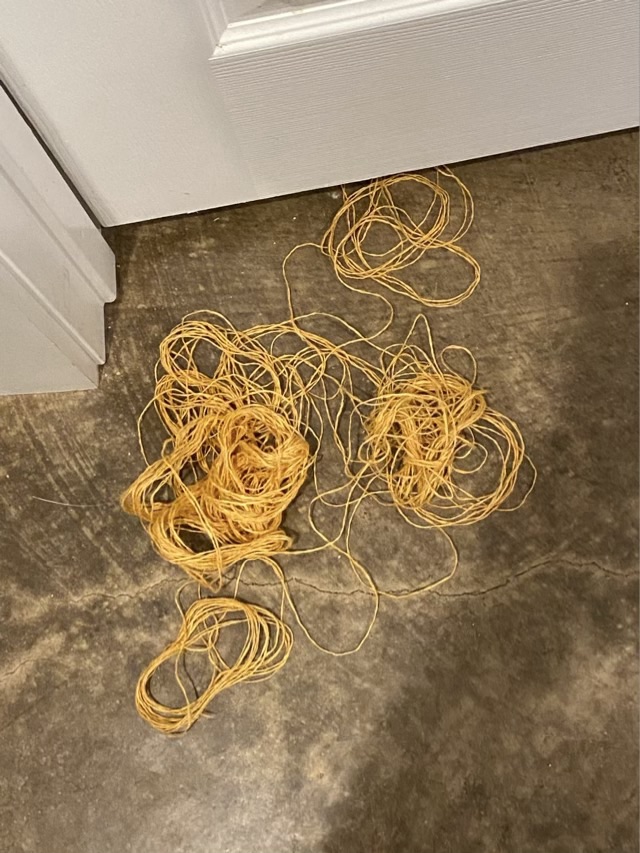
Well, I thought Thor the cat was mostly interested in wool, but I found this former ball of linen yarn out of its bag and in another room from where I left it.
Photo description: loose tangle of orange colored hand spun linen yarn on the concrete floor in front of a closed door
Here is the culprit, looking pleased with himself on Griffin the dog’s bed.
Photo description: large gray tabby cat in a larger brown faux fur pet bed
I don’t believe he ingested any yarn, and I was able to wind the tangle back into a neat ball without any knots. The yarn ball is back in the project bag, and hung up where the cat can’t stick his head into it. Yeah, I love yarn and I love cats and cats love yarn. It is a timeless love triangle.
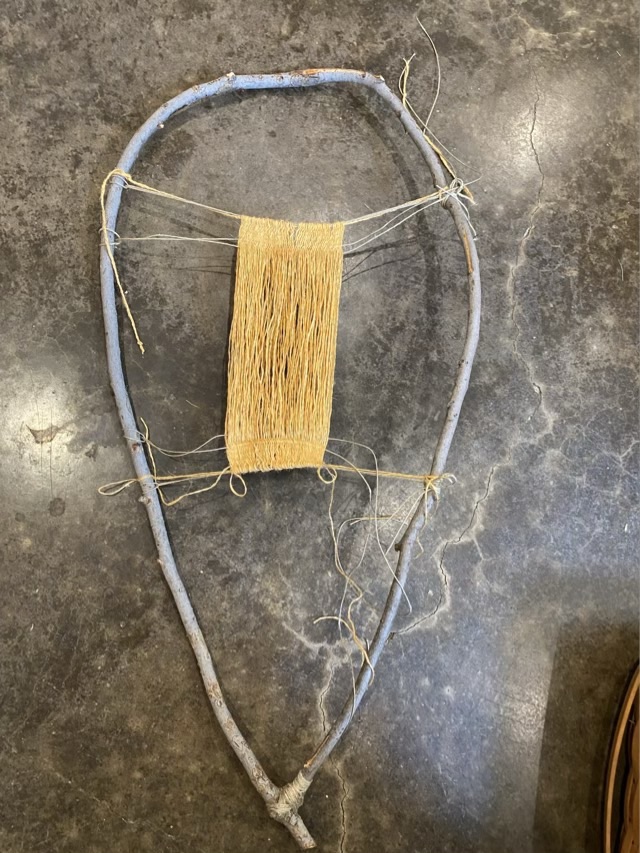
I intended to just trim the grass going to the coop, then, while I was out there, decided to uncover a path that I hadn’t cleared in over a year, then decided to trim some of the branches across the path, then decided to use a branch to make a bigger sprang loom. Logical, right? Once I secured the branch into a loop shape with hemp cord and added life lines, I now had the means to attempt to make an ancient style hair net. I warped the loom with some left over linen yarn that I spun from nettle dyed roving (that was also a lesson learned).
Photo description: Sprang loom made of a cedar elm branch tied with hemp cord and warped with hand spun nettle dyed linen yarn
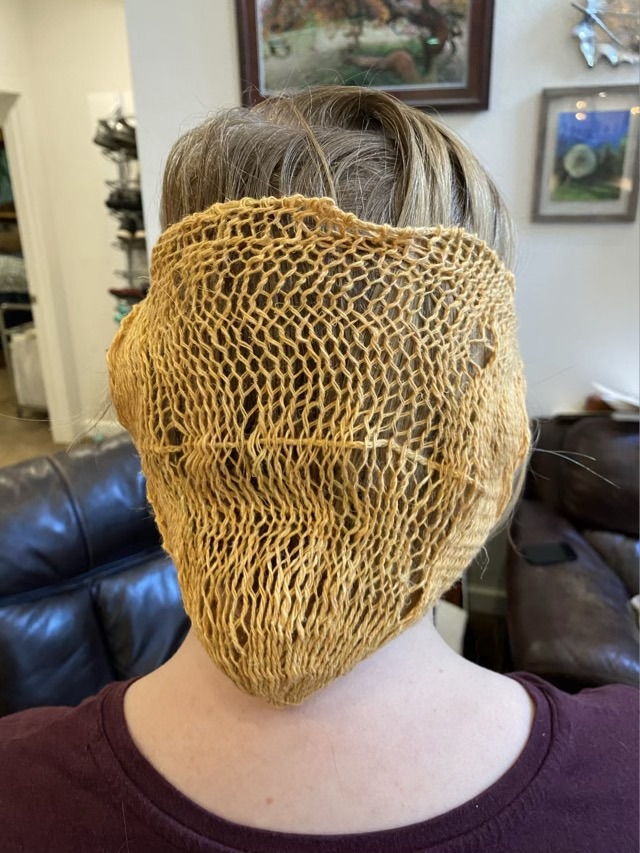
The number of warp threads on this loom was easily triple what I’ve previously attempted. I intended to do interlinked sprang with some lace holes, and switch twist direction halfway through. Here is where the mistake study starts. I ended up with holes that spanned three or four rows instead of just two, and rows that changed technique midway through. Oops.
Photo description: Sprang hairnet full of weaving errors
I think, to solve the errors, I need to do a check at the end of each row by pulling open the weave and looking at the thread path. The yarn was also loosely plied, which made it difficult to tell what was plied yarn, and what was a single strand. I will add some twist before the next attempt. The happy note on this project is the finishing cord through the middle. This was a much neater way to secure the final twist and also acts as a second tie to secure the hairnet. On one end of the sprang I pulled the cord tight to gather the side together, but I left the middle and other end loose on the cords.
Photo description: Sprang hairnet on my eldest, back view
To wear the hairnet, the top cord ties around the temples, across the front of the forehead. The middle cord comes up at an angle and ties at the hairline. The back of the hair is tucked into the lower gathered section.
I will make another attempt, armed with the data gained from this project.
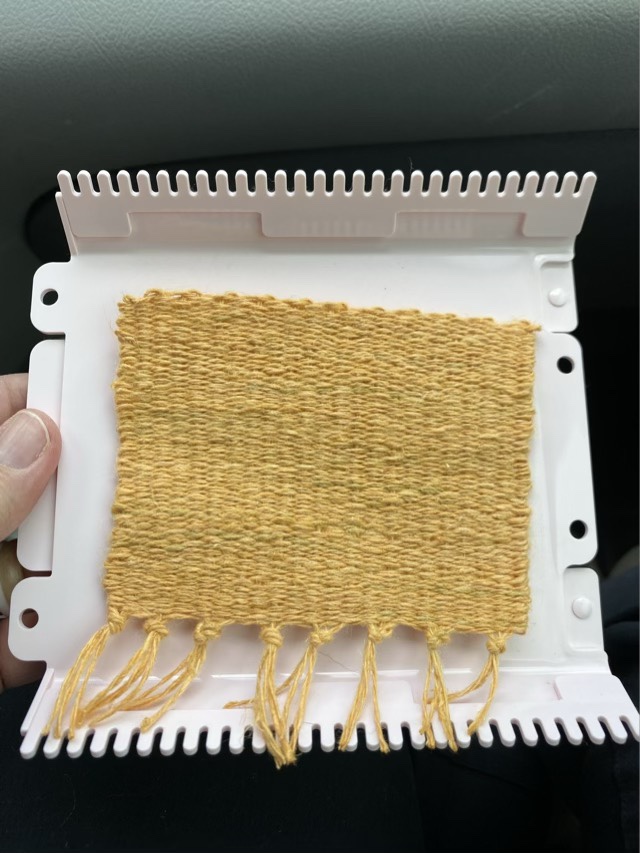
I recently used points to get a Clover mini loom. I have been using scraps of cardboard to weave samples of my spun fibers to go in my fiber journal, so this was an upgrade!
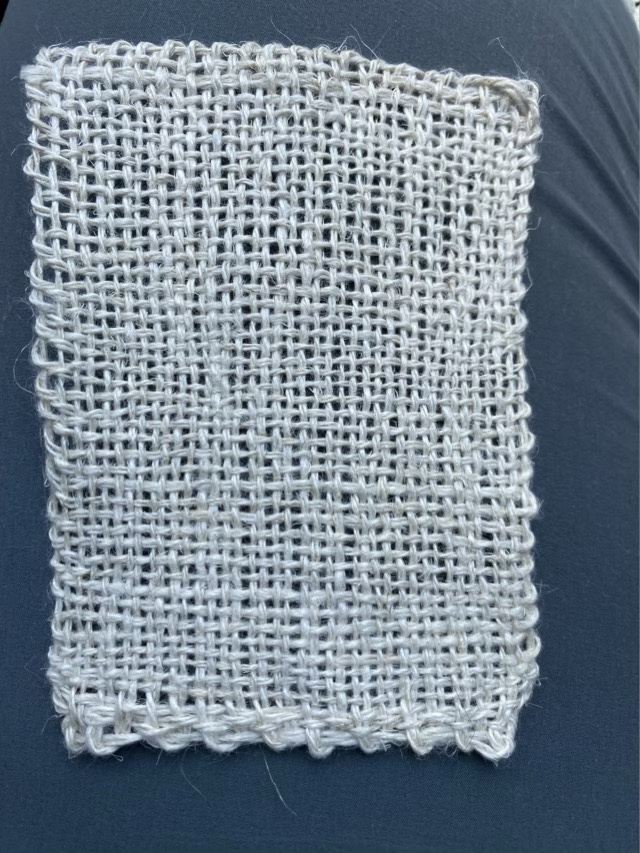
First finished linen swatch, forgot to take progress photos, warped for fringe on the bottom only, came out a weft-faced weave
I started by following directions, amazingly, but the spacing of the tines were very wide and gave me a weft-faced weave, where the warp threads are completely covered by the weft yarn. This is the technique used for tapestry weaving, but not what I was looking for.
Linen warp doubled up and wrapped completely around the loom, starting with a twined row to space the threads
The next attempt I doubled the yarn in each slot by wrapping the warp yarn completely around the loom. This gave me fringe on top and bottom when it was finished, but the weave came out with both the warp and weft showing.
Linen woven swatch with knotted fringe
I moved on to my hemp yarn, and of course I forgot to take progress photos, but I doubled up the warp thread by making loops around the tines, resulting in a fringeless swatch. I found I didn’t need the twined first row to space the threads. It came out a bit wonky, but I am seeing process improvement.
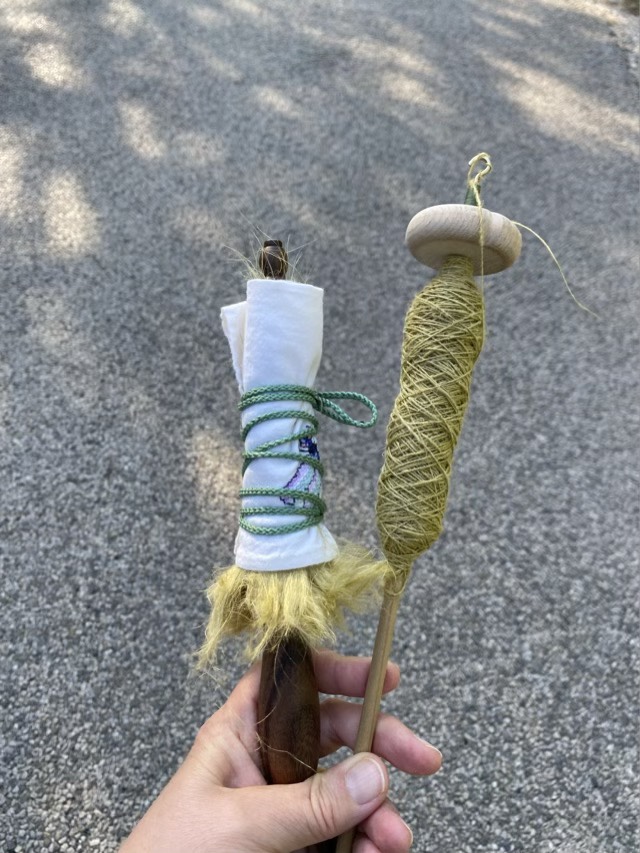
I have finally finished spinning the flax singles from my flax roving. Flax prepared as a roving is not the traditional form, but I didn’t know this when I made the purchase. It has been a challenge to spin, but I’ve learned new techniques and have produced a yarn.
Dressed distaff and drop spindle
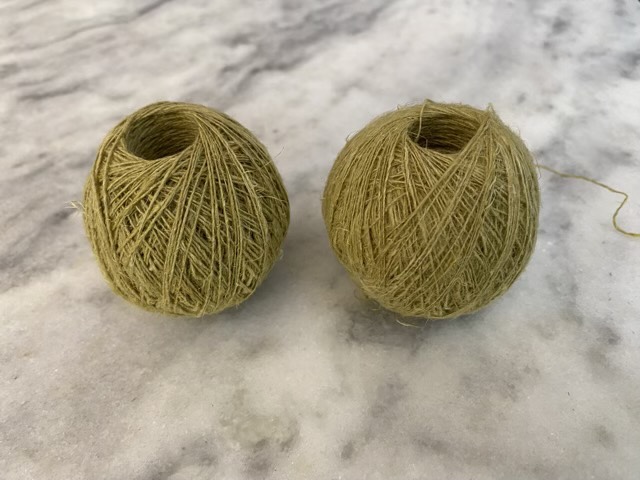
I wound off my singles nostepinne style into two center pull balls.
Center pull balls of flax singles
I plied the two balls together to even out the thickness differences. Despite weighing out the roving, the balls were different weights, but I solved the excess issue by doubling up the leftover. I plied using my spinning wheel. Flax when spun is called linen. I suppose I should use that term for my yarn!
Two-ply linen on a spinning wheel bobbin
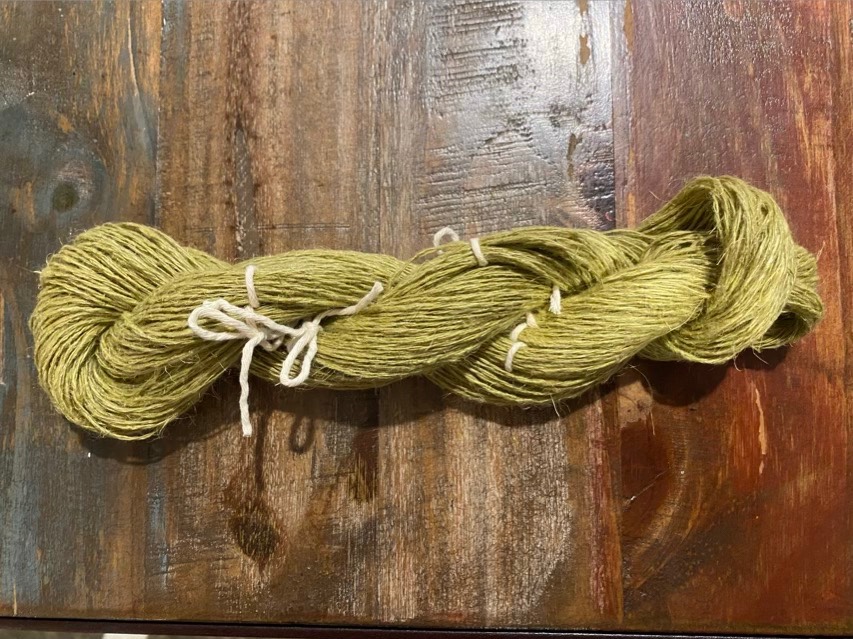
I wound off the two-ply yarn onto a niddy noddy, to make a skein.
Two-ply linen skein
My book tells me that the next step is to boil the skein. I’m going to have to work up my courage for that, so I will share in a future post.






 Critters and Craft