Leather wrap bracelets

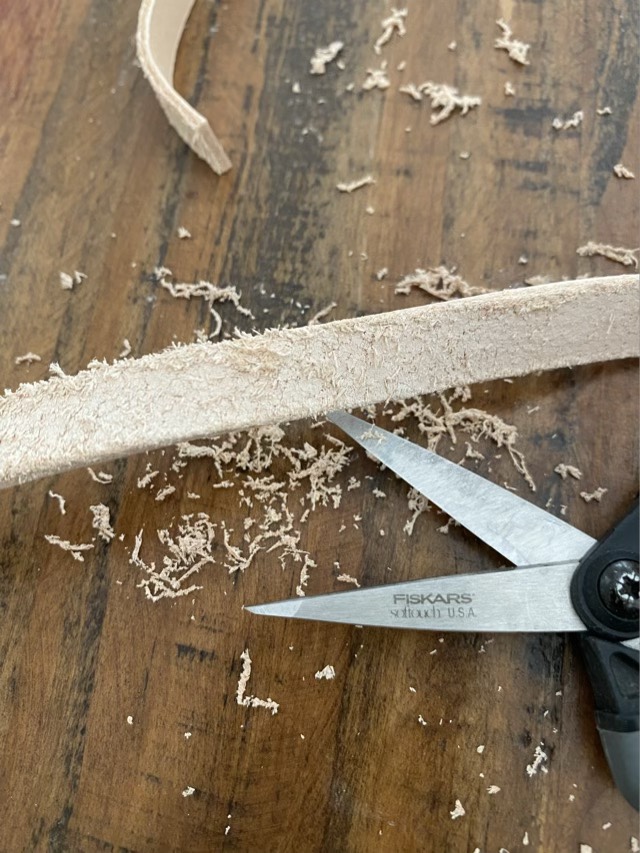
I recently finished a commissioned order for leather wrap bracelets with a saying. I used 1/2” strips of tooling leather, which were a little fuzzier on the back side than I’m used to, so I trimmed the “fuzz” as a first step.

Trimming off excess leather on the back of a tooling strip with scissors

Next I wet and smoothed the edges of each strip round with a slicker. I found a wooden slicker tool awhile back, but am not impressed with it in the raw state. I think I will give it a good sanding and glossy finish before using it again.

Wooden slicker tool and three wet strips of leather

I have multiple options on making the saying on the leather: I have stamps, leather tools, and my pyrography kit. I haven’t done pyrography on leather, so really wanted to see how it might work. I took a scrap piece of tooling leather and did some experiments.

Scrap leather with “Find” written with pyrography

I found that the heat of the pyrography pen, when at about 5 and a half, would burn into the leather and make a mark like stamping, but also darkened the leather. This was what I was hoping for! I could do the sentence free hand. I also found that it was better to dye the leather first, then burn it, then seal it.

Laying out the design on a paper strip “Find Joy and Meaning where you can, and file the rest appropriately.”
Dyed and burned bracelets with buttons unassembled, the shorter one was my test case

Once the pyrography was done, I cut in the button hole and sealed the bracelets. When the sealant was dry, I punched holes for the button and used waxed linen to sew on the button. The leather had become stiff, so some bending and moving freed up the form some.

Finished bracelets sitting on the windowsil

I do really enjoy pyrography, so this was a fun project and discovery!

Woven bracelet

I found another thing to do with my woven bands: bracelets! I chose to sew leather ends on to reduce bulk, and I had the materials.

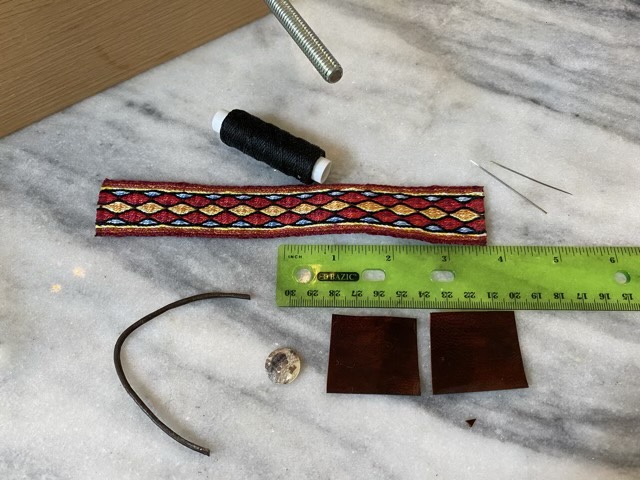
Materials to make the bracelet

I cut a strip of goat leather and stained it dark brown, then sealed it with an acrylic clear coat. I cut two smaller rectangles from the finished leather, cut a length of leather cord, sealed the ends of the woven strip with clear glue, selected a shell button, and sewed using waxed nylon cord.

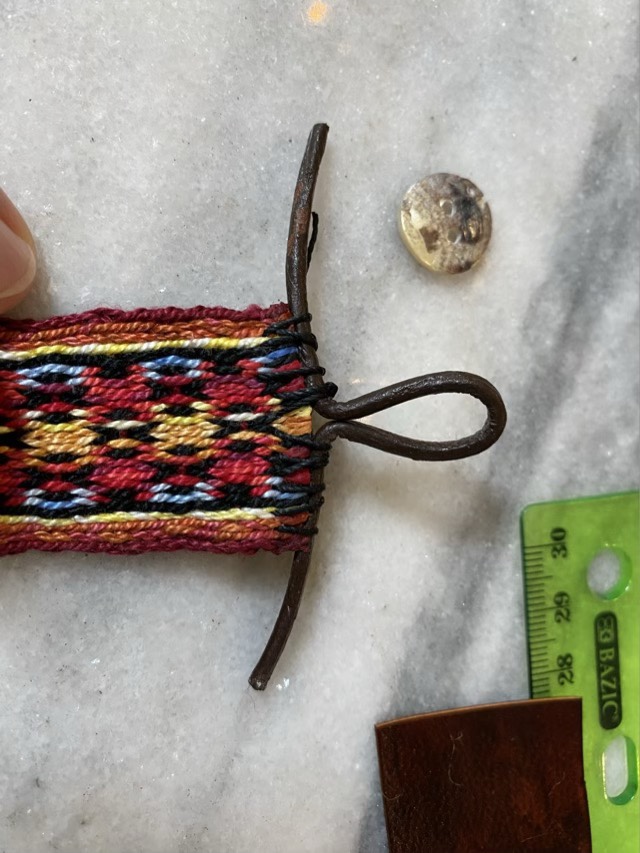
Attaching the eyelet

To form the eyelet for the button hole, I folded the leather cord in half, then bent the ends outward at a 90 degree angle. I secured it to the end of the woven band with waxed cord, then cut off the excess. To cover the end, I cut a slit in one leather rectangle to slide over the eyelet, then sewed the leather to the band. The nylon thread was thicker than I wanted visible, so I separated the three strands and just sewed with one.

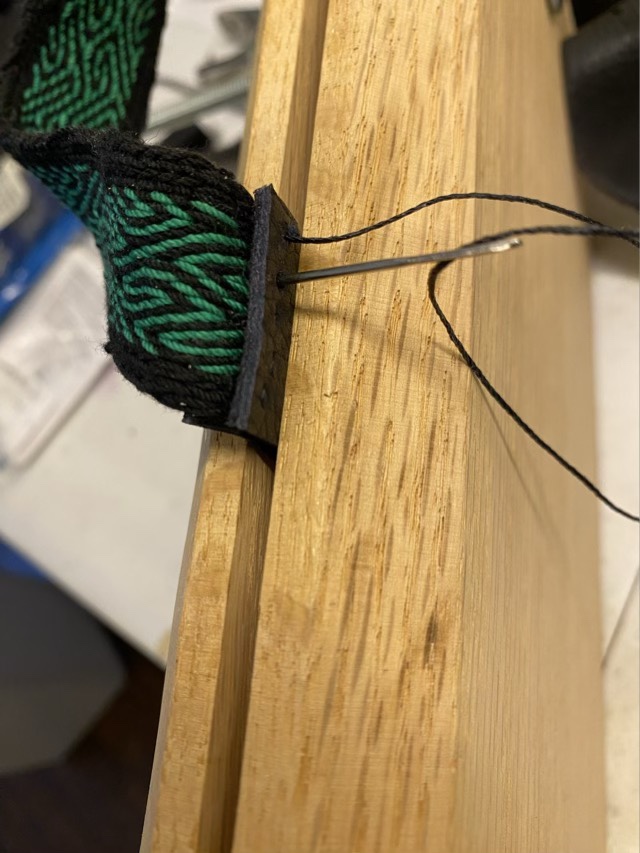
Sewing the leather using a clamp

My wooden book clamp serves well as a leather stitching aid. I used wax paper to keep the newly finished leather from sticking to the wood. (I recommend waiting 24 hours before sewing, but I was impatient.)

Finished button hole end

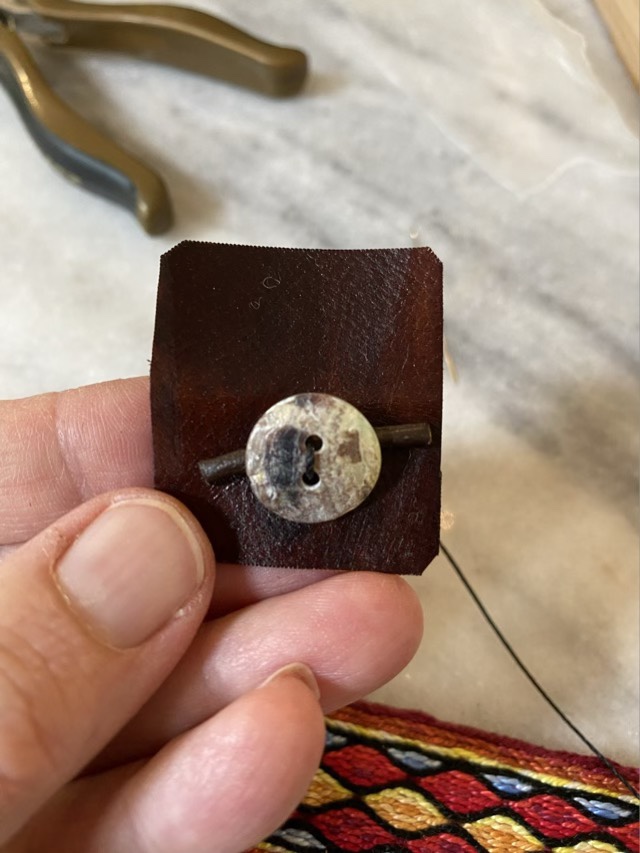
For the button end, I sewed the button offset on the other leather rectangle, using cord scraps to space the button off the leather. If the button is sewn tight to the surface, there isn’t enough room for the eyelet.

Button sewn using a cord for a spacer
Button end sewn using a wooden clamp
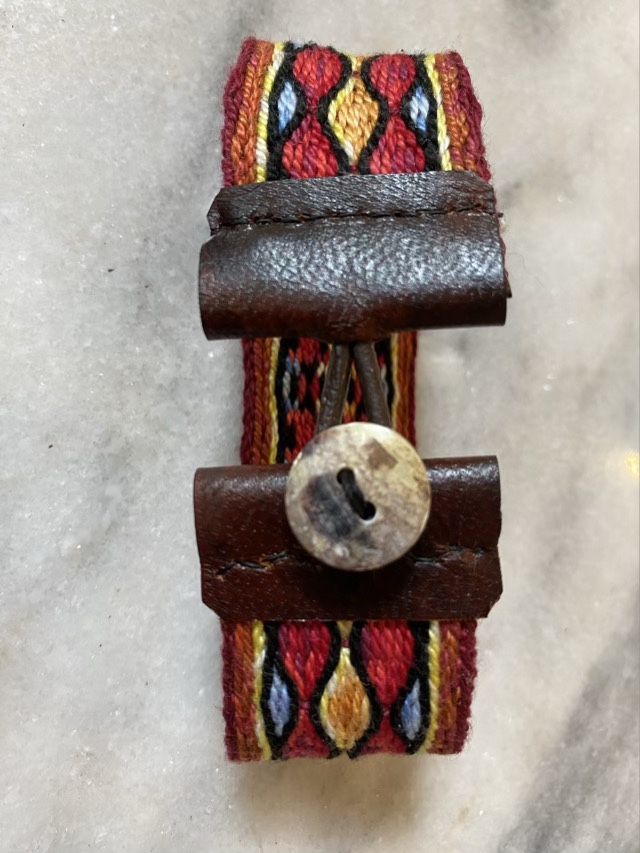
Finished hand sewn leather button clasp

I’m pleased with the finished bracelet. Although I would have preferred the leather ends to butt together, the gap actually makes the bracelet more comfortable to wear by giving more flex. The bracelet is easy to button one handed, and is light.

Wrist strap

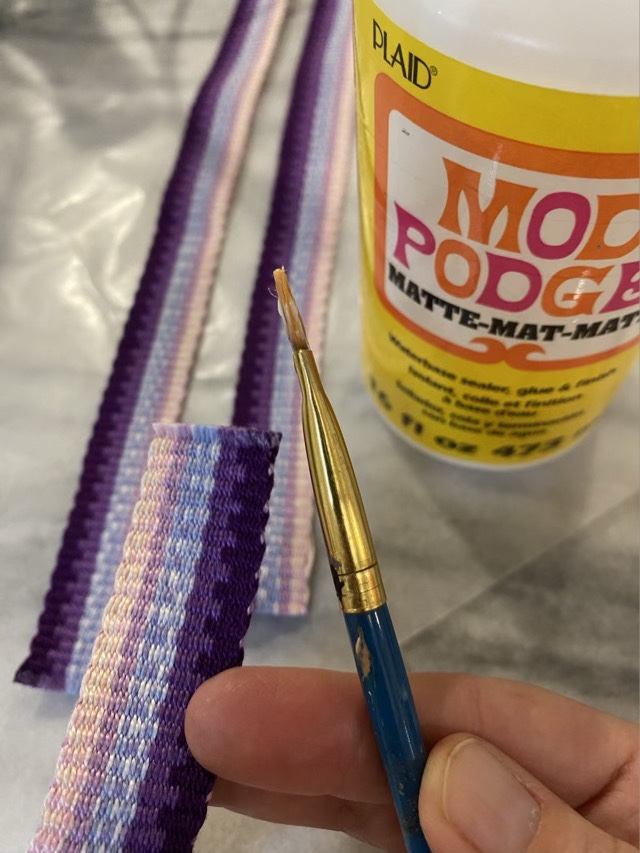
I’ve been pinning many pictures of things I can do with my Inkle loom woven straps. So many things, but what caught my attention this time were wrist straps. Most of the articles talk about attaching keys, but I also saw wrist straps used for walking canes, cameras, and small bags. I also saw a method for securing the end of the cut woven strap with clear flexible glue. I used Modge Podge, which worked well painted on the ends and allowed to dry.

Securing cut ends by painting on clear glue

There is metal clamp hardware that make the creation of a wrist strap quicker, but I preferred the sewn leather direction. I noticed that leather makers use a wooden clamp that is similar to my bookbinding clamps. My clamp is larger, but it worked well to hold the pieces together while I stitched. I used a single ply of waxed nylon thread to sew a loop of leather to the ends of the strap.

Stitching leather using a book clamp

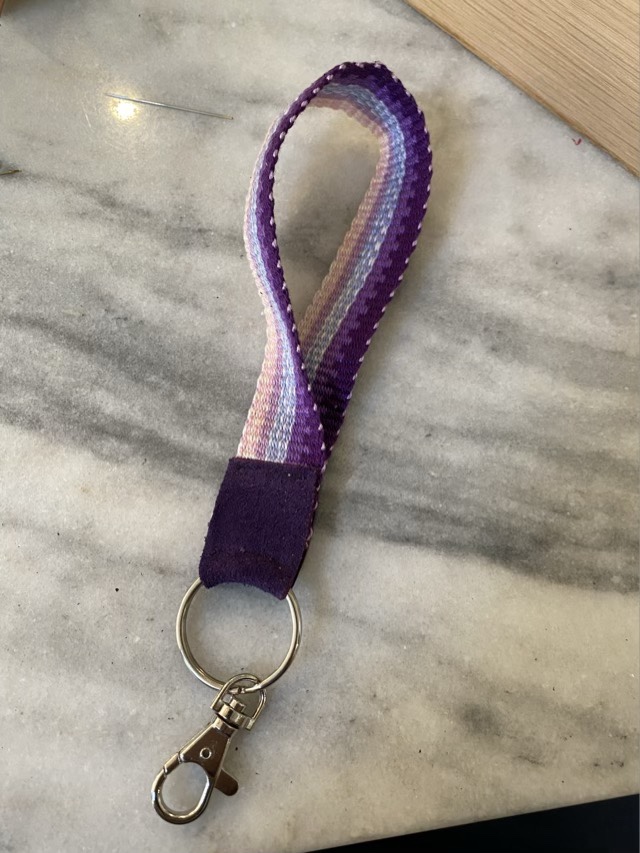
Rather than a D ring, I used a split ring and a toggle clasp because these can be removed if the strap needs to be modified with different attachments.

Wrist strap made from an Inkle loom woven strap and leather

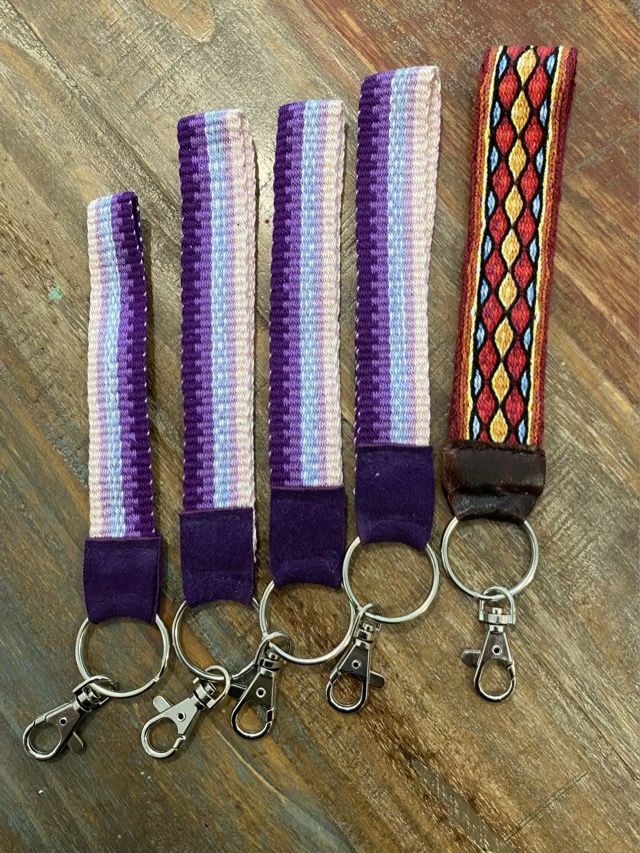
I liked how this one came out, so I made more.

Hand woven, hand sewn, cotton and leather wrist straps

Pan handle

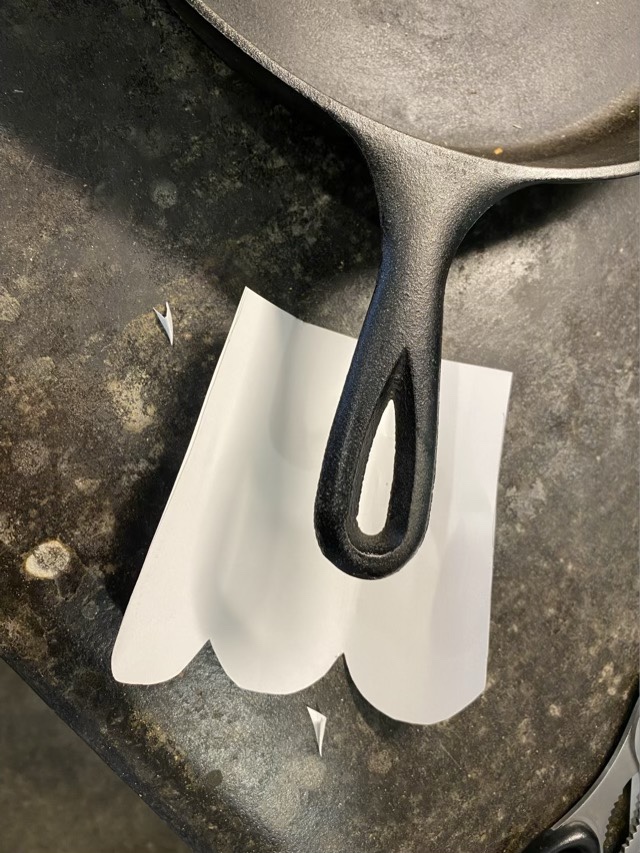
One of my Dad’s favorite cooking implements is a cast iron pan. I saw ideas on leather handle covers so thought I would make him one. I started out with some card stock to make a template. I liked the idea of a wrap around handle cover because it seemed it would be more comfortable to grip.

Making a paper template

I used the template and leather shears to cut the design from tooling leather. With the wrap around design, only the end needs sewing, the wrap has enough give to slide onto the handle, but should stay in place. I wetted the leather and punched holes, then I lashed the end with a strip of leather.

Securing the end with leather thong

I let the sewn assembly dry in place on a cast iron pan (both my sister and I have pans at our house in case Dad needs to cook something while he is visiting.) When it was dry I sealed it with Resolene to protect it from food spills.

Finished leather pan handle

Third anniversary

Well that snuck up on me. I had plans to lay out a lovely leather carving for the third anniversary of my blog, but the time suddenly loomed so I whipped up a quick stamped leather oblong instead. Three years can be an awkward age.

Leather anniversary