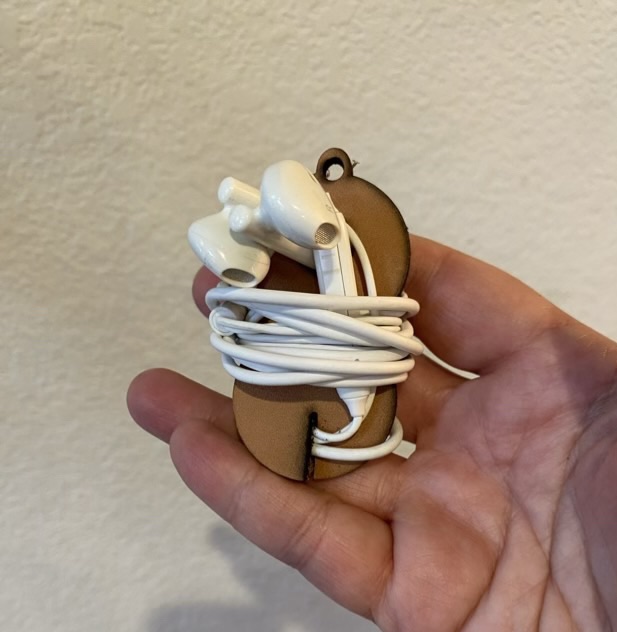
My headphones were in a tangle in the bottom of my bag. I realized that I now have a way to design and cut leather quickly, and could make a holder! I laid out an SVG file in Adobe Illustrator inspired by a Pinterest pin, put a piece of scrap tooling leather in my laser cutter, and ran the program.
Photo description: prototype leather headphone holder with key chain hole, hole for the ear buds, and slit to hold the end of the cordPhoto description: headphones wrapped around the leather holder
Hm. Not as neat as I hoped. Still, first prototypes usually aren’t spot on. This design would probably work better with headphones that don’t have a volume button on the cord, and have different shaped ear buds. I also need to beef up the keychain ring. It’s looking a little thin. Back to the drawing board. (Really, I’ll do a pencil sketch first on paper this time, then go to the computer.)
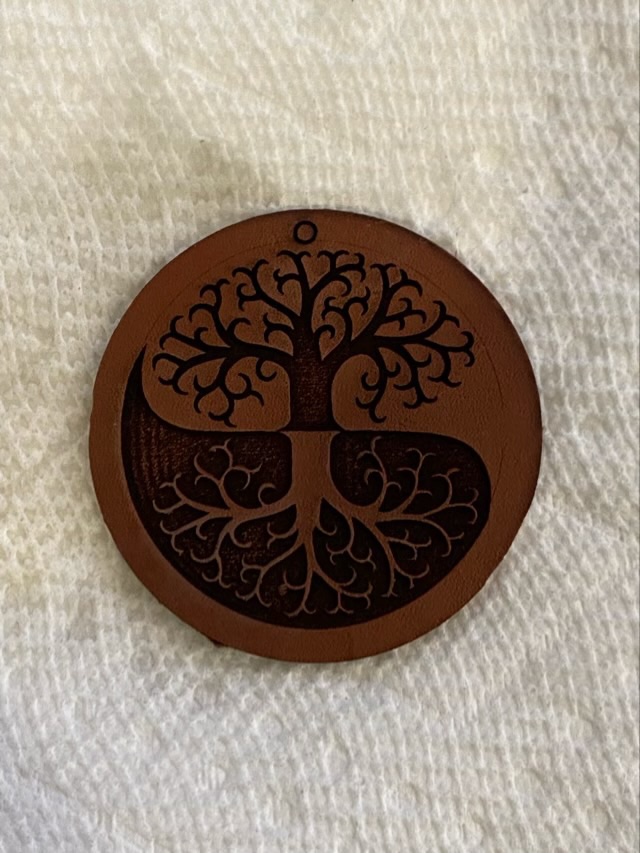
I did my first test of tooling leather in my laser cutter. I used a two color version of my business logo and did a fill engrave of the logo and a cut for the circle. The cut wasn’t quite powerful enough to go through the thick tooling leather, but not surprising for my first attempt.
Photo description: Caryn’s Creations tree logo burned into tooling leather with a laser cutter
I had to finish the cut with shears. There was smoke residue on the surface, but a quick rise removed it.
Photo description: same logo on leather, cut out and wetPhoto description: same leather logo now dry
I do take screen shots of the engraving and cutting settings because I’m pretty sure my software resets every time I open a file. I’m also starting to get a good feel for the settings.
I’m am now well and truly dangerous. I love working with tooling leather, and this opens up a whole realm of opportunities.
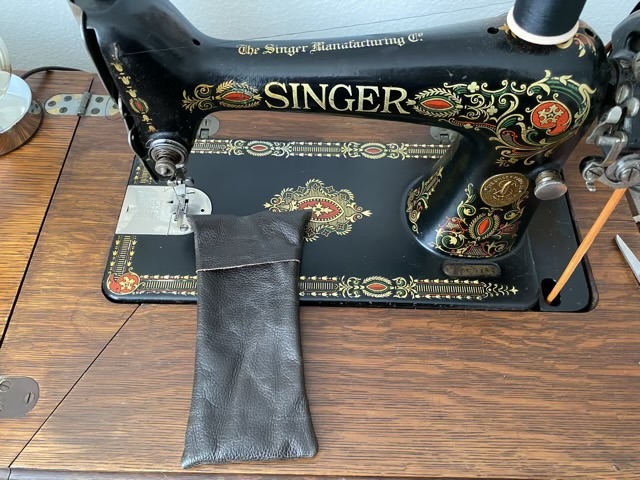
I had the chance to sew some reclaimed leather on my antique Singer 66 treadle sewing machine. This leather is thin and flexible so was easy to sew, I suspect that a modern machine would be able to handle it as well. (There are tales out there that these old machines are great for sewing leather, but the truth is much more complicated.) I did crank the machine by hand rather than risk the speed of the treadle, and I used upholstery thread (and found my purchased bobbins don’t fit, sigh.)
I wanted an envelope style pocket with the flexibility to thread on a belt, or hang from belt loops with carabiners.
Photo description: sewing thin soft leather on a Singer 66 sewing machine Photo description: pouch turned right-side out Photo description: pouch with carabiners through the central hole in the belt pass through
The design needs work. I like the hole in the belt loop and the flexibility it gives, but the flap makes it difficult to get the phone in. I ended up clipping the edges of the flap so it still helps the phone stay put, but is easier to get the phone inside. Not ideal, but experiments will continue.
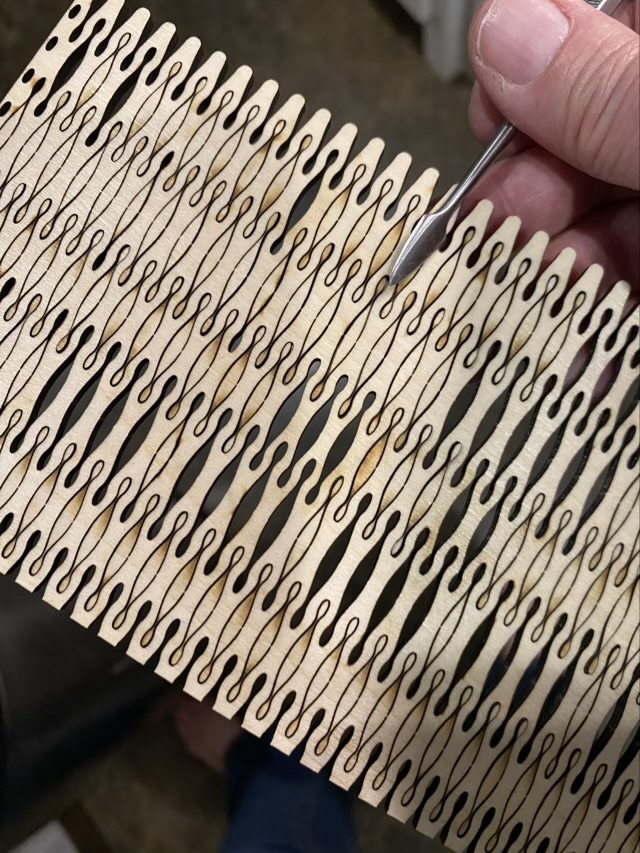
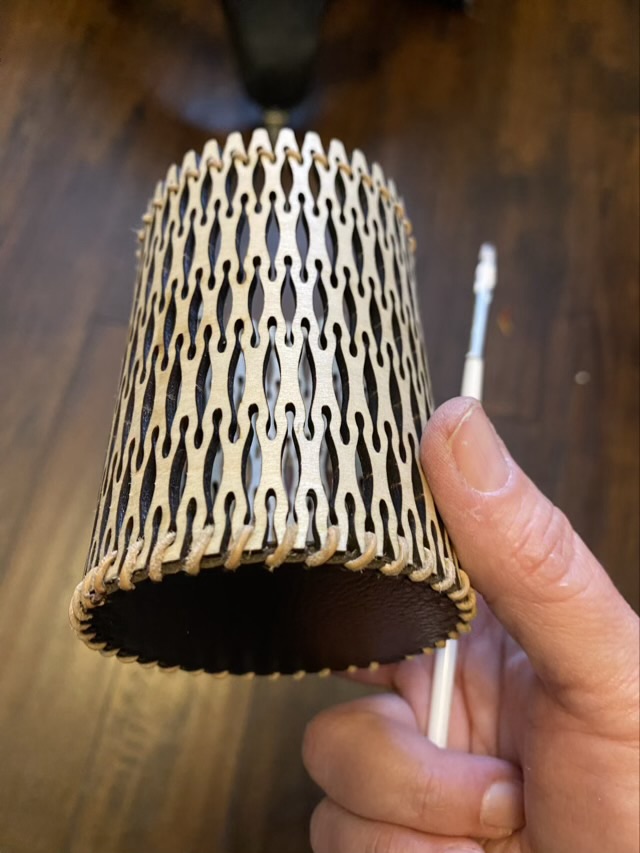
Making kerfs, small straight cuts, in thin plywood allows the wood to bend without breaking. Those kerfs can also be decorative. I found free patterns on an Instructables post, downloaded them, and used the basic building blocks to make an SVG file for a round dice cup. The SVG file was built with sections of the rounded pattern, which resulted in incomplete cuts only a fiber width thick, but enough that many of the cutouts had to be manually ejected (dental tools or long thin carving tools work well for this).
Photo description: cut sides of the dice cup with stuck cutouts, along with the end of the metal tool I used the weed the pattern
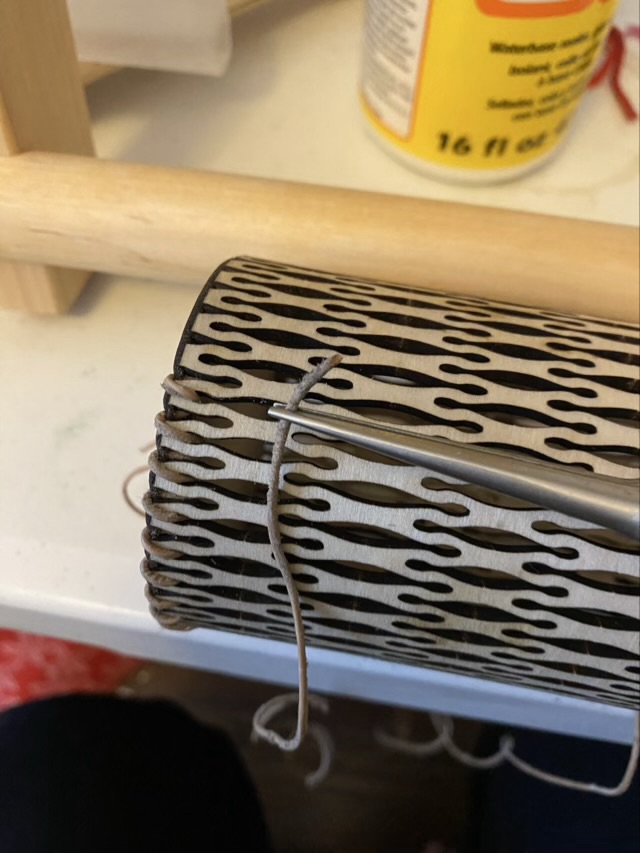
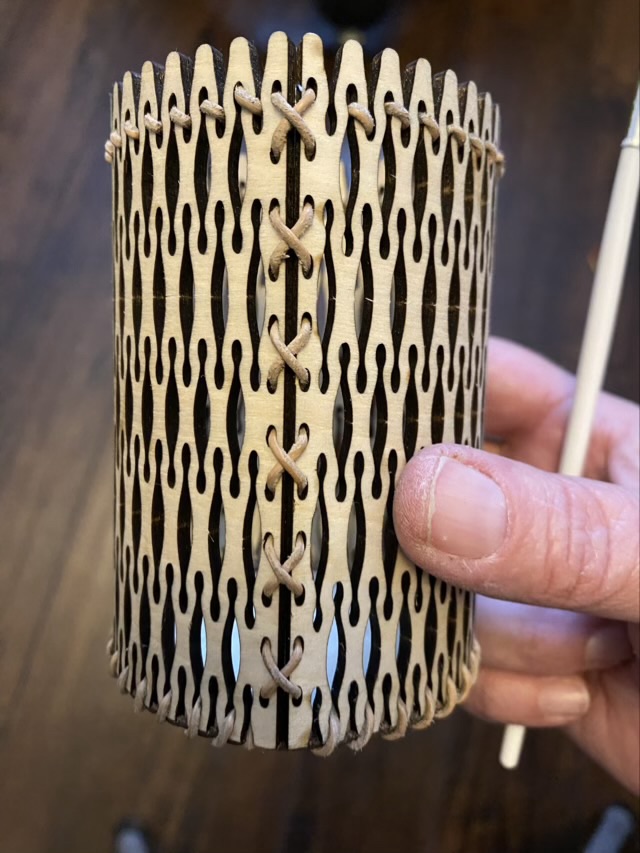
I mentioned that I don’t like butt joints, so I added lace holes along the edge and secured the join by lacing with leather cord. I then measured the diameter of my cup and cut a circle of wood to fit inside the bottom. This is a different kind of butt joint, so I also cut a piece of recycled leather (thank you old recliner) with holes spaced to line up with the gaps in the sides. I glued the leather to the wood and used the same leather lace to sew around the edge of the base.
Photo description: laser cut leather base for the dice cupPhoto description: reinforcing the base with leather lace sewn through the holes using a long nose pliers to reach inside the narrow cupPhoto description: finished cup with leather lace securing the joins and another line of lace as a decorative element at the topPhoto description: dice cup bottom oblique view
I used my go-to finish, Howard’s Feed-N-Wax, which was problematic. The wax became wedged in the small decorative curves and was very difficult to rub into the surface. Some time in the oven on low melted the wax, but I think for the next project I’ll use light coats of a spray finish.
This was an interesting project that resulted in an unusual object, but not one I think I’ll repeat. I will take elements of this piece and apply them to other ideas.
I replaced my recliner. The padding in the old one was breaking down, especially on the arms, causing pain and numbness in my own arm. I tried reworking the existing padding, and then replacing the padding, with no improvement. The recliner mechanism was also staring to go, again. (I did replace that a few years ago by ordering a new ratchet strip, but I even wore that out.) Time for a new seat, but what to do with the old one? It was not all leather, but did have some, could I reclaim it?
Photo description: old leather recliner
I took a pair of kitchen shears and went after the fabric of the chair.
Photo description: inside the recliner showing the leather (tan) and the faux leather (white)
Deconstructing was not terribly hard. Most of the screws were two sizes of Torx head, and I had the right size screwdrivers. I was appalled at the amount of cardboard inside the recliner, it was a thin sheet of that over the sharp edge of wood that was causing the pressure point in the arm of the chair; the curved slope was an illusion. The hardest thing to remove was the handle for the recliner action.
Photo description: handle removed after applying a wrench to the screwdriver to get enough torque
I’m thought about reclaiming some of the steel and springs, but I didn’t have a purpose in mind, and I don’t have the storage space for that much “maybe”. I used leather often, so I knew that was a valuable resource.
Photo description: steel mechanisms and springs inside the recliner
In the end, I reclaimed 2 pounds 9 ounces of leather and reduced the recliner to fit in four black bags, which could be put out with the other trash and not require a special pick up.
Photo description: four large black garbage bags ready for take out