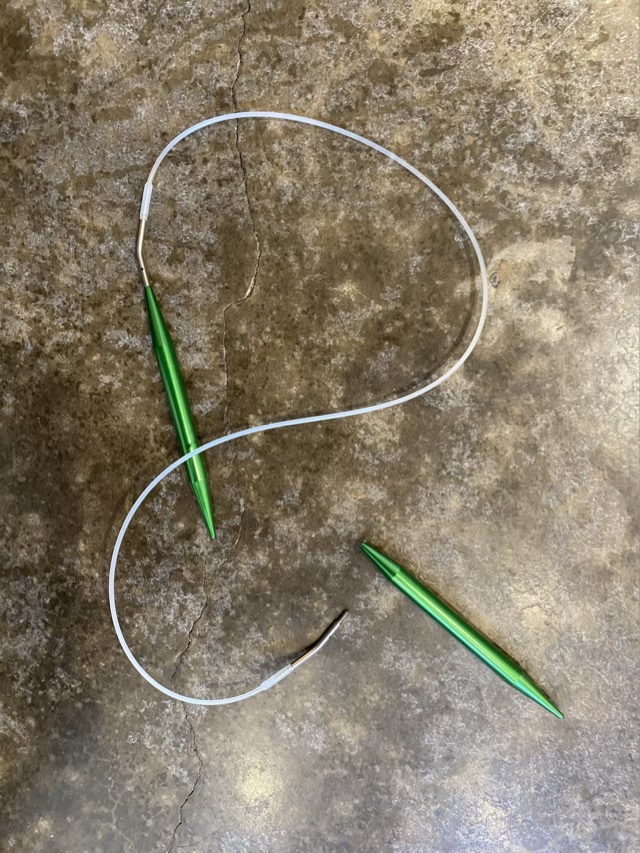
I don’t like metal knitting needles. The are so slick I feel like I’m going to drop them, and if you don’t notice them coming unscrewed from the cable, you have an extreme panic moment when you suddenly have loose stitches at the end of the needle. The nylon cable has also taken on a permanent twist, which makes it fight the needle movement.
Interchangeable circular knitting needles with stiff nylon cord
My Grandma used metal replaceable needle tips on her interchangeable circular needles. Although I want to finish her project, it won’t be with her needles if I want to retain what sanity I have left. I understand that at the time they were the latest thing and better than what came before, but there are now even better options. I ordered some Prym circular needles in the same size Grandma used, but with a fixed multi-strand steel cable, which is strong and flexible. These needles are easier on my hands as I knit because I don’t have a death grip on slippery slidey needles that have a mind of their own.
Switching from metal needles to Prym ergonomic knitting needles
I do not get a kick back from Prym, in case you are wondering, I just really enjoy the thought and engineering that went into their design.
Could it be? Have I found a knitting technique I really enjoy? Maybe! This is another thing that looks complicated on paper, but in practice is not bad at all. I rather like sliding the double pointed needle from one side to the other to start the next row; it is satisfying. In fact, I like knitting it to the edge, rather than sewing on an i-cord, not only because it is a nice finish, but it also hides the edge inside the cord. Neat! There are all sorts of instructions out there, and I admit I did resort to watching a video, so I won’t spell out the steps here. So I remember for next time, though, I used a four stitch i-cord, and used the slip one, knit two together in the back method for decreases at the beginning of a row.
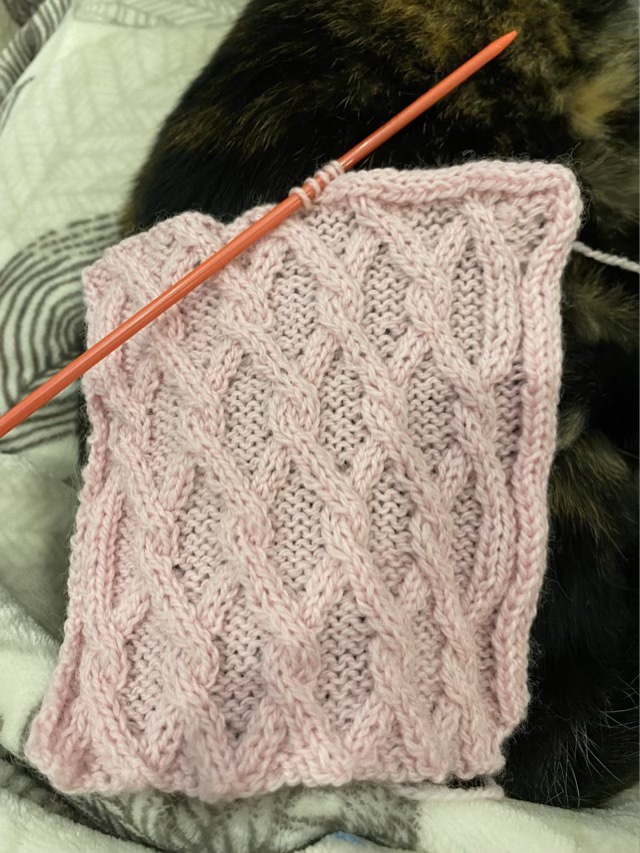
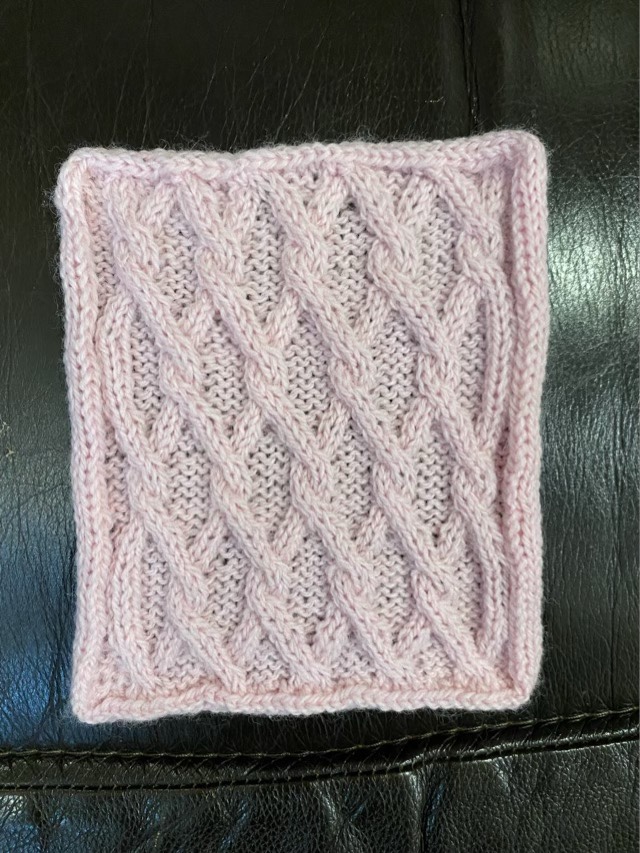
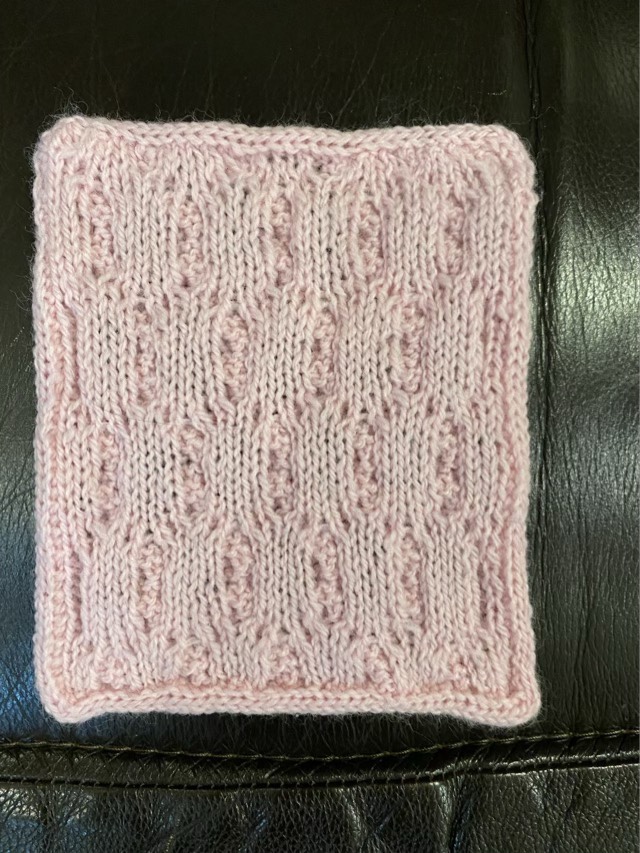
i-cord in progressSwatch with i-cord edging after blockingBack of swatch
I think the i-cord coordinates well with the cables as well. (Well, there is a sentence that flows strangely. I’ll leave you to ponder the depths.)
Before I delve into finishing my Grandma’s blanket, I needed to test knit the pattern to make sure I understood all the notations and how it goes together. It took me a couple goes to get the stitch count correct (take the pattern repeat and add the edge stitches, so I remember for next time), but once the number was right, it came together well.
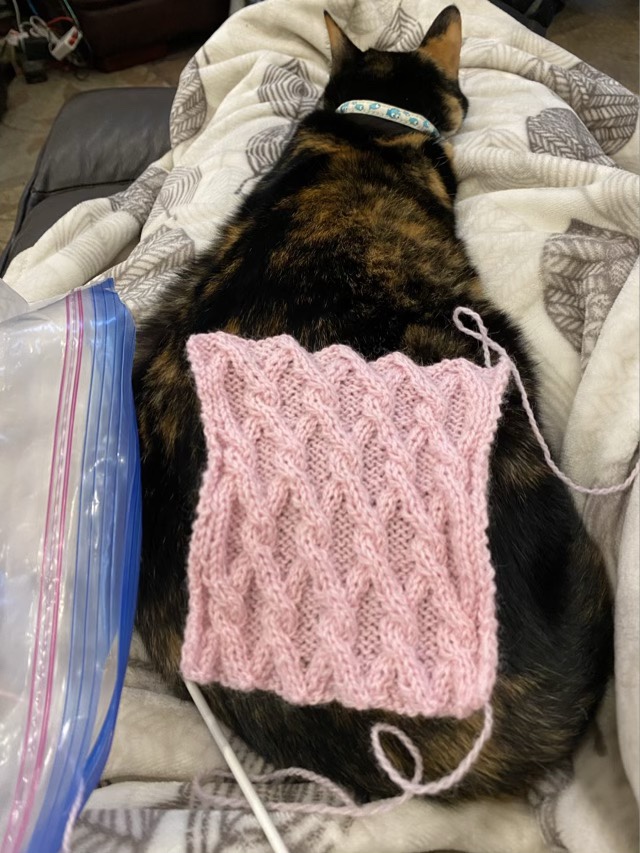
Swatching seems to be a hated or loved knitting activity. I fall on the love side. I would rather see how the pattern or yarn behaves on a small scale before delving into a large project. I used a stocking weight wool yarn, and size 6 circular needle, which is a far cry from the bulky yarn and size 11 needles used for the blanket, but it was the pattern I was investigating.
Izzy the cat is fine with being a backdrop for the cabled swatch if it means she gets more fuzzy lap time
I see why my Grandma liked this pattern, and why she made it so many times. It looks complicated, but it flows well, and it is easy to “read” the prior row of stitches to figure out where you are. Then the back row just follows the previous row’s stitches, and goes in twos or fours predominately, which makes checking for errors easy. The swatch came out OK, and I feel comfortable with the pattern. I do think I will finish off this small piece with a suitable edging, and it can join the doll house blanket army.
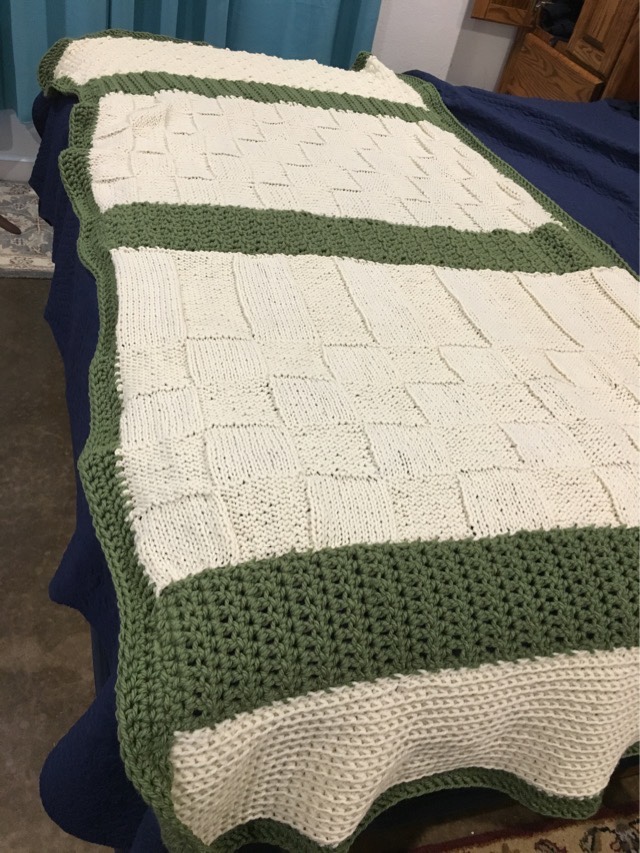
Boy, is that title going to be misinterpreted. UFO in this case is “Unfinished Object”, and refers to my Grandma’s knitting projects. I finished one in 2018 (which was before this blog started). Rather than try to match Grandma’s knitting (or rip out to the point the pattern needed, which was probably why she abandoned the project), I made it a patchwork of knitting and crochet, even using the same brand but different colors of yarn. It came out nice and long and finished!
Conglomerate blanket finished in 2018 using sections of knitting and crochet (Grandma’s section is the third from the bottom)
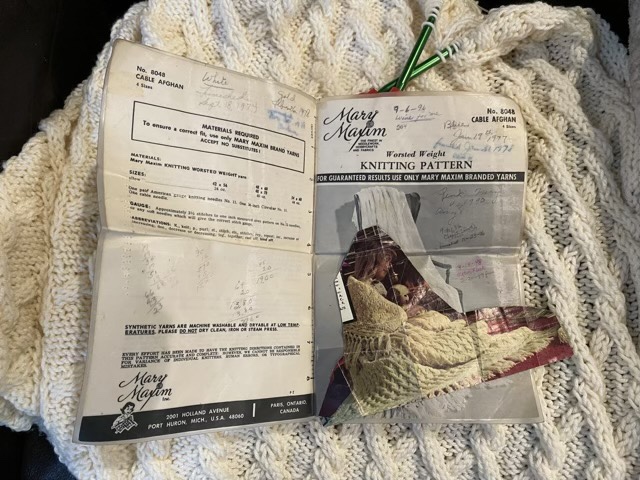
I have another project, which does not appear to need any ripping. It is the start of a beautiful cabled blanket. Grandma laminated the pattern and took notes each time she made a version. It appears that she used this pattern 10 times before this cream one, the first being made in 1974. If I am reading her notes correctly, it seems that she started this cream version in 2006, but then restarted in April of 2013. She passed in November of that year. She marked each row of the pattern with a minus when she started working on the row, then made it a plus when she finished the row, so she could tell exactly where she was (I know because she stopped mid-row, and it corresponds with the markings).
Grandma’s unfinished blanket with laminated and marked pattern, and cutout magazine photo
Yes, I am going to attempt to finish her project, but there are some preparatory steps I need to take first. I need to make a swatch to get the feel of the pattern under my fingers (and make sure I can), and I need to wrap my head around a project that will take me months to finish. Grandma wrote on her pattern that it took her “35 minutes to do two rows, 10 min back row, 25 min front row”. So only the center section of one of these blankets took her 63 hours to complete. And I am not the knitter she was.
The portion of work my Grandma completed on this cabled blanket
I am glad she left notes on her pattern, not only for her own memory, but so she could share that information with me. It would have been better to sit with her to receive instruction, but I am happy that I am still able to learn from her experience.
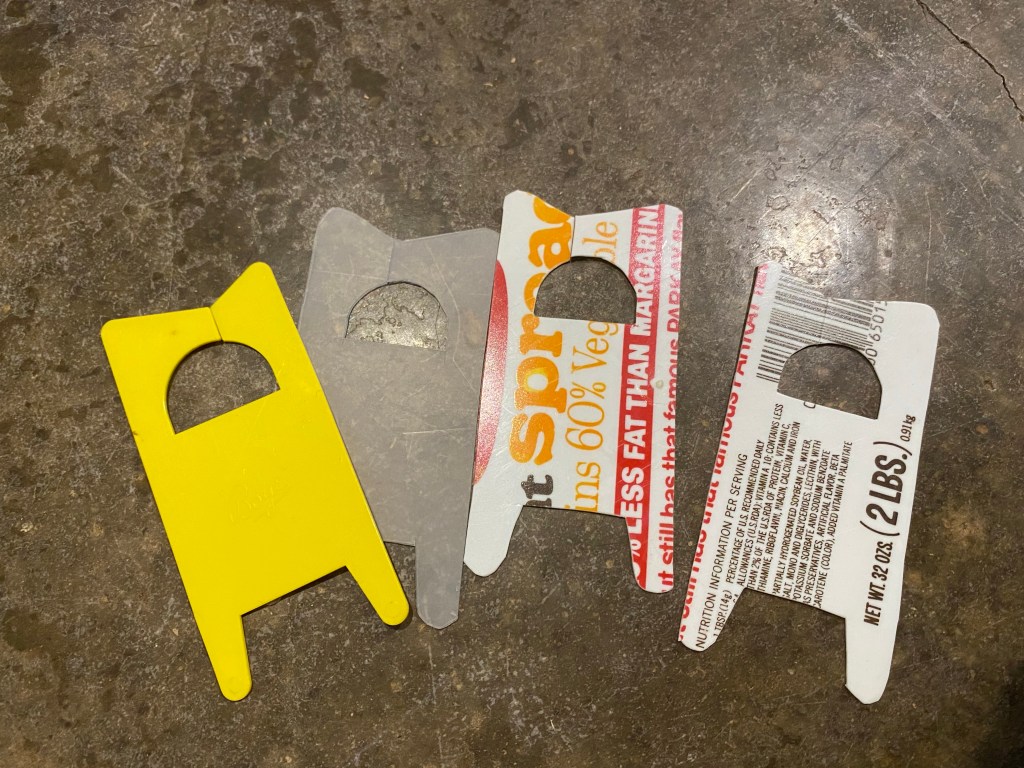
The apple doesn’t fall far from the tree. I was going through my Grandma’s knitting tools (I have inherited quite a few craft tools from both sides of the family), and found some home made yarn bobbins. My Grandma was an avid knitter and very skilled. It looks like Grandma used the commercially produced bobbin (yellow one on the left in the photo) as a template, and cut the others out of margarine tubs and other thick plastic. Very nicely done.
Three yarn bobbins made by my Grandma probably 30-40 years ago on the right, commercial bobbin (yellow) on the left