I have been plugging away at my hand-spun Shetland wool yarn, learning how to make Shetland lace. It is full of mistakes, but I think for future projects it will just take some practice, and making sure I’m not distracted while I knit. Blocking the lace (getting it wet, and pinning it in shape to dry) made a huge difference.
Unblocked lace (left), compared to blocked lace (right)
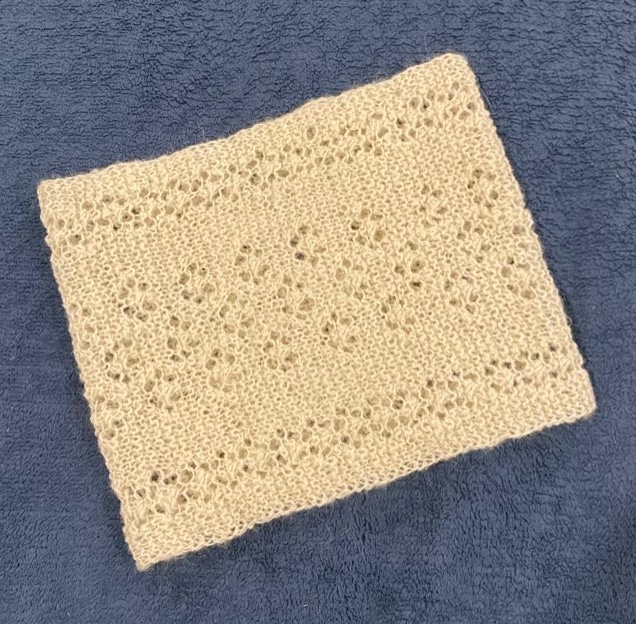
Since I didn’t have enough yarn to make a long scarf, and I would rather start over than continue on this one, I sewed the ends together to make a cowl.
Shetland lace cowl
Alas, the wool is too itchy for my neck, but it does OK as a head cover. I think I put too much twist in the singles. When I spin the next batch, I will go a little easier on the twist. I rather like spinning fine, and that goes well with lace knitting, so is worth pursuing.
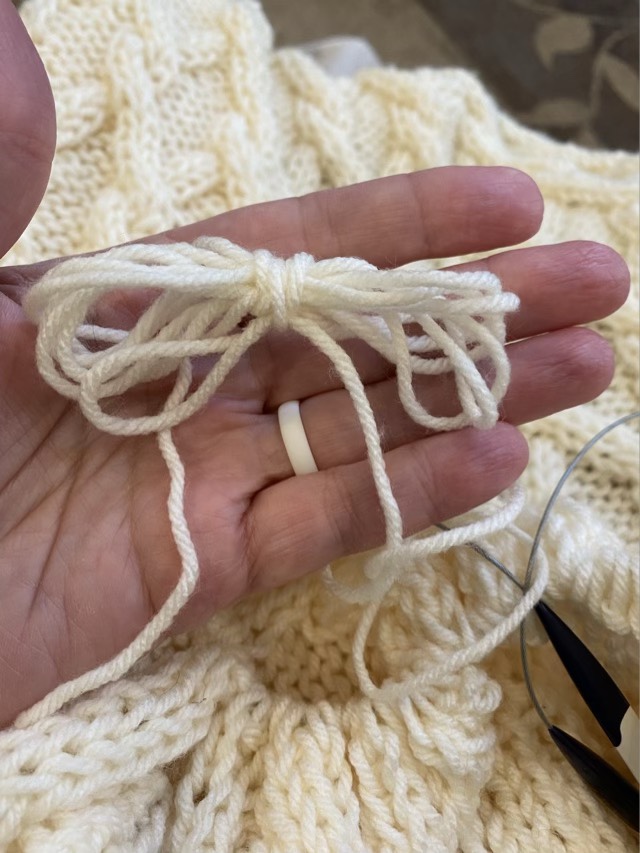
I have finished a full skein on my Grandma’s blanket. This time I was able to estimate how much yarn was left a little better so I only have a small bundle, rather than enough to make a ball.
Smaller yarn amount left at the edge
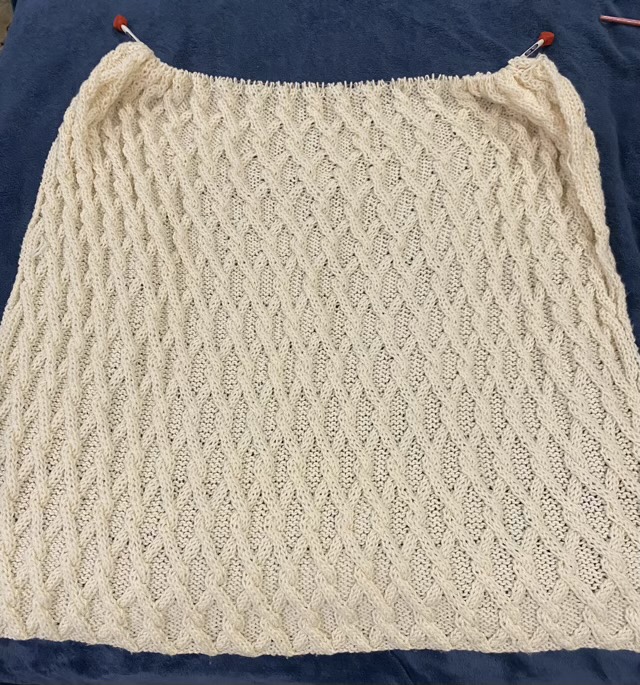
I also laid out the blanket as it stands, and I can’t immediately tell where Grandma stopped and I picked it up, so that is a relief.
Grandma’s blanket in progress
I think I will take a picture after I finish each skein, just to have progress notes.
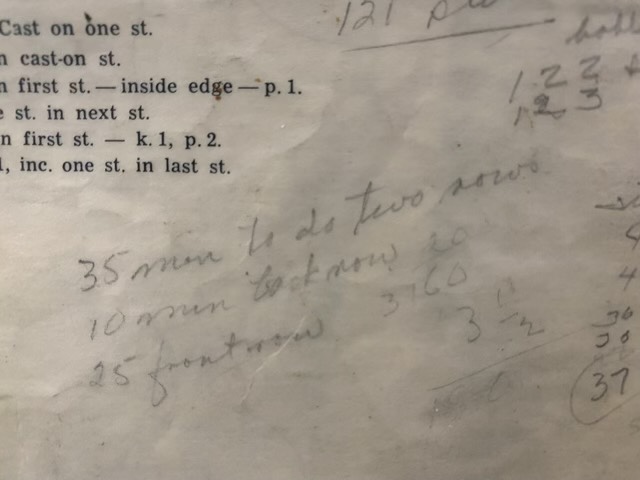
My grandma wrote down on her pattern how long it took her to knit a row on the blanket. She recorded one time for a back row, which is just knit and purl stitches, and a second time for the front row, which takes longer because of the cables.
Grandma’s writing on a 48 year-old pattern
So I timed myself doing a back row, and was pleasantly surprised that I did it in 10 minutes. Perhaps my knitting is not as abysmally slow as I feared. Or Grandma did her times on a larger blanket. Hm.
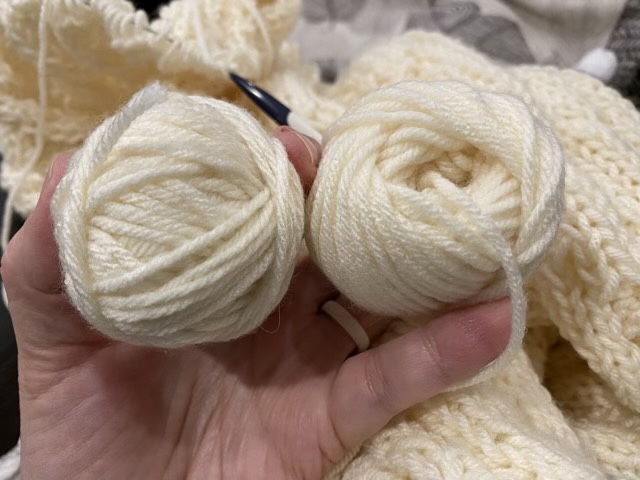
When I was learning to knit and crochet, I was taught to roll up extra yarn into a ball. Generally, you started with a small nest of yarn and wrapped more yarn around, changing directions every so often so it came out more or less round. Inevitably, I would drop the ball, it would roll across the floor, the cat might help its progress, and I would have to wind it up again. When I was older, I obtained a “new wool winder” which winds yarn from a hank into a cake-like structure, but was wonderful because the cake sat still and yarn could be pulled from the center. It did not work so well with small amounts of yarn, and I had to go and find the machine and a place to secure it to use it. Fast forward many years (better just skip, because there is quite a lot of time from then to now), and I was learning about spinning on a dealgan (a Scottish type of drop spindle), and the presenter in the video said the newly made yarn was wrapped around the spindle in the same way as for a nostepinne. What? The resulting cop of yarn could come directly off the spindle and the yarn could be pulled from the center. Hm. New rabbit hole. Nostepinne is a word for a fancy stick. I used a 1” dowel, which worked just fine the first time, but you really don’t even need a stick. A rolled up piece of paper will also work (especially if the cat is comfy on your lap and you can’t reach your stick, but there is a handy piece of paper).
Wrapped yarn ball (left) versus center pull ball (right)
I’m sharing because I really found this way of winding to be life changing. And it is so simple.
On a separate note, Adobe Premier now will make captions from my audio automatically. So that saves me a bit of typing. It still needed editing because “nostepinne” is not in its transcription vocabulary. Shocking. The video isn’t fancy because I’m still learning the software.
I’m ready to add in a new skein on Grandma’s blanket. I actually made it through the skein she was working on, which bodes well for the project! Grandma did not let the yarn run out willy nilly, but gauged if she had enough for a new row, and did her joins at the edges with an overhand knot. I’m guessing that she addressed the ends when she added the border.
Joining yarn at the edge of the project
I can appreciate this method because making joins in the middle of a row can leave unsightly lumps. There are many methods of joining (that might be another post), but leaving them on the edge is a sure fire way of avoiding seeing them in the field of work. Now I’m really hoping Grandma added the yarn waste into her yardage calculations.