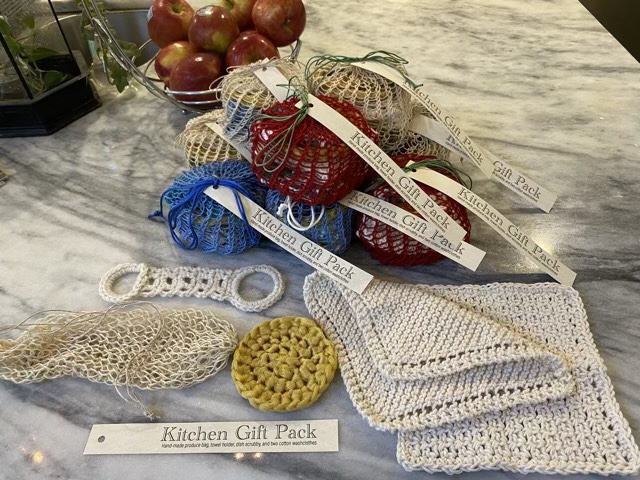
I combined all the kitchen aids I’ve been making into a bundle to sell at a local craft fair. The produce bag is the packaging, and inside are two cotton washcloths, a dish scrubby, and a towel holder. I even did them in a variety of color combinations.
Photo description: Stack of filled and labeled hand-made produce bags, with the contents of one bag displayed in front, all sitting on a kitchen counter with a basket of apples in the background.
So I thought a rolled brim knit cap was some kind of knitting voodoo. I was looking up patterns to see how to do it. Y’all, it is just knit. Stockinette stitch, which makes the familiar v shaped stitches that we associate with knitting, is unbalanced and curls without a stabilizing edge (like ribbing). So the rolled brim is the natural state of a knit tube. Hm. So I tried one, and sure enough the edge curls. I even managed to do the crown of the hat in knit using seven decreases, then ran the end of the yarn through the last seven stitches and pulled tight to form a nice little rosette in the center. I threw some embroidery on to see how that went.
Photo description: Green and white knit hat with vine embroidery.Photo description: Crown of the hat showing seven slightly spiraled sections neatly closed at the top.
I used superwash merino sock weight yarn. I would do things differently next time, so I’m not going to write up a pattern. For posterity sake I’ll write down details, though. I used two size 2 circular needles; a slip, slip, knit decrease on each of the seven sections, sometimes separated by a row of knit; and attempted a stem stitch for the embroidery. The stem stitch stretches with the fabric, but I don’t like how it doesn’t make a continuous line. That might just need practice, though. I was hoping for more of a spiral on the top of the hat too.
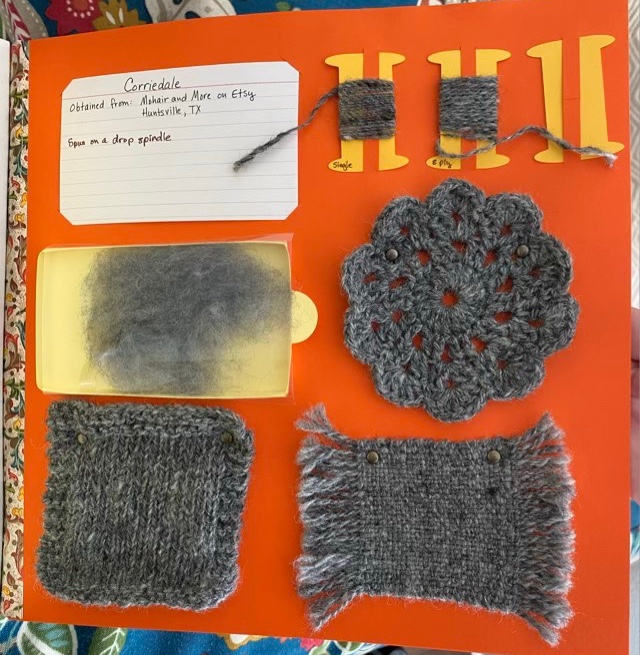
I did a fiber sample page for the Corriedale wool I’ve been using for teaching spinning. The woven sample is my best yet; I started the weaving with a pass of twined weft away from the edge of the loom. My weaving then stayed more even and consistent to the end, where I did another twined pass. The twining keeps the weaving in place better too, so I didn’t need to make knots. If I were making a piece that would see more action than laying in a book, I would secure the fringe better, either with more twined passes, or knotted or sewn fringe.
Photo description: clockwise from top left: 3×5 card with “Corriedale obtained from Mohair & More on Etsy, Huntsville, TX, spun on a drop spindle”; single ply on a paper bobbin; two ply on a paper bobbin; crocheted lace round; woven sample with two salvages; knitted sample with garter stitch edge; sample of un-spun fiber
Corriedale is very nice to spin, has a nice feel, but isn’t the softest. The blended dark and light fibers make it easier to see the twist, which is why I like it for learning.
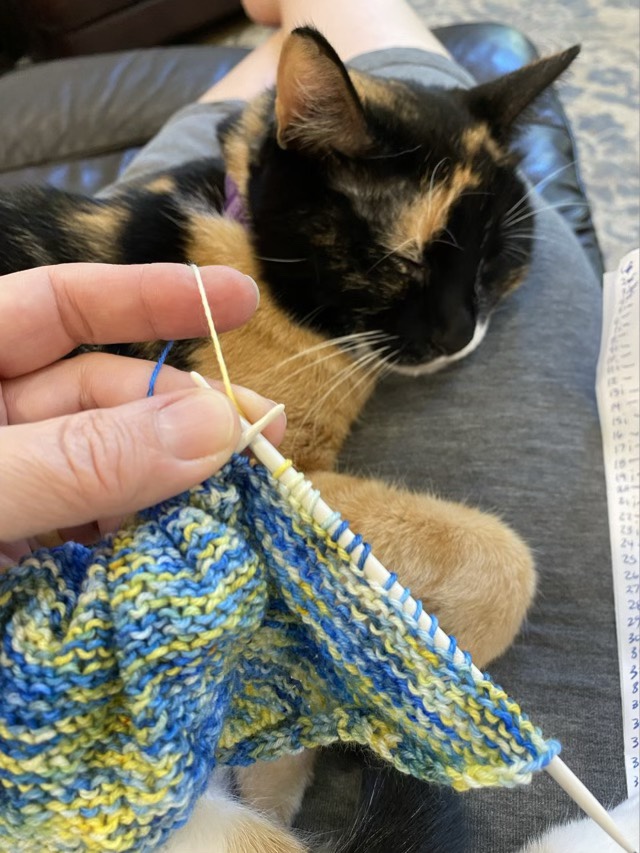
I have two knitting works in progress. One needs a section ripped out, so is resting until I have the courage to tackle it, and the other I cast on several months ago, and am now circling back around to work on it. This is a fingering weight sweater (right? Crazy.) that I bought the yarn to support a cause, and determined I wanted to make my youngest an actual garment. The knitting isn’t hard, but it does take a long time. Izzy the cat appreciates it when I knit; I provide a long-term nap space.
Photo description: Yellow and Blue fingering weight yarn on Prym circular needles in the foreground; in the background a sleeping calico cat laying on my lap.
I am acknowledging that this will be an on-again off-again project as other shiny things distract me.
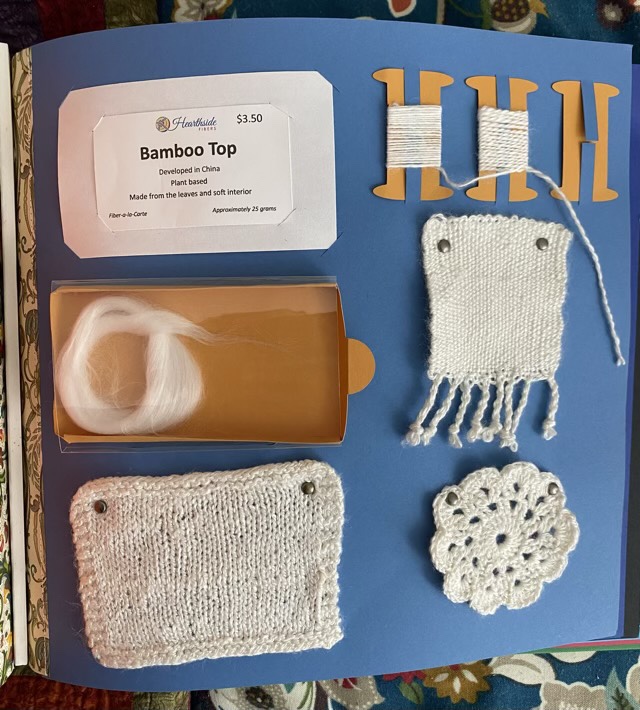
Photo description: Clockwise from top left: “Bamboo Top” card which reads “Developed in China, plant based, made from the leaves and interior”, single spun yarn on a paper bobbin, 2-ply yarn, swatch woven on a Clover mini loom with 3 selvages, crocheted lace round, knitted rectangle, unspun fiber in a paper box.
Spinning my bamboo sample was very enjoyable. The fiber is soft, and the staple is a nice length. I did have some static issues, but those that were resolved with a spritz of water. I spun the singles on a drop spindle, and I kept the fiber and spindle in my purse to spin during waiting times. I made the two ply yarn from a center-pull ball using the same spindle. The fiber has a beautiful luster.
Photo description: A hand holding a single spun bamboo yarn wrapped nostepinne style on a 3D printed spindle.




 Critters and Craft