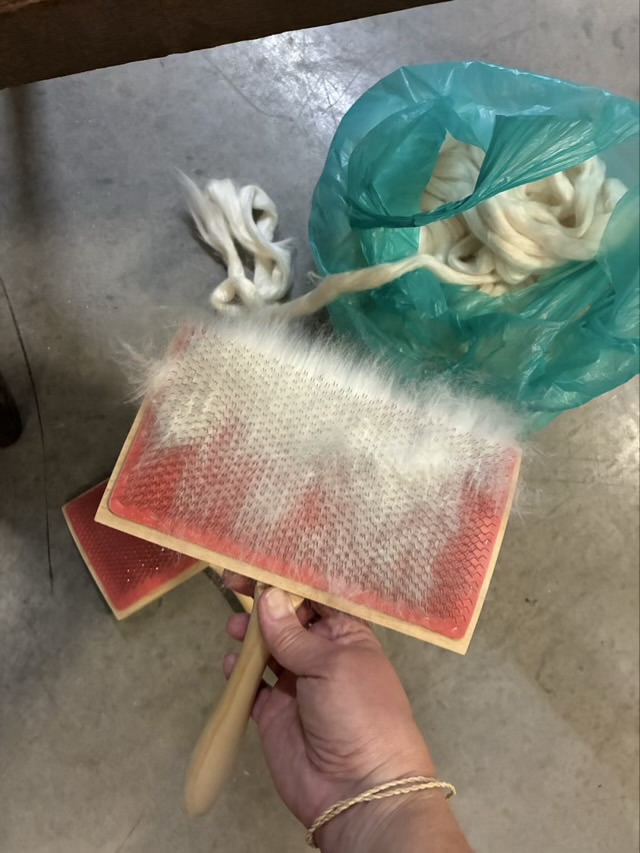
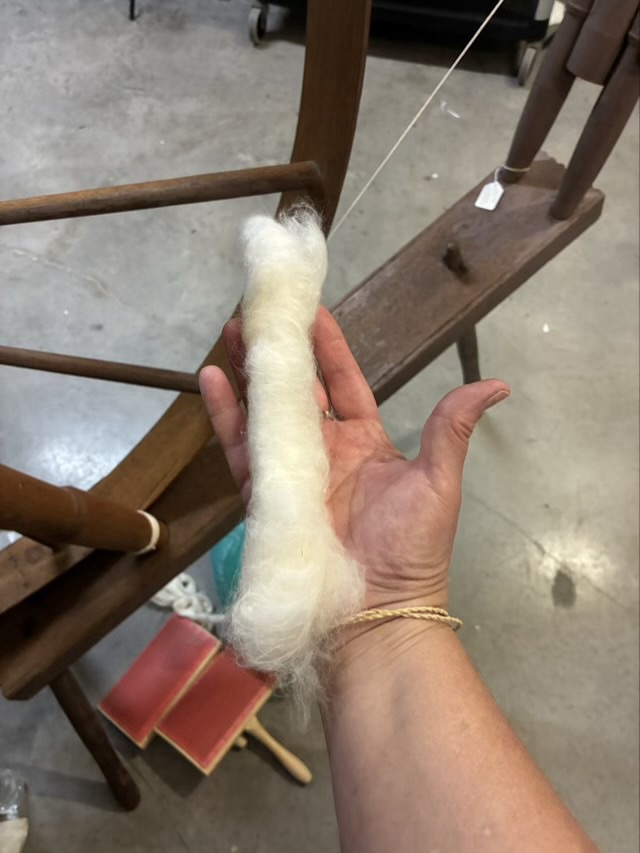
I have been using Texas grown cotton sliver, a combed preparation, to spin on a Great Wheel at the Doss Heritage center. The sliver is very smooth and all the fibers are aligned, but it has been fighting me when I spin. So I took it back a step and carded it. This mixes the alignment of the fibers, especially when I roll it up into a rolag.
Photo description: fine carder loaded with cotton, bag of sliver in the backgroundPhoto description: cotton rolag held in my hand, after taking it off the card
This woolen preparation (fibers not aligned is “woolen”, fibers aligned is “worsted”) actually spins much easier with fewer clumps and bumps. The draft zone flows better and the wheel and I happily spun for an hour (three rolags) with very few issues. The wheel did pick up a squeak, which I remedied with spinning wheel oil.
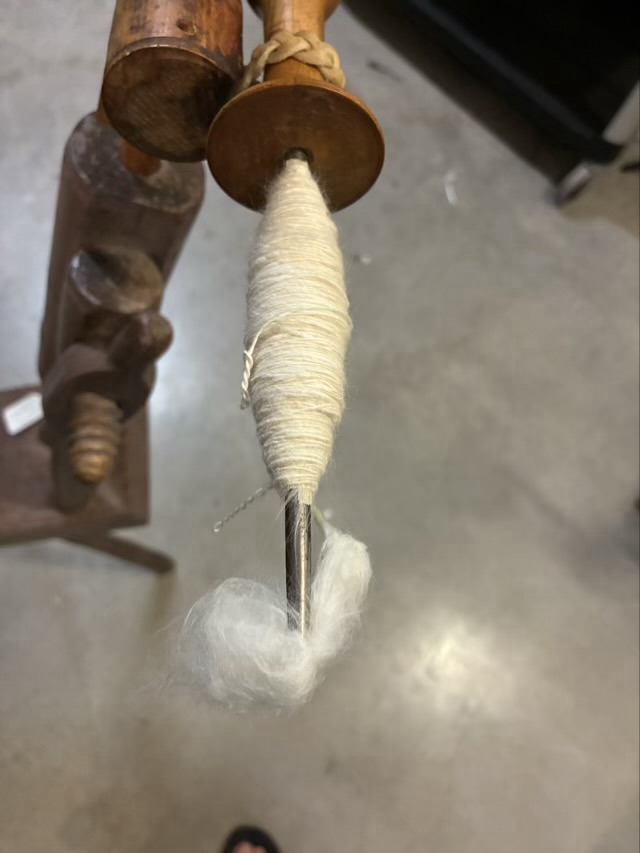
Photo description: cop of single spun cotton yarn on a Great Wheel spindle
I will be demonstrating at the Pioneer Festival at the Doss Heritage Center in Weatherford, Texas on October 3rd, 2026!
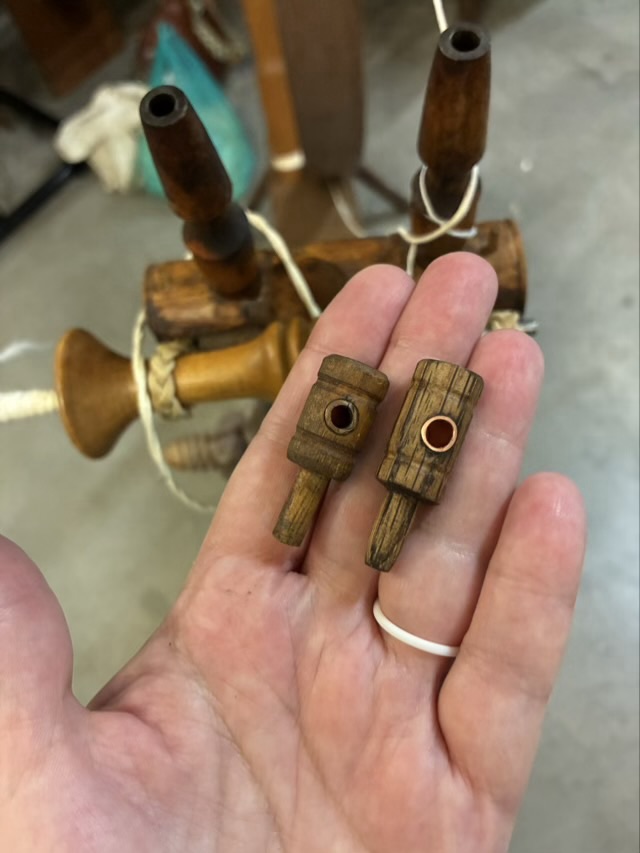
The new bearing that I made for an antique great wheel works! It is slightly longer than the original, but since the maidens adjust separately, the fraction of an inch difference doesn’t affect functionality.
Photo description: my hand holding the original bearing on the left and the new one on the right
The shaft of the bearing ended up being a little thick. It was a tight fit, but needed to be able to rotate to hold the accelerator wheel as the maiden post was twisted up or down. I used my pocket knife to shave off some of the wood so the bearing could rotate.
Photo description: bearing with the shaft narrowed held in my hand next to the maiden post, spindle visible belowPhoto description: fully assembled accelerator head on a great wheel with new bearing on the left side of the picture and the original bearing on the right
I spun for about an hour, working on my yarn width consistency and testing out my new part. It worked just fine! And rotated in the socket when it came time to stop and release the tension on the drive bands. I always lighten the tension between spinning sessions so the bands don’t stretch. I don’t loosen them enough to come off when stationary, which is standard practice for spinners. I can see though, how someone coming along and turning the wheel might be startled by the drive bands coming off or the parts not moving. The bands just need to be tightened before use.
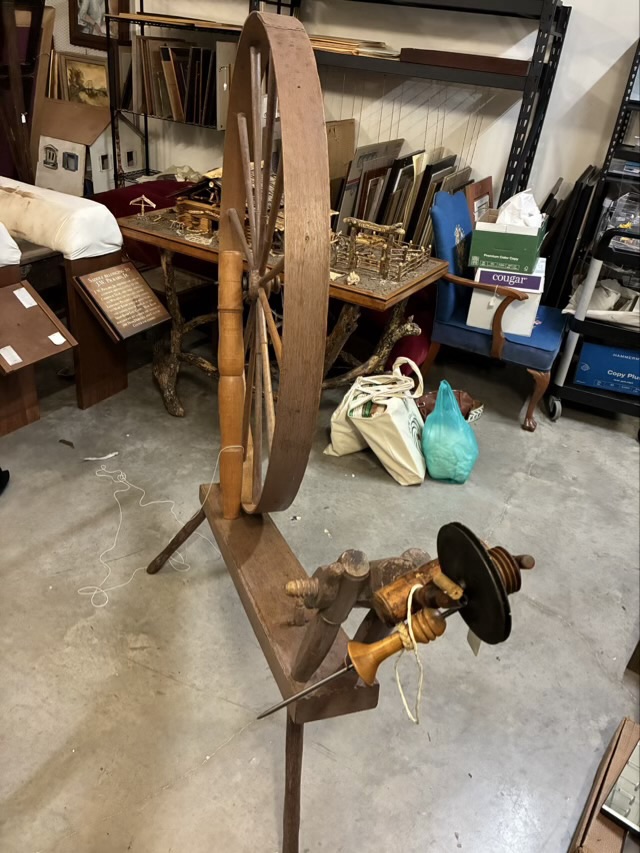
I had the opportunity to make friends with another walking wheel! I went to the Doss Heritage and Culture Center in Weatherford, Texas and met with the lovely people working there with the collections and events. They let me go down to the basement where there were two antique walking wheels, one with all the parts, albeit with some field-expedient repairs, and another missing the spindle and accelerator wheel.
Photo description: great wheel before I startedPhoto description: mother-of-all with spindle and accelerator head
I took off the mother-of-all, which holds the maidens, accelerator head, and spindle, to get a good look at the condition. I’m fairly certain that this mother-of-all is not the original one that went with the wheel, or the wheel was painted at some point, but the colors don’t match. The top of one of the maidens has also been lost to time, replaced with a dowel and metal spike, which certainly does the job.
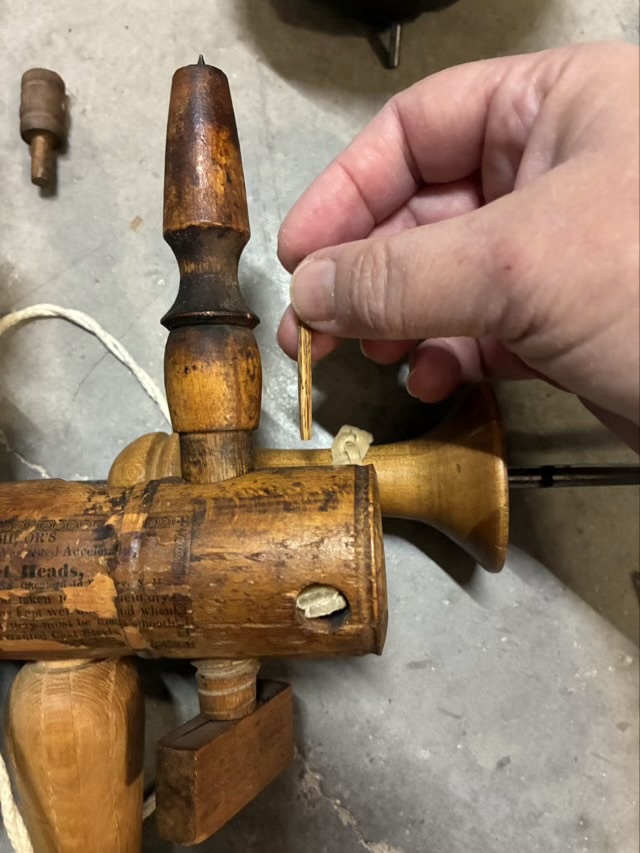
Photo description: small wood stake that goes into the mother-of-all to hold the braided rawhide straps in place
Where the last great wheel I worked with had waxed linen that held the spindle, this wheel had rawhide magic braids that were nearly as hard as the surrounding wood. I was surprised that the pegs holding the rawhide in place could still be pulled out.
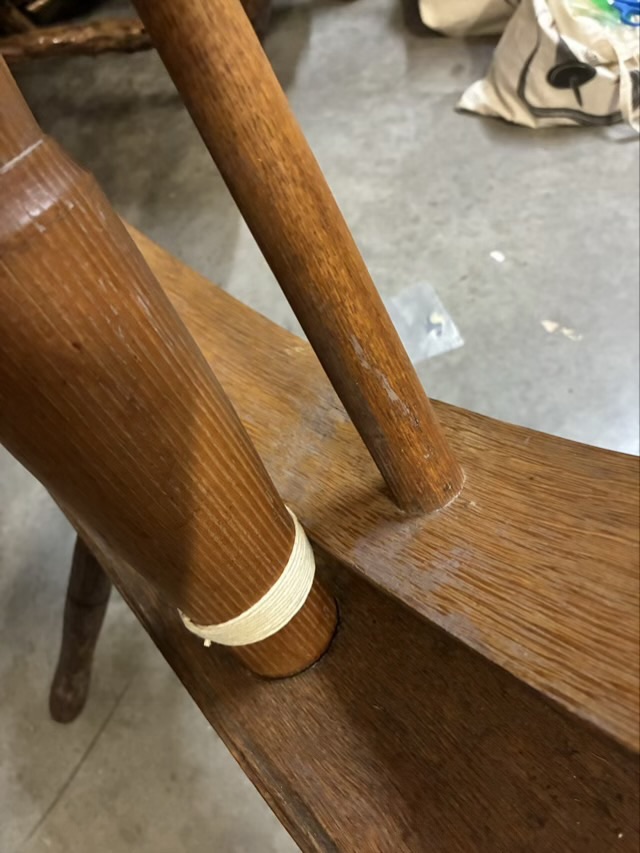
After looking over the mother-of-all, I put it back on the wheel, upside down. Oops. It took me about an hour of tinkering and fussing before I figured it out. In that time, though, I gave her a new cotton drive band waxed with beeswax, waxed the accelerator band, aligned the wheel with the base, and adjusted the wheel spacing against the post. The wheel rubs against the post, so I wrapped the post with waxed cotton cord to protect it from abrasion.
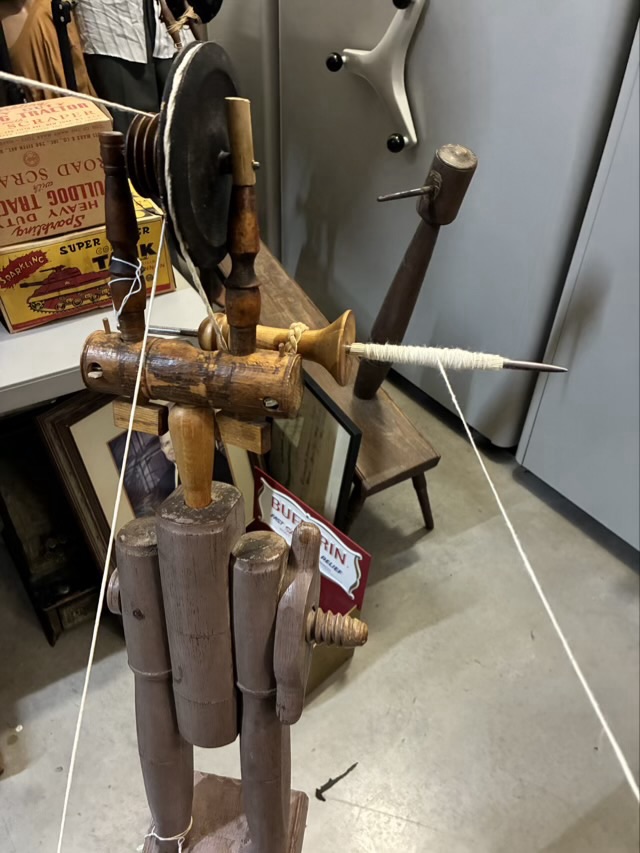
Photo description: waxed cotton cord lashed around the base of the post where the wheel rubs against itPhoto description: great wheel mother-of-all and tension system set up and spinning, there is another great wheel base in the background, which has a wheel, but the hub hole has worn away and it needs refitting
I love the tensioning system on this wheel. The wood nut on the right in the picture loosens to allow the center post to rotate forward and backward, decreasing or increasing tension. I think I actually like this set up better than the double nut Great Wheel, although both are more reliable over time than a greenwood tension system that relies on the bend-ability of fresh wood.
I did put a corn husk quill over the spindle to make it easier to remove the cop of yarn. For a leader I pulled three strands from my cotton twine, and did a larks-head knot over the corn husk quill. I spun Texas grown cotton sliver for a while before time called me away.
I had the absolute privilege of spinning on a Great Wheel from the 1860s.
Photo description: double nut New England Great Wheel dated to the 1860s and brought outside to demonstrate spinning for Founder’s Day in Mansfield Texas
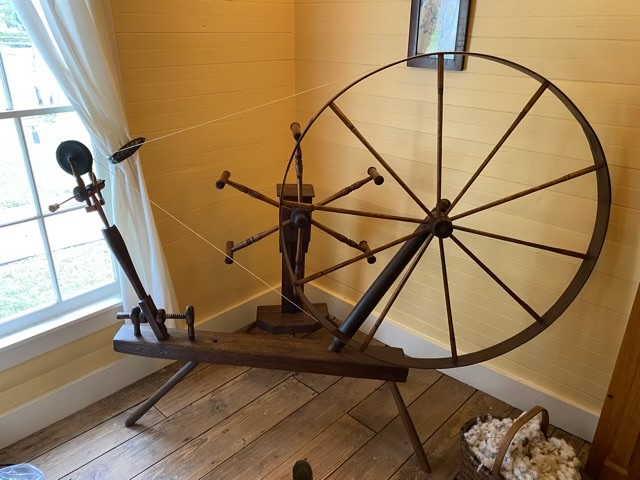
The wheel is older than the house she lives in (any item that is 165 years old deserves a pronoun upgrade, in my opinion.) The wheel was used to spin cotton, which was a primary staple in Texas at the time. She was in a private collection for many years, but was placed in the Man House as an honorarium to her former spinner. It is an appropriate placement historically and a valuable display for visitors to see this wonderful piece of human-powered engineering. I was the first to spin on the wheel for ten years, if I have my stories straight, and it was a joy. I did spend an equal amount of time spinning, adjusting the wheel with field-expedient fixes, and talking about the wheel. I took with me Texas Coop cotton sliver and spun two cops of yarn over six hours.
I like to keep these posts relatively short for this blog, so I’m going to spread the deep dive into my spinning experience out over several days!
Photo description: 1800s Great Wheel at Man House in Mansfield, TX, yarn weasel in back corner, basket of raw cotton (bottom right)
Y’all, I get to demonstrate spinning on a great wheel, also known as a walking wheel, in October. I recently took a drive out to meet the wheel and see if I could spin with her. We are compatible. I took some Teeswater wool roving to give her a spin, and she has been kept in good working order. There is a little slip in her drive band, but I have permission from the museum to use beeswax if necessary. She has an accelerator head, so was probably used mostly to spin cotton, especially since they were growing cotton in that area in the 1800s. I will take two kinds of local grown cotton sliver to spin in the demonstration. I’m so excited.
Photo description: close up of the spindle head showing the cotton drive bands, accelerator head, and spindle with 15 minutes worth of spun Teeswater wool, and a cork on the spindle tip for safety
The wheel is potentially 200 years old, or at least approaching her 200th birthday. It is a humbling experience and an honor to spin with her.