Möbius scarf

I’m looking for a light weight idea for a pattern for my spun alpaca yarn. I keep coming back to lace. Personally I do not consider myself a lace person; I don’t tend to buy clothes with lace trim, and I don’t care for frills. But Texas is hot most of the time, and thick warm clothing is only necessary for a short span. What am I going to do with all this yarn I’m spinning? Which is why I keep coming back to lace. It can be warm when made from insulating fibers, but not too warm.

Möbius scarf showing the twist

When looking for lace ideas, I came across the idea of a möbius scarf. This is not a new idea, I have just apparently been hiding under a rock (not entirely metaphorical there). The idea is that the garment is created from the center out, and each row adds to the top and bottom since the edge of a möbius strip is continuous. Really, really cool concept. And it can be done in crochet, knitting, or nälbinding. Sweet. I did have some trouble wrapping my brain around it, so rather than diving in with my good yarn, I tried a pattern with some wool sock yarn from my stash.

Möbius scarf shown on a mannequin

I really enjoy the long edge and chance to get each row firmly under my muscle memory. I don’t care for this particular pattern because the center line is not as stretchy as the rest. So now I’m on the hunt for a pattern that stretches uniformly across the fabric (for comfort’s sake). I’ll keep you posted.
Crochet waffle stitch baby blanket

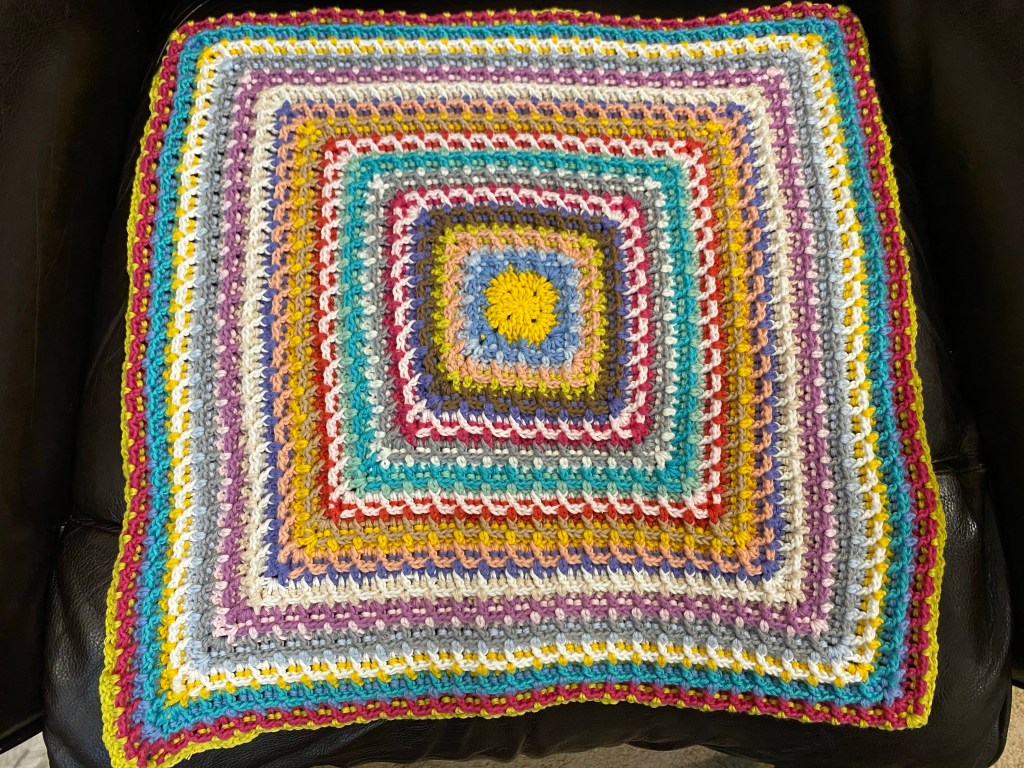
I had a small bag of little skeins of cotton in a variety of colors. The bright hues and soft cotton seemed a good match for a baby blanket. I found an intriguing pattern for a waffle stitch blanket that starts in the middle, which is ideal for an item made of odds and ends, as when the yarn is done, so is the project. I also wanted stripes (which frankly made my project more complicated for yardage calculations, but the color interaction in this stitch was worth it). The reason the stripes increased the difficulty is that I needed enough yarn of one color to make it all the way around. Not a problem at the beginning, but quite the conundrum nearing the edge. I ended up weighing the last few skeins and putting them in order from lightest to heaviest to make it more likely to have enough.

Baby blanket in cotton, crocheted waffle stitch, center start

The instructions had me turn the work at the end, which to me seems to defeat the purpose of crocheting in the round. I do really like the two-row repeat, which makes it a very easy pattern to memorize, and the simple row pattern makes it easier to recognize where the stitches need to go. This idea works fine working only from the front, with no turns. To illustrate, I put together a chart (I like charts better anyway). I made this one in Adobe Fresco, but I think if I needed to make one with any more rows, I would work on a desktop in Illustrator so I could align the rows more precisely.

Crochet chart for waffle stitch with a center start, to increase size, repeat rows 3 and 4

I’m still a student of colors and how they interact (and probably always will be), and the fascinating thing about the build of this blanket was the way the the colors looked pastel crammed together in the bag, but became quite bright the way I ordered them in the blanket. I made a hat in double crochet stitch (American notation) from the bits and bobs left over from the odds and ends of the blanket and the overall color feel is quite different.

Baby blanket and baby hat

What to do with small bits of yarn

I took the single ply merino wool I had left over from plying and made a simple lace scarf for my youngest’s doll. I had just enough for a decent length. The yarn is about 32 wraps per inch, which is small even for lace weight yarn. I tried nålbinding a new stitch, but the dark yarn was too hard to see. I tried knitting, but again, it was tiny and hard to see. So I used crochet, because I can crochet without having to distinguish individual strands. I did a simple lace pattern (chain three, single crochet in previous chain, repeat), and it still took me days to complete. Making doll clothes, though, is a great way to try different techniques with small amounts of yarn, rather than tackling a human sized project.

Crochet lace scarf from hand-spun merino wool for an 18” doll

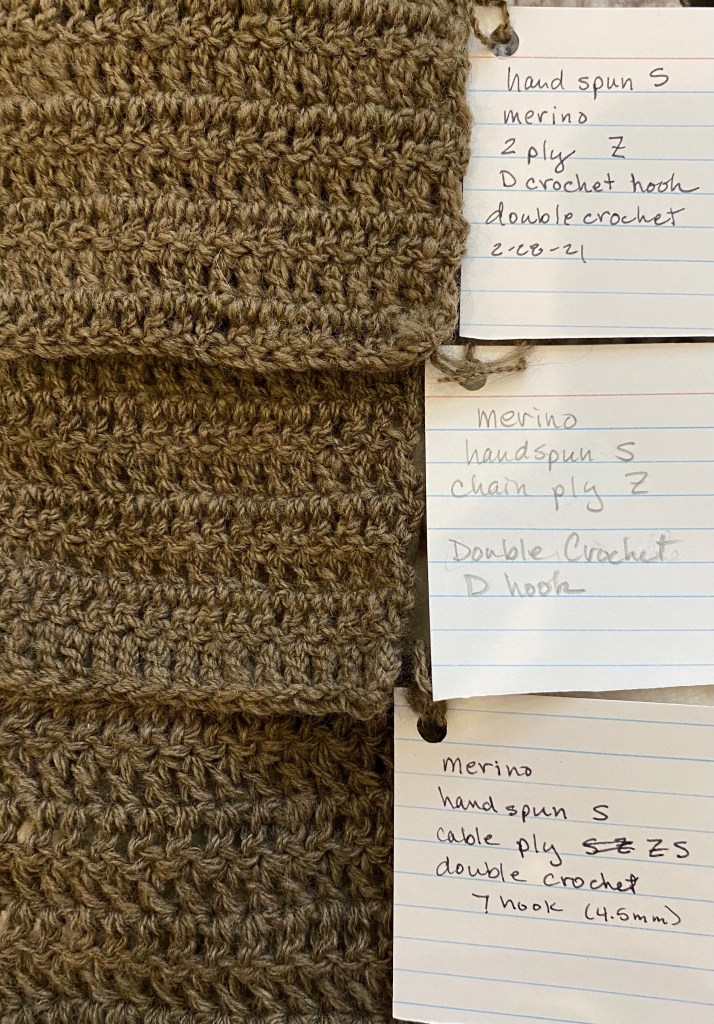
Crocheted swatches

What to do with wee balls of yarn? Swatches! The experiments on my hand-spun yarn continue. I crocheted up a swatch from each of the three balls of yarn, one two-ply, one three-ply, and one four-ply. I used a double crochet stitch for each swatch, but used a different sized hook for the four-ply. I’ve labeled each swatch (as you do) with a bit of hole-punched card stock.

The stitch definition is nicer (to me) for the three and four ply yarns, but the two-ply is has the softest feel. Although, the three ply may have felt softer if I used a size larger hook.

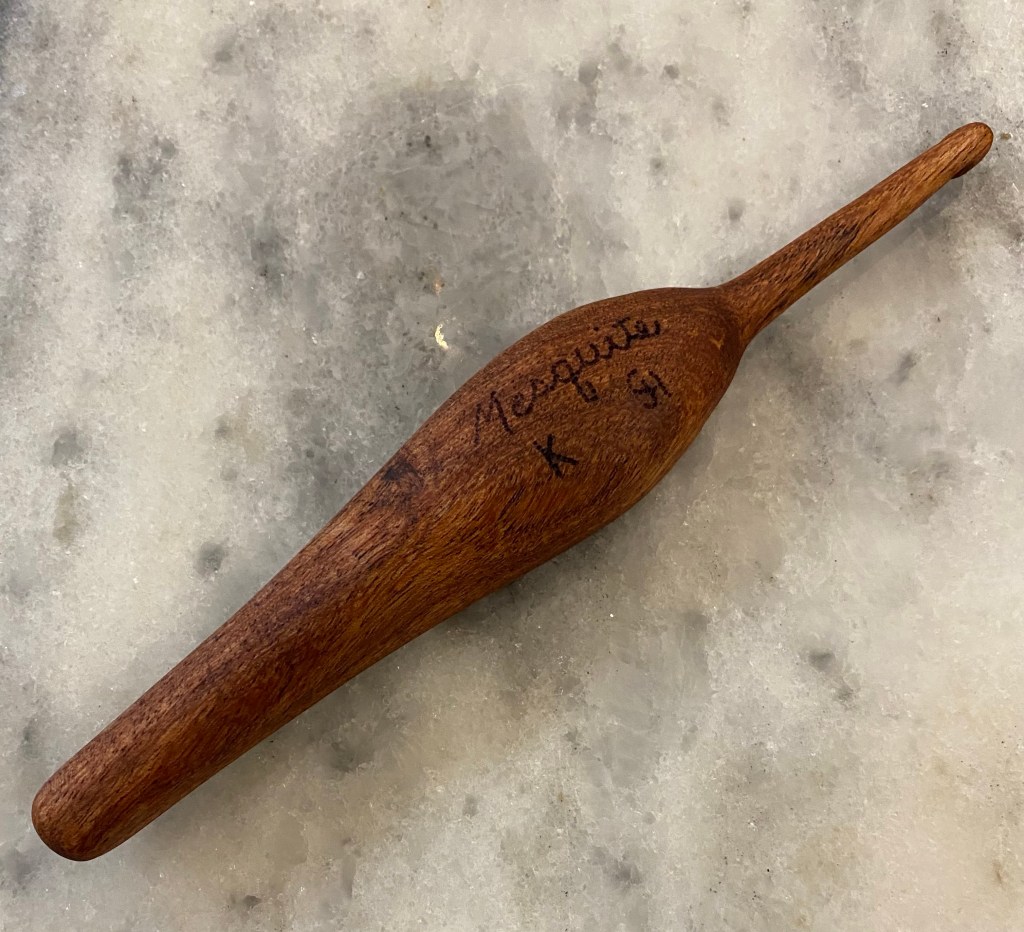
Wooden ergonomic crochet hook

Well this was fun! I made a crochet hook out of a chunk of mesquite. Rather than a straight dowel (which are harder to hold and manipulate), I made a handle shaped to my hand, then chiseled out an indentation for my thumb. Then I shaped the actual shaft and hook. It took me a couple tries to get the length right (I used some scrap cotton to test), but found a good length and refined the head. I sanded down to 400 grit and sealed with tung oil. The shaft is a size K hook. I could probably have gone smaller, but we’ll see how this one performs. I sent it off to my Mom for the holidays!

Finished mesquite crochet hook
Back of crochet hook with wood burned lettering
Side of crochet hook