I couldn’t take it. Looking at the crocheted Wisteria wreath every time I opened the front door, I couldn’t take the tri-colored “blooms”. I made more light purple elements and replaced the multi-colored ones.


Now to see how it weathers.
I couldn’t take it. Looking at the crocheted Wisteria wreath every time I opened the front door, I couldn’t take the tri-colored “blooms”. I made more light purple elements and replaced the multi-colored ones.


Now to see how it weathers.
I was going to crochet a spring wreath with multiple flowers and leaves, but when I did the first Wisteria drop, the plan shifted.

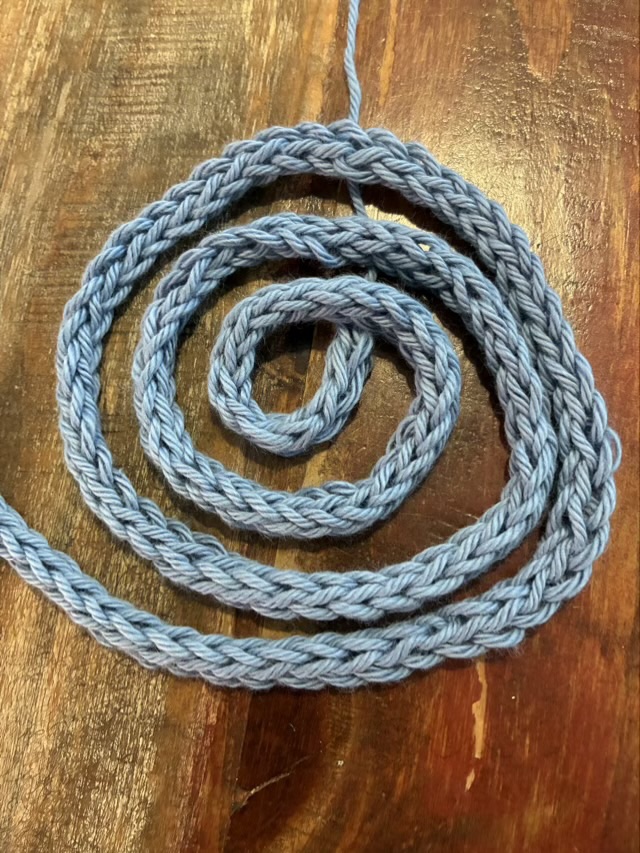
I did make some other types of flowers, then abandoned them all to just make Wisteria. The drops are easy to make and rather addictive. The basic plan is similar to making a crocheted worm or spiral.
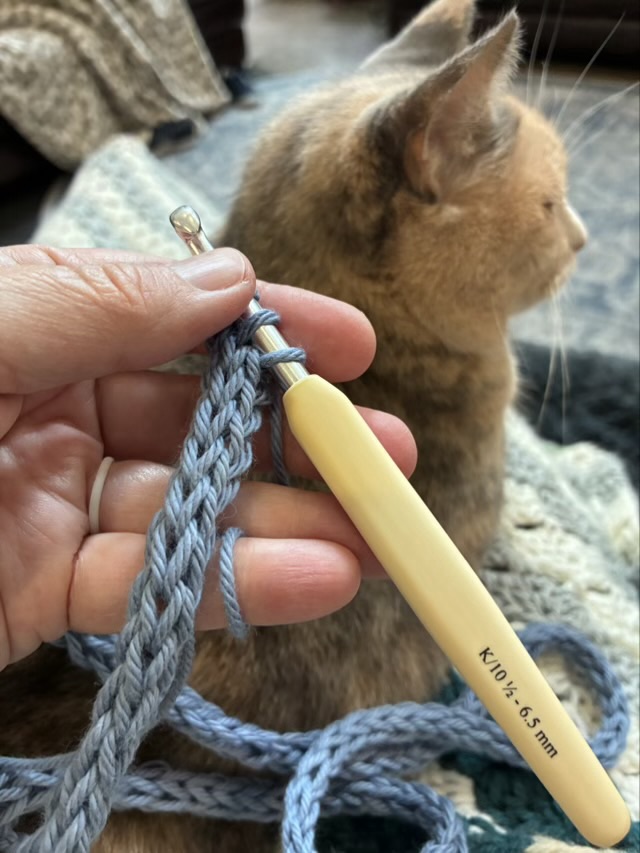
Make a chain of 30, then chain 3, single crochet into the same chain three times for 10 chains. In the next 10 chains, make 5 chain loops, and in the last 10 chains, make 7 chain loops.
I varied the number of initial chains, experimented with slip stitches instead of single crochets, and changed the ratios of 3, 5, and 7 chains sections. I also tried different color combinations.
I did use some of the leaves I crocheted and applied them to the crochet covered wire wreath, by sewing them on. The bark-like texture was achieved by doing a chain embroidery stitch (I used my crochet hook, with the yarn held behind the wreath.)
I’m not entirely in love with the multi colored Wisteria drops, but we are rapidly running out of Spring here in Texas, and the winter wreath on the front door needed to come down.
In June 2017 I used up leftover acrylic yarn to make several baby hats.

The pattern is:
Row 1: In a magic circle make a standing double crochet (sdc), then double crochet (dc) 9 into the circle, slip stitch (ss) to sdc (10 stitches total).
Row 2: sdc, dc in same space, 2dc in each stitch, ss to sdc (20 stitches total).
Row 3: sdc, dc in same space, dc in next stitch, *2dc in next stitch, dc in next stitch*, repeat around, ss to sdc (30 stitches total).
Row 4: sdc, dc in same space, dc in next stitch twice, *2dc in next stitch, dc in next stitch twice*, repeat around, ss to sdc (40 stitches total).
Row 5-8: sdc, dc around (40 stitches total).
Row 9: *skip 1 stitch, 5dc in same space, skip 1 stitch, single crochet in next stitch*, repeat around, tie off, weave in end (10 shells.)

I did a pattern test, and have to admit that it took me a couple tries. Counting stitches from a picture isn’t always easy.
In March of 2017 I was crocheting a yellow lace circle vest for my sister. The pattern included classic crocheted lace elements.


My sister was visiting, so we did a fitting and she requested sleeves. By June of 2017 I had finished the sleeves by doing a simple net for the arms, and a matching edge pattern for the bell sleeves at the elbows.


Although it was pretty, the delicate lace was, well, delicate. It didn’t hold up well to use.
I’m experimenting with crocheted flowers for my wreath. To make a mum-like flower I used four colors of acrylic yarn and made four layers of petals, each with the same type of “petal” but with different diameter centers and thus different numbers of petals.


To make the layers, half double crochet into a magic circle eight times, slip stitch to join.

To make the petals, chain 9.

Skip the first chain and single crochet eight along the rest of the chain.

Slip stitch into the next double crochet on the round. Then make the next petal.

For the other layers, add a round of half double crochet increases to the center before adding the petals.