Testing crochet stitches

I really like to make swatches, which probably puts me in the minority of crocheters and knitters. I like to see how different stitches, yarn, and needle sizes affect the overall fabric. This test involves polyester cord. I want to make more hammocks in the catio, and polyester is more UV resistant than other man-made fibers and even natural fibers, and is mildew resistant. I have made hammocks using outdoor fabric, but they retain water for quite some time after the rain. I’m hoping a crocheted hammock will let the rain pass through and dry quicker. I had some left over polyester macrame cord and did two test swatches, one with a simple single crochet repeat (American terminology), and one with alternating single crochet, chain one, repeats.
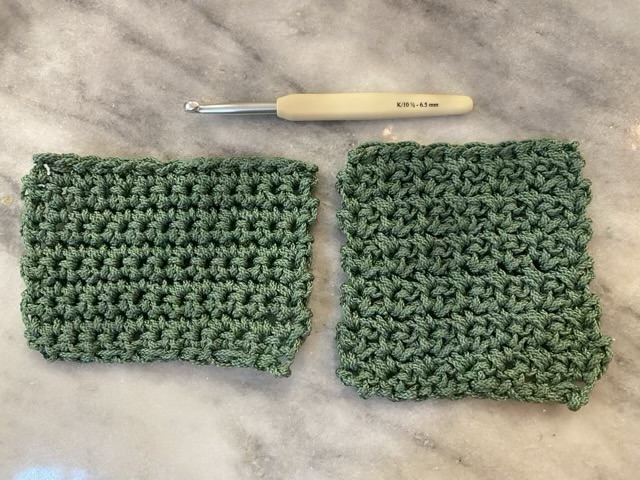
Photo description: two small rectangles of crocheted cloth, on the left a single crochet pattern, on the right a single crochet, chain one pattern. K sized crochet hook above the swatches.

Even though I really like the texture and look of the single crochet and chain one fabric, the holes are a little bigger than I think the cats will like when weight is applied. The holes are about toe bean sized, which seems uncomfortable. I do like that this cord has some shape memory, and retains a curve when stretched.

Next for a full-sized version.
Dividing yarn: subtractive method

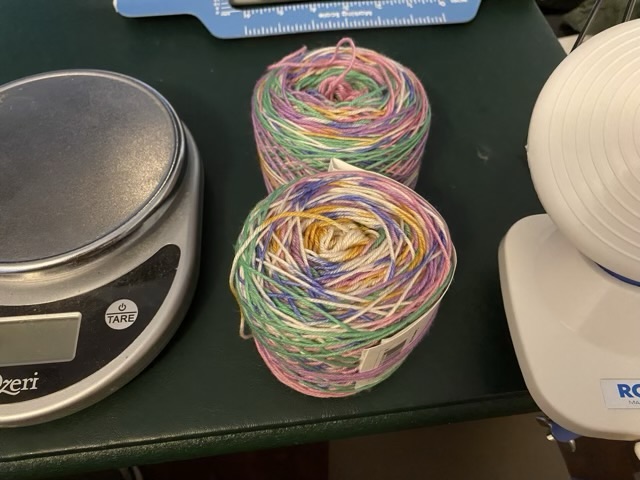
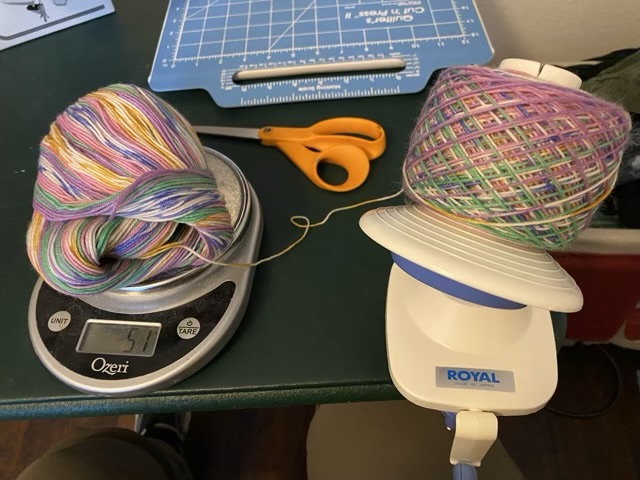
I found painted yarn at my local yarn shop! This yarn is self striping by having a precise color repeat. I don’t need my socks to be identical, but I don’t like knitting two socks from the same ball because of tangle and twist issues, so I divided it in two using a scale and a ball winder.

Photo description: Printed yarn by Cascade with 51g on the scale, and 51g on the winder

I place the full amount of yarn on a scale to get the total weight, then I wind my yarn into a cake using a Royal wool winder until the scale reads half the original. I cut the yarn, and start a new yarn cake.

Photo description: two equal weight yarn cakes with pretty pastel shades of green, purple, blue, pink, white, and yellow.

It is harder to measure going from skein to cake because the skein is on an umbrella swift and the cake on a ball winder, both clamped to the table, but if you go a little past what you think is half, then weigh the cake, it is easy to wind off back onto the swift.

Soybean top page

I have finished a new fiber page for my spinning book! I mounted all my samples from hand spinning soybean top (top is the description of the fiber preparation, involves combing, and produces parallel fibers) on prepped black card stock. I would definitely use this fiber again, it is very strong, yet so soft.

Photo description: Soybean top fiber page. Clockwise from top left: original card from Hearthside Fibers reading “Soybean Top Developed in the USA in the 1930s by Henry Ford Used in Ford car upholstery pre-1940”, single spun, 2-ply, and 4 ply yarn samples, woven swatch, nålbinding swatch, crochet swatch, knit swatch, combed fiber.
Photo description: same page with swatches flipped up to show the writing underneath: plain weave on Clover mini loom, nålbinding Dalarna O/U O:U O, crochet 1.75mm hook, Stiockinet size 2 needle knit.

Blocking Soy

I made four example swatches from my spun soybean fiber: knitting, crochet, weaving, and nålbinding.

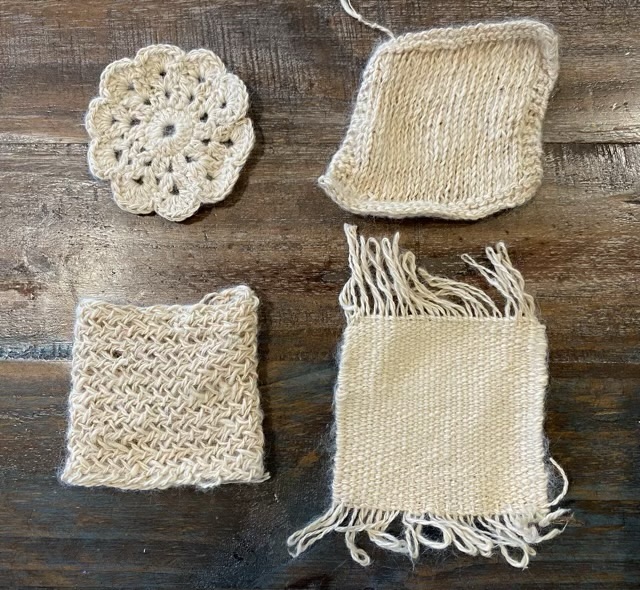
Photo description: swatches before blocking, clockwise from top right: stockinette knitting, plain weave, nålbinding Dalarna stitch, and crocheted lace round

The knitting swatch tells the most about the yarn, the obvious skew is because my singles have more twist than my ply. This bias does not have a significant impact on the other swatches. The nålbinding has several small knots because I could not get the fiber to felt together. I used a 1.75mm hook for the crocheted coaster, which was on the small side because the stitching is dense and stiff. The soy yarn is incredibly strong; I can’t break a single strand with my hands, but it is also incredibly soft even with the amount of twist I put in the single. There is good reason that it also carries the name vegetable cashmere. It also blocks well. It was very easy to shape when wet, and kept that shape when dry.

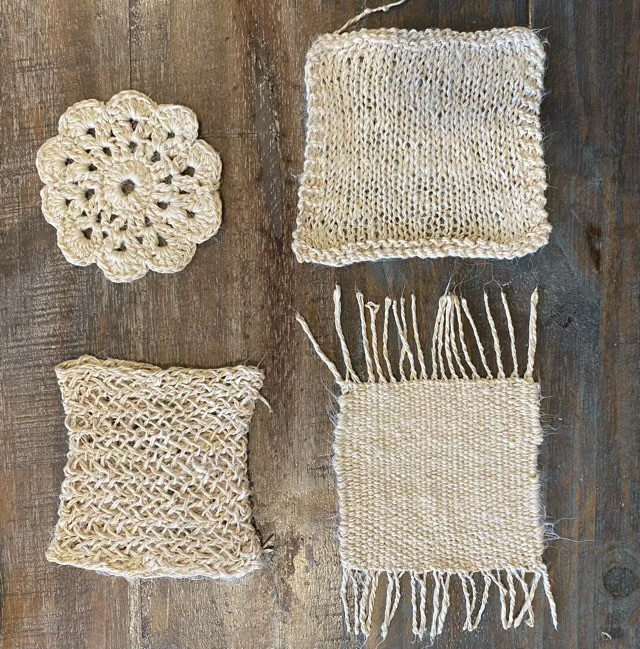
Photo description: same swatches after blocking

I was able to square up the knitting, and give the woven swatch some more twist in the fringe. The nålbinding swatch stitches opened up, but the crochet didn’t have much change, probably due to the density of the stitches.

The next step is to mount the swatches in my fiber book.

Throwback Thursday: crocheted helmet

I’ve been thinking about doing some throwbacks to projects I did before I started this blog. Here is a crocheted and embroidered Roman style helmet that I made for my sister in 2016. Yes, I’ve always been a serial crafter.

Photo description: yellow crocheted helmet with red yarn crest and gold embroidery. Visor is secured with buttons and is able to lower over the mouth.