Oops, it’s a beret

I’ve drifted off firmly into the realm of experimentation in this round of crocheted hats. Because I had red, green, and white in the stash of acrylic yarn, I wanted to experiment combining the colors with a spike stitch. A spike stitch drops one loop of yarn down a row, making a long V shaped yarn embellishment. I stuck with my standard double crochet hat pattern, making spike stitches every three double crochets and switching colors every row. I did not think that one loop of yarn would change the width of the row, but it did. Instead of getting a nicely rounded beanie, I had a flat circle. Hm.

Photo description: flat crocheted circle with rounds of alternating red, green, and white acrylic yarn, the spike stitches mixing the colors like a star burst

Time to make it a beret instead. I switched to using just the white yarn with no spike stitches, and the fabric immediately made the turn without decreases. I didn’t have to make decreases until round three. Then I switched to a single crochet parallel rib for the last band. The ribbing is very stretchy and although it looks in the picture like a small opening, it expands to fit a head, and lays flat for storage (happy accident).
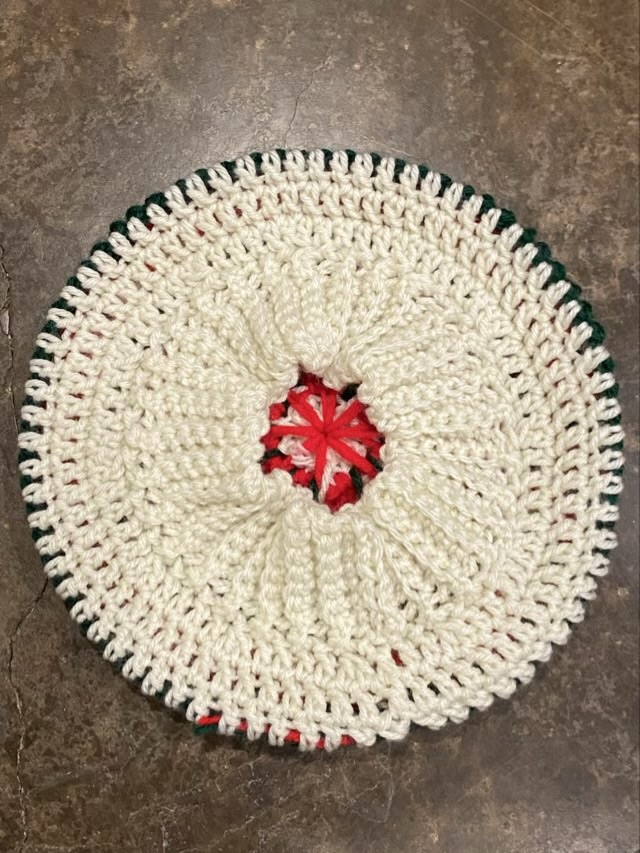
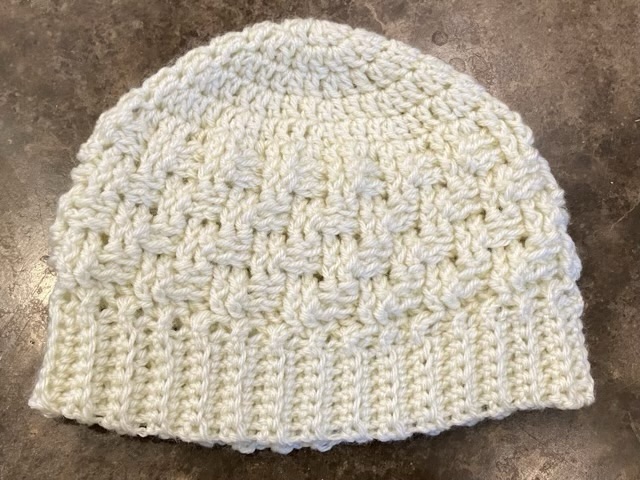
Photo description: under side of the beret all in white with three rows of double crochet and a band of single crochet rib

White hats

I did say that I have a boat load of acrylic yarn and am on a hat kick, right? And I mentioned that this an experimentation time, since I can’t do the same thing more than twice? Oh good, that established, here are more hats.

Photo description: white crocheted hat with woven band and ribbed edge

I tried the new-to-me crocheted ribbing technique combined with one of my favorite crochet textures: a woven stitch.

Technical summary: (American notation) Double crochet (dc) 12 into a magic circle. Increase 12 each row until diameter matches desired hat size. Switch to waffle pattern which is two front post crochet and two back post crochet for two rows. Offset the waffle pattern by two for the next two rows. Continue until the hat reaches the top of the ears. Chain 8, make single crochet back loop ribbing around the edge.

I also made Moogly’s Diamond hat in white.

Photo description: white acrylic hat with diamond pattern from crown and ribbed edge

I may be able to make an exception to the “only two” distractibility rule by interspersing different hats between making the diamond hat pattern. I like it that much.

Pattern Review: Diamond Hat

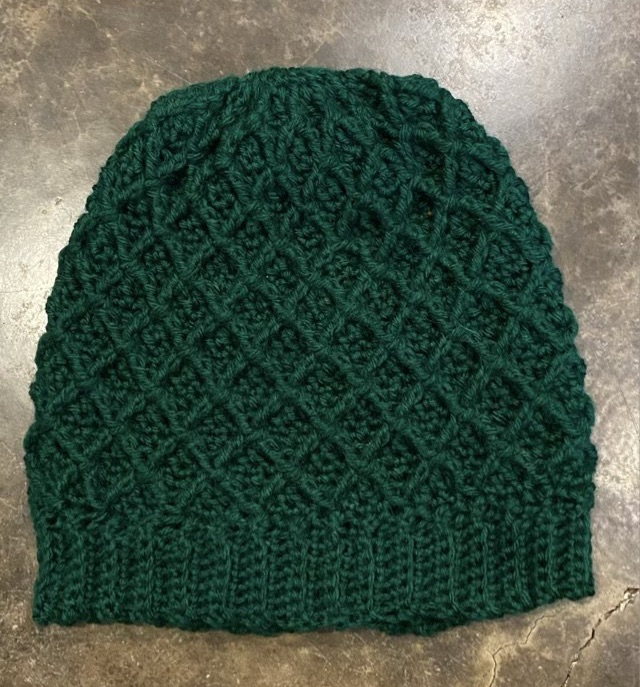
It is that time again. I have a build up of gifted acrylic yarn, and a chorus craft fair coming up, so it is time to crochet hats. I can’t bring myself to make the same hat over and over, so it is also a time for me to explore patterns and techniques. Moogy is running a campaign with Warm Up America for a hats, scarves, and mitten drive. Moogy graciously provided some of their free patterns for the drive, including a Diamond Hat pattern. This pattern had two techniques that were new to me: using treble crochet stitches to make diamonds, and using back loop single crochet to make ribbing. I like both methods! This hat crochets up quickly because of the double crochets, but has a very classic look. It did take me a few rows to figure out exactly where to hook in the treble crochets: under the leg so all four legs have a single join point. The picture below is actually my second hat. The first did not have as much definition near the crown. There is a PDF version available of the pattern for a price, but unfortunately the designer included links for the special stitches in the PDF, which don’t work when you print the pattern (obviously).

Photo description: Diamond crochet hat in green acrylic using a pattern by Moogly

The hat is flexible, thick, and warm. I think I will make a few in different colors without getting distracted (much). This is definitely a pattern that I will keep in my repertoire.

Fiber Page: Ramie

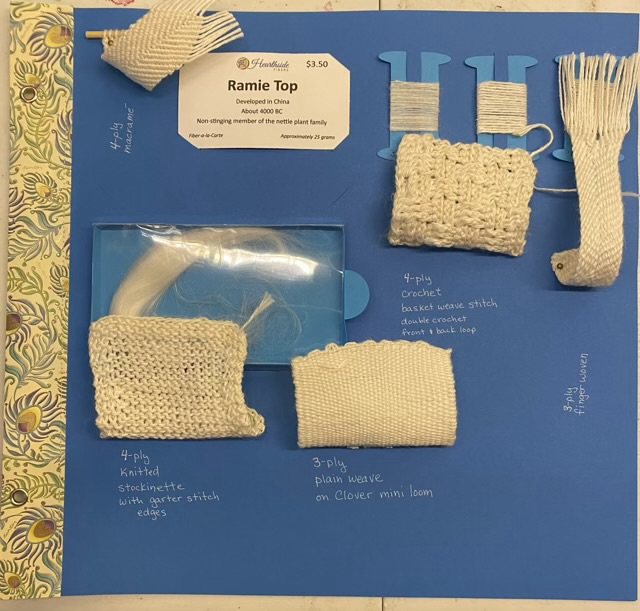
I completed the fiber page for my spindle spun Ramie top fiber from Hearthside fibers. Ramie was pleasant to spin and has a cottony feel but with a long staple length. I experimented with three and four ply yarns.

Photo description: 12 x 13.5 inch fiber page with (clockwise) a sample of macrame on a bamboo stick, the card from Hearthside Fibers that says “Ramie Top Developed in China about 4,000 BC Non-stinging member of the nettle family”, paper bobbins containing single spun, 3-ply, and 4-ply yarn, finger woven sample, crocheted basket weave swatch, plain weave swatch, knitted swatch, unspun fiber in a clear topped drawer
Photo description: sample fiber page with the swatches flipped up to show the descriptions written in white ink on the blue card stock

Throwback Thursday: Mixed Media

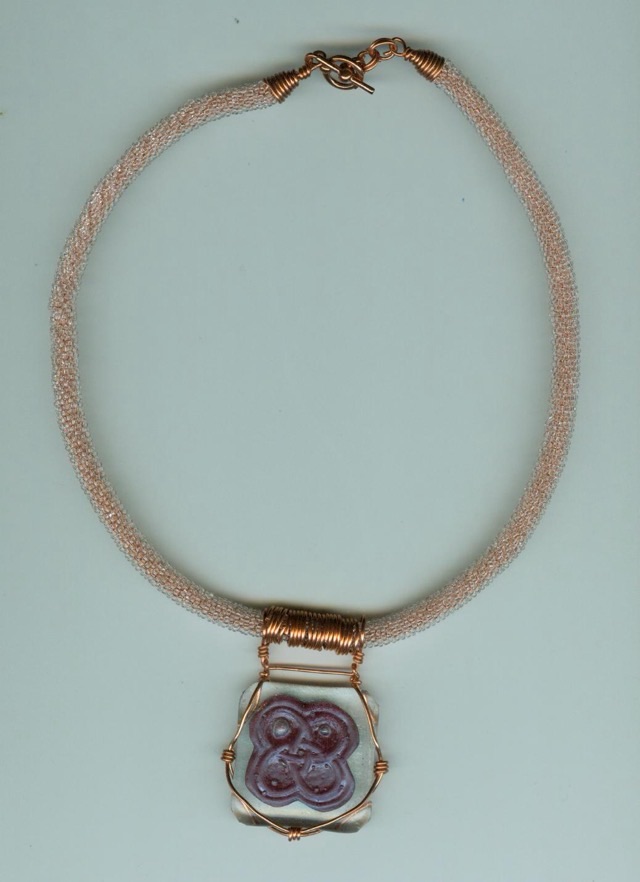
Here is something from July 2008 that reflects most of the crafts I was involved with at the time: crochet, wire work, and glass fusing.

Photo description: copper and glass necklace from 2008

The rope was crocheted with copper lined seed beads (I think, I may have crocheted copper wire with clear seed beads, but the rope looks too even with a nice drape, which tells me I probably used silk cord, rather than wire, and the the copper color may come from a lined seed bead). I finished the rope with hand made wire cones and a purchased copper toggle clasp. The pendant is fused glass with a hand made chased copper inclusion in the shape of a four loop Celtic knot. I was experimenting with fused glass using a small kiln because I could set it up, let it run its program overnight, and check on it in the morning in my own time, very important when dealing with a young child and another on the way.

I attached the glass pendant using copper wire, and added five independent coils of copper around the rope. I must have done this for flexibility reasons, it would have looked better with a single longer coil, but that would have changed the drape.

These seed bead crocheted ropes do make me nostalgic for the times I could wear necklaces. They have a comforting feel in the hand.