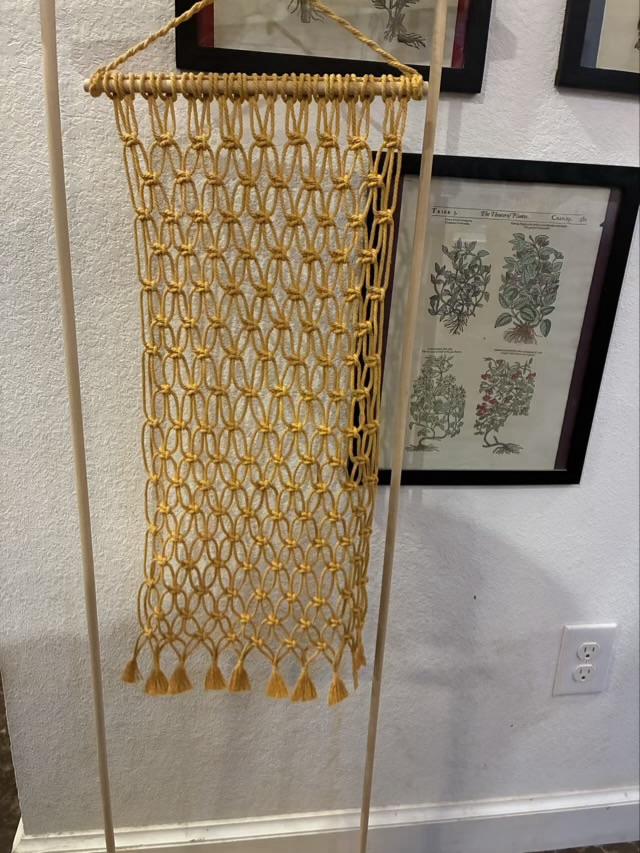
At my Dad’s request, I knotted a macrame utensil holder for his handmade spoons. I used yellow recycled cotton cord from RockMountainCo, and a dowel. I like the geometric pattern made by the alternating rows of square knots.
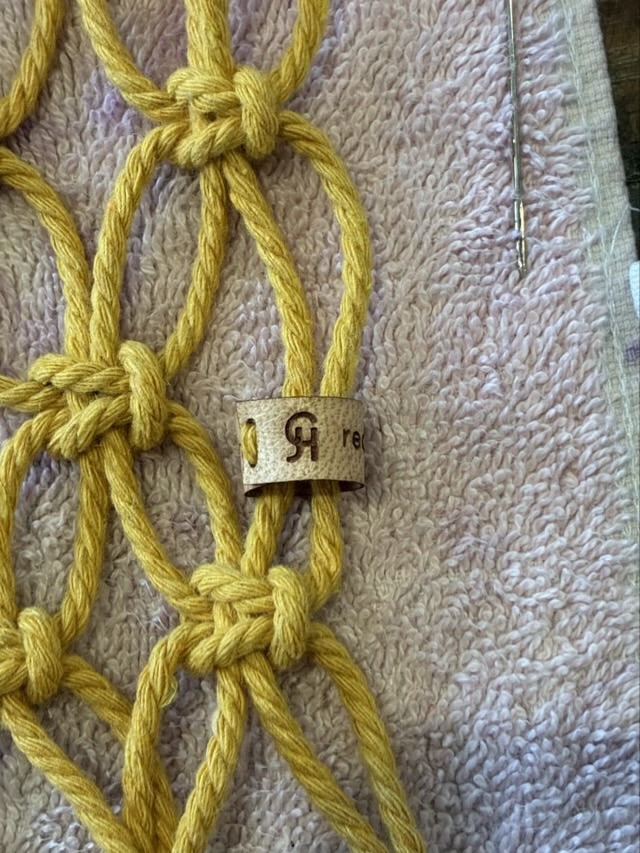
Photo description: simple yellow macrame wall hanging hanging on a twining loomPhoto description: same wall hanging with spoons inserted into the holes between the knots, showing horizontal and vertical storage optionsPhoto description: leather tag sewn into a circle around a pair of cords on the wall hanging showing my mark, the other side says “recycled cotton”
Technical details: 4mm recycled cotton cord cut into 18 pieces, 90 inches in length, attached to a 1/4 inch dowel with lark’s head knots, then tied with square knots over two core cords in alternating rows. The ends were lashed together in groups of four, then untwisted and combed into tassels.
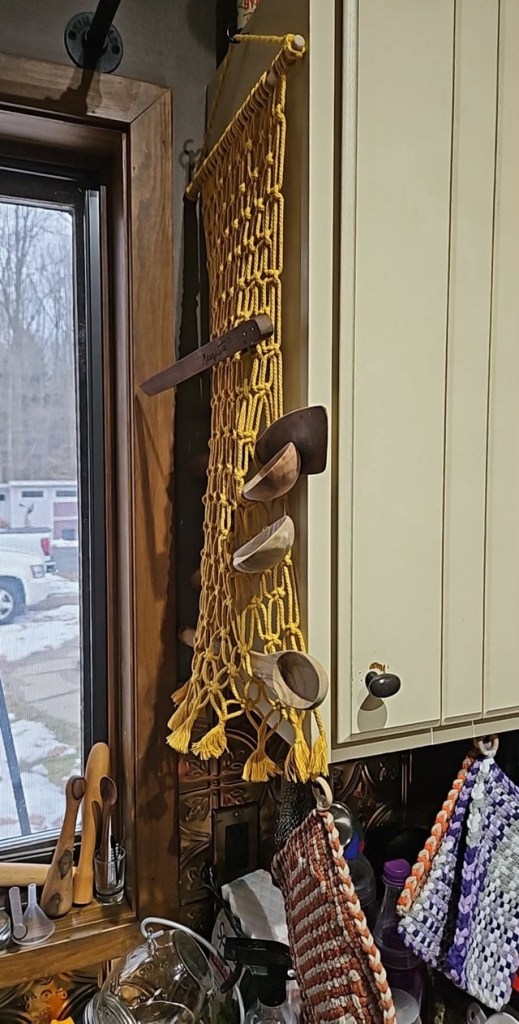
Photo description: wall hanging installed, holding three spoons, a spatula, and wood tongs
I found a source of recycled cotton macrame cord from RockMountainCo, based out of Colorado, and some recycled glass beads from our local vintage store, The Haps. The combination of recycled/upcycled materials seemed very appropriate to make macrame hanging plant holders requested by my sister.
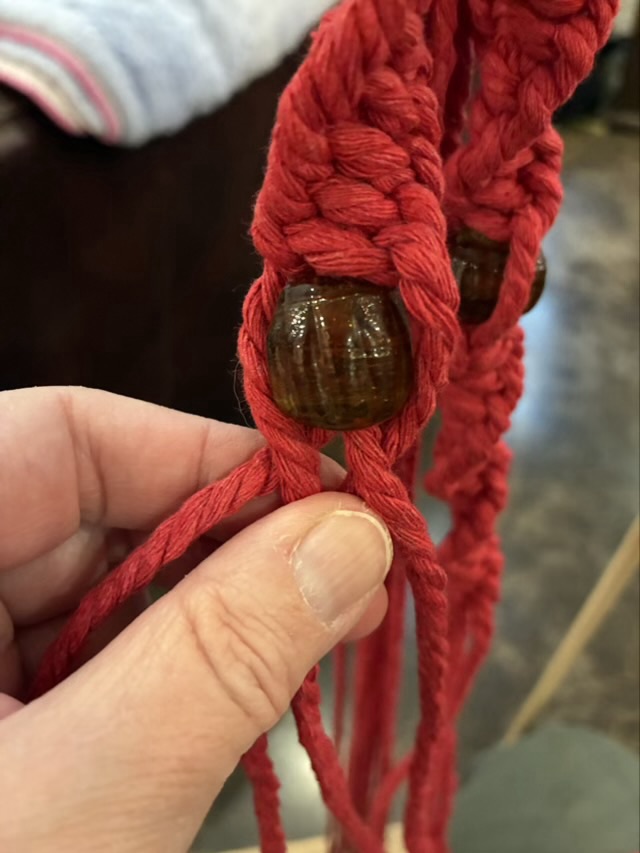
Photo description: close-up of the macrame in progress, adding a bead to the center two strands of a half knot twist
I found that my bag twining loom works well to hold macrame in progress, and to display the finished piece.
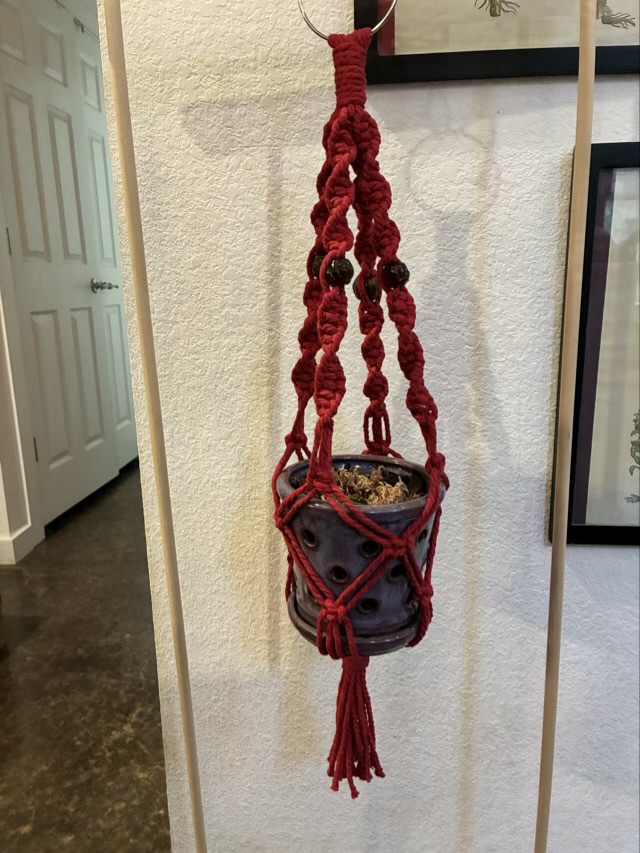
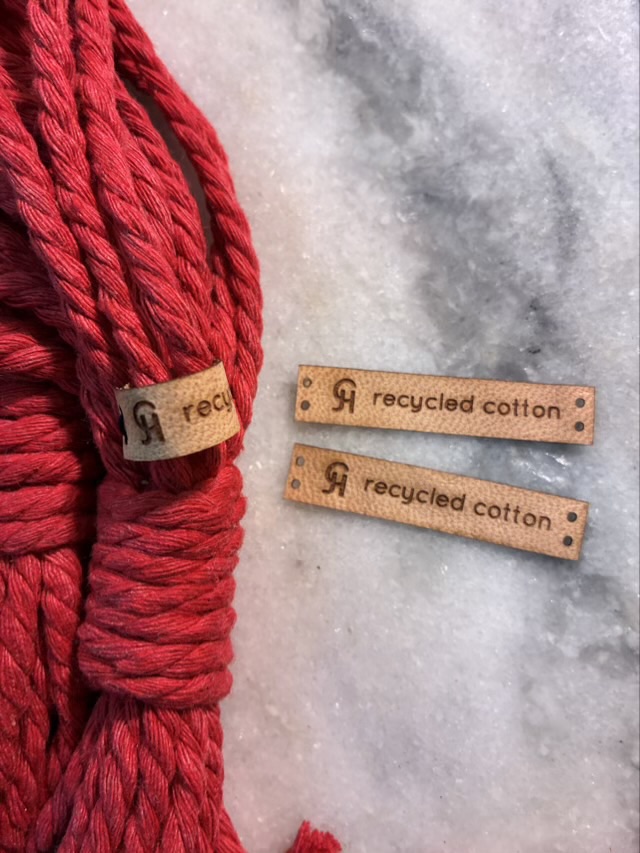
Photo description: hanging macrame pot holder made from red recycled cotton cord and recycled glass beads hanging from a bag twining loomPhoto description: leather tags marked with my signature and “recycled cotton”, one sewn into a circle on the macrame hanging
Technical details: I cut 8 lengths of 4mm cord 99 inches long, folded them in half through a welded metal ring, lashed the strands together with 30 inches of cord, made four half-knot twisted sections with 15 knots on either side of the bead, then three sets of offset square knots to make the body of the holder, finishing with another 30 inches of cord to lash the strands together at the bottom.
In macrame, when making a half-square knot twist, the two center cords function as a core, and don’t get knotted, so the outer knotted cords get short and the middle don’t. To balance this and make the most of the cordage, I used a bead to interrupt the pattern and switch the outer and inner cords. By making the same number of knots above and below the bead, the cords end up the same length. A little macrame trick for those that read this far.
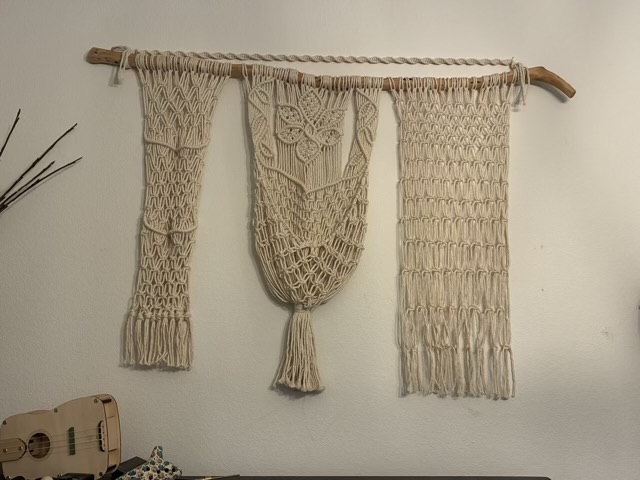
I started this large macrame hanging back in October of 2024. This basically qualifies as a throwback Thursday post, except that this project has been in progress suspension for over a year due to indecision. It has been hanging in a hallway and I’ve passed it daily during the last year. Many possibilities have gone through my head, and I’ve done a few knots, but a concrete plan never coalesced. I finally just wanted it done so I could organize my small instruments that have been living in a box in the closet. I decided to just knot a mesh of offset square knots on the right, similar to the two layer open side pockets on the left. As I started the net pattern, I decided that there should be different spacing between row to accommodate different sized instruments. It turned out perfect for my flutes, whistles, and recorders. I’d like to say I planned it for that, but really I was just desperate for it to be done and the knot pattern was the easiest path.
Photo description: large cotton macrame wall hanging with natural cedar rodPhoto description: same macrame hanging filled with small instruments from top to bottom, left to right: maraca, harmonicas in cases, kalimba in a case, pan flute in a case, castanets, steel tongue drum, train whistle, wood whistle, sliding wood whistle, soprano recorder, chanter, alto recorder, bamboo flute, rain stick, and on the top of the piano, a ukulele made from a laser cut kit
I’m glad the hanging is now doing its job and not sitting idle in the hallway. I would absolutely do the macrame mesh again for a different storage project, especially for long stock, such as spoons. Hm.
Happy Thanksgiving. May your projects result in satisfying completion.
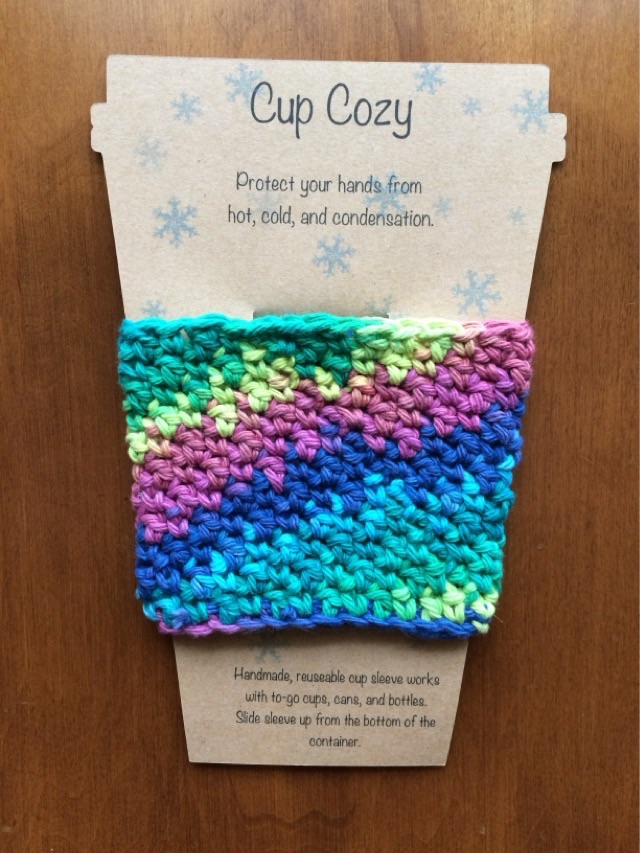
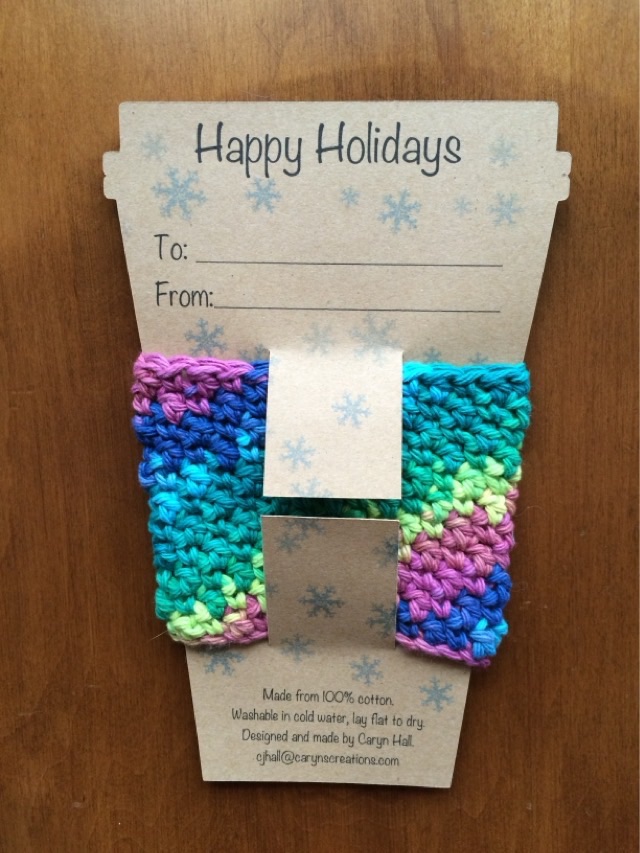
In December 2015 I was crocheting cup holders, and even went as far as designing packaging.
Photo description: front of a crocheted cup holder on flat paper “cup” that says “Cup Cozy” with a diagonal striped rainbow cozy (serendipitous pooling)Photo description: back of the same cup cozy with flaps to hold the crochet in placePhoto description: stacks of different colored cup cozies
I made these as teacher gifts for my kid’s teachers, which is why the back “to” and “from” are blank, so we could decide later which went to whom.
Cup Cozies are a good way to use up scrap cotton yarn.
As I was demonstrating spinning on 165-year-old Great Wheel, I spent an equal amount of time spinning, talking about the wheel, and adjusting the wheel alignment.
This Double Nut New England wheel has a flat wheel surface made by bending two long thin wood boards into a circle, tapering the ends, and securing with iron rivets. The flat surface does not hold onto the cotton drive band like a concave surface would, and alignment with the spindle post is key in keeping the band on the wheel.
Photo description: view of the Great Wheel from the back, one cotton band on the wheel is the drive band, the other was an attempt to keep the drive band from slipping off. It didn’t work, the drive band merrily skipped right over it.
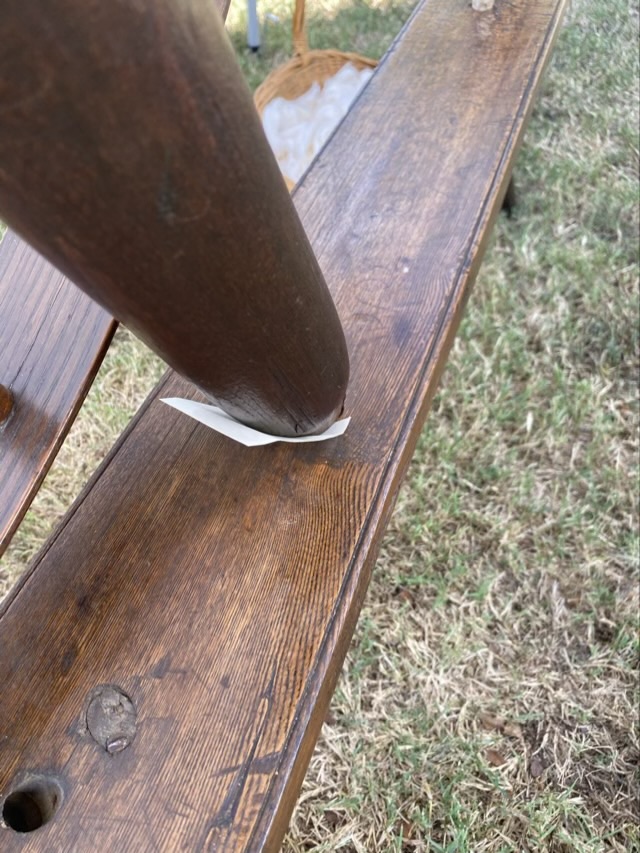
I found that the wheel post was not glued or nailed into the table, and had some play forward and backward as well as side to side. I attempted to wedge the wheel post in using a business card, with limited success.
Photo description: base of the wheel post with a scrap of card board wedged in
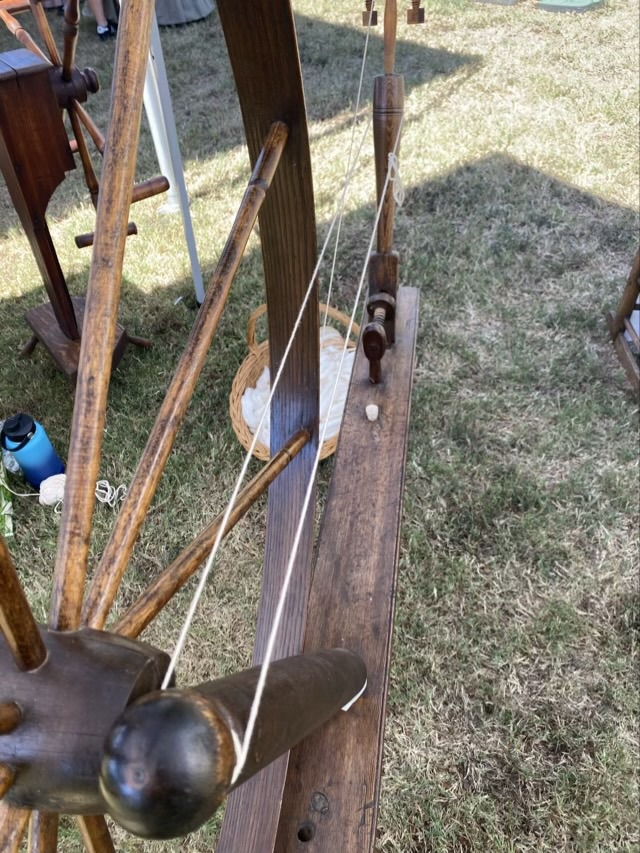
I did have some luck when I ran some cotton string from the wheel post to the spindle post. Mainly the line of cotton rubbed up against the drive band, keeping it on the wheel. Not an ideal situation, but a decent stop-gap measure.
Photo description: cotton string going around the wheel post and spindle post
I also tightened the drive band by cutting it and redoing the knot. I used a double sliding knot that is near impossible to undo once it is slid together. Once the ends are trimmed the knot also has a low profile, making it easier to pass through the grooves on the accelerator whorl. I ran some pure beeswax along the drive band as well, to give it some grip.
Photo description: tying the cotton drive band together with a sliding knot
The biggest factor in keeping the drive band on was to make sure the wheel was aligned with the accelerator whorl. The whorl has several grooves so the drive band can go in the one that aligns best to the center of the wheel. There was play in both the spindle post and wheel post, so keeping them in alignment was a game of concentration. When the area was quiet, I could get quite a long spin going, but when I started talking, my concentration would drift and the drive band would pop off.
I think I will add some tissue to my kit. Wrapping the base of a post with paper tissue can often increase the security of the connection, without causing permanent damage. I’ll talk about my spinning wheel field kit in another post!
This post is part of a series about my experience demonstrating spinning on a 1860s Great Wheel in Mansfield Texas.






 Critters and Craft