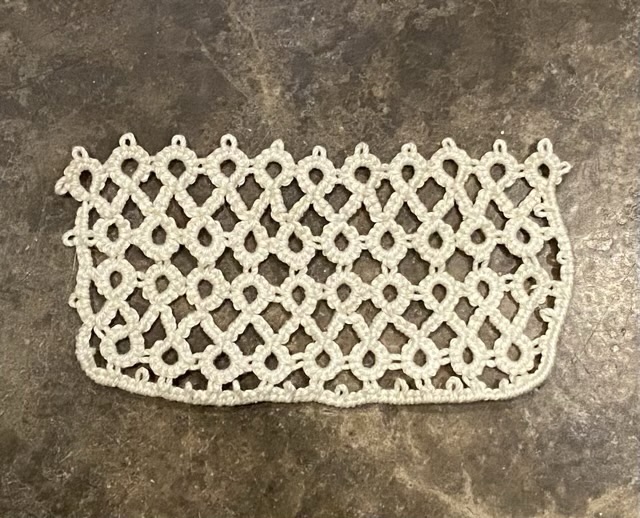
I tried a rectangular tatting experiment, connecting lines of opposite loops (there might be a name for it?) The picots line up well, but I need to work on my end turning techniques. I ran a solid edge around three sides, just for something to use up thread, and it helped me realize that tatting is a double edged craft. I need to be thinking of two sides as I knot. Knitting, crochet, and nålbinding in general work in single rows, making stitches that connect to previous stitches. Tatting “rows” are really connected motifs.
Photo description: rectangle experiment tatted with number 3 cotton, with many learning moments
I did block the piece, but it didn’t even out the wonkiness. It is an odd bit of lace, but I might find a use for it, and it certainly helped me understand tatting construction better.
P.S. This is actually a variation on a Josephine knot; it just puts a closed loop in place of a picot in the middle of the chain.
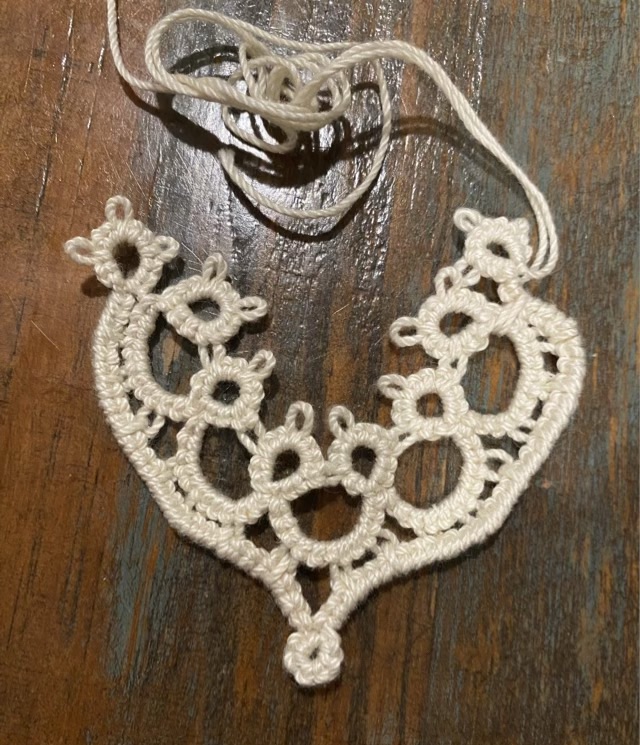
I’ve been carrying around tatting supplies in my purse and using them when I have a few minutes of waiting. Rather than bother with the bulk and hassle of a pattern, I’ve been exploring how the forms of tatting go together. Such experimentation is very useful to develop my skills and also results in some learning opportunities. In tatting, motifs are connected using picots, or loops in the work. This requires preplanning or an abundance of loops on a useable side of the work. I was attempting a triangular piece, and merrily made a line of knots with no loops. Oops.
Photo description: experimental bit of tatting, with the bottom edge solid without picots
Although the line of the piece shows promise, I can’t add onto the smooth edge with my current level of knowledge (there may be a technique out there that gets around this conundrum).
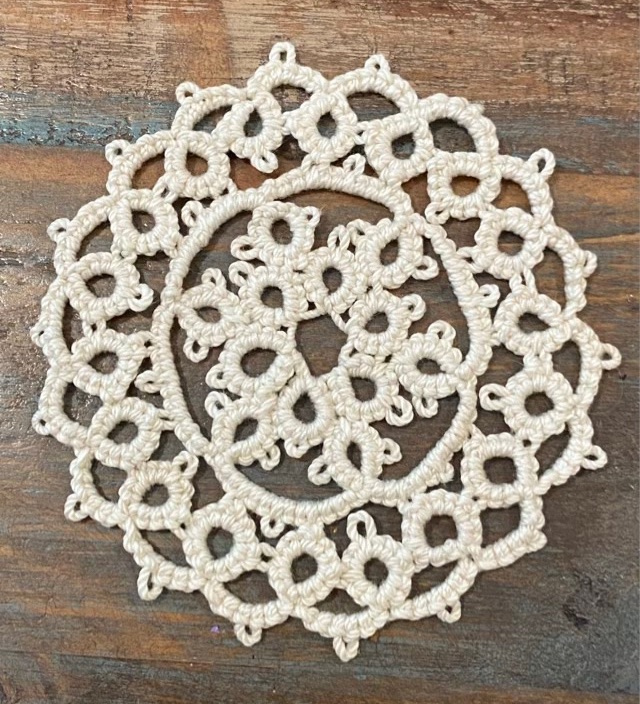
As an added learning bonus, it seems tatting also has some play with tension. How tight you pull the center thread determines the motif radius, so even when following a pattern, if the arcs and loops differ from the author’s, the piece might not lay flat. Irish crochet had a similar artistic feel.
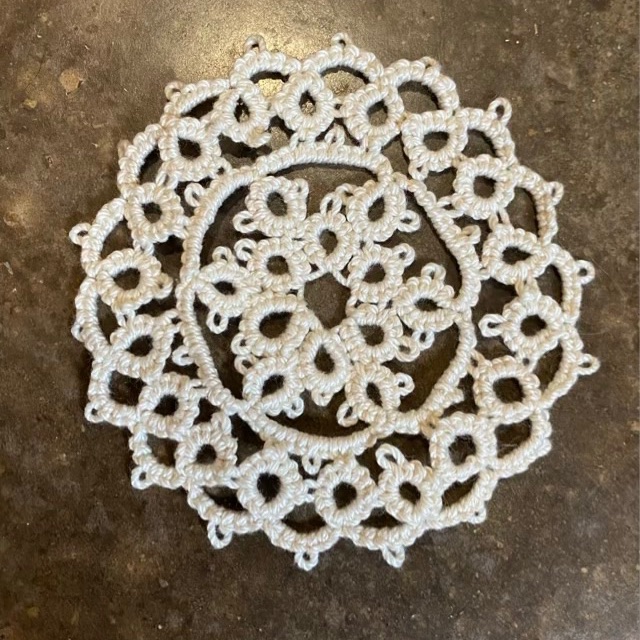
The urgent need cotton thread that I picked up on vacation because I ran out was a natural colored size 3. I haven’t worked with this size before, so it was an intriguing purchase. It didn’t take much thread to fill up my tatting bobbins, but the tatting work went well.
Photo description: three round tatted coaster using different sized Josephine knots, unblockedPhoto description: same tatted coaster after getting it wet and letting it dry flat (blocking)
What drives me crazy about crochet thread is how it is wound around a cardboard tube. I’m sure this is a marketing thing, to make it look like you are getting more yarn. I have not figured out if it is possible to center pull from the factory wrapped tube, which is frustrating, and pulling thread from the outside is vexing because the tube jumps around. So I rewound it. Next time I will use a nostepinne style wrap, but this time I really wanted to try put my new laser cut plywood spool.
Photo description: transferring the number 3 cotton thread to a wooden bobbin/spool/shuttle/holder
The thread is now much more compact and can fit in my small project bag.
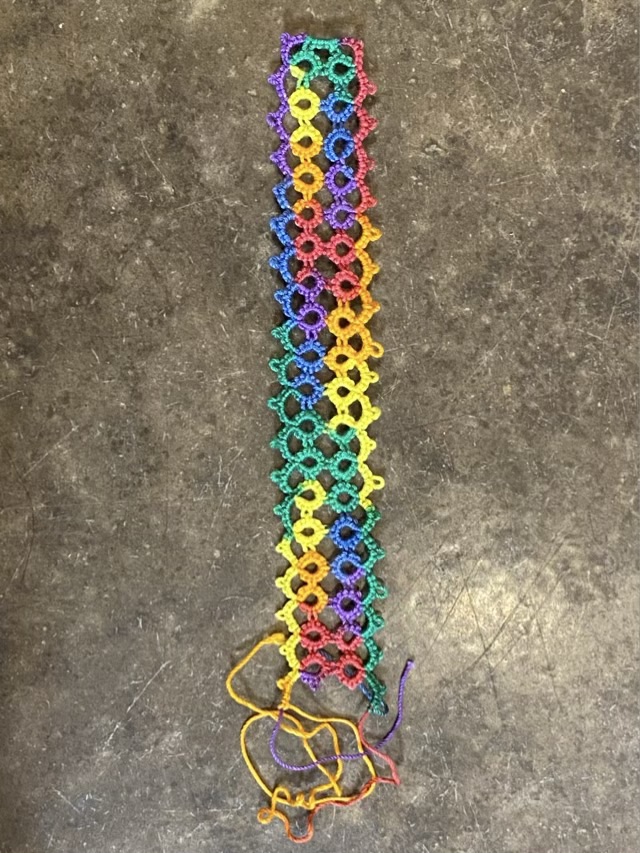
Here is another item I couldn’t finish on the plane, but not because I ran out of thread, but in need of a button. (I actually worked on this before my critical thread shortage on my mini doily posted yesterday, and considered taking it apart for the thread, but opted to keep it intact.)
Photo description: rainbow variegated thread knotted into a lace bracelet, unfinished on one end
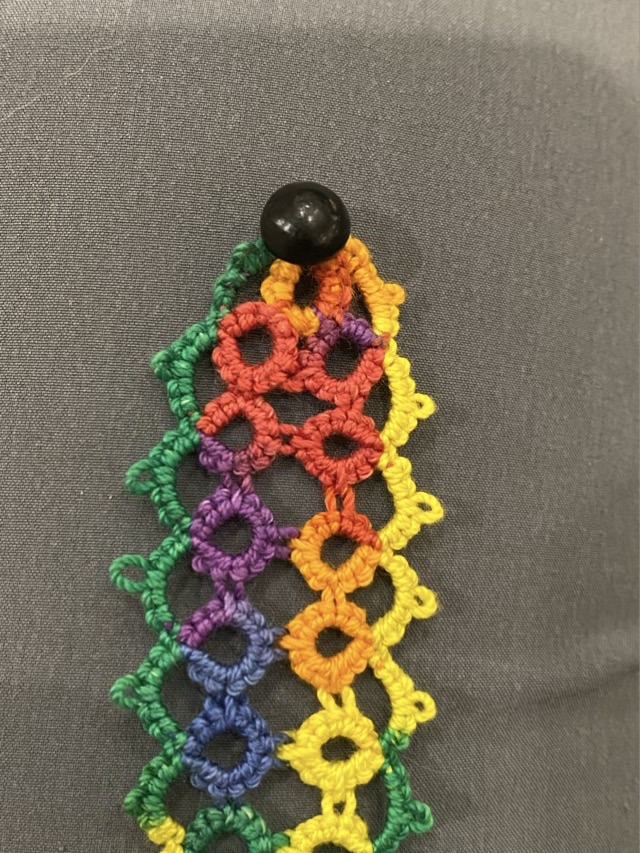
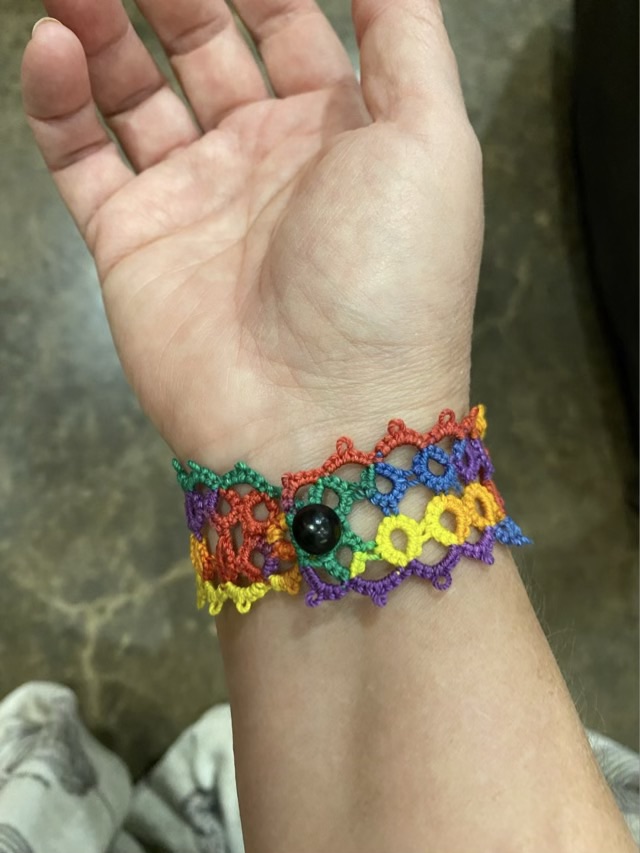
I found a small, probably vintage, black shank button in my button stash at home, and fashioned the end into the bracelet clasp. The inner circle below the button was too small for the tatting shuttle, but I was able to do the square knots with a needle to cover the threads and add structure around the button.
Photo description: finished end of the tatted bracelet with button Photo description: tatted bracelet attached with a button on my wrist
I am getting better at estimating how many knots will get me the shape I want when I’m tatting. How tight I pull the center thread also makes a difference in shape and size. This bracelet is made of two opposing rows of basic Josephine knots.
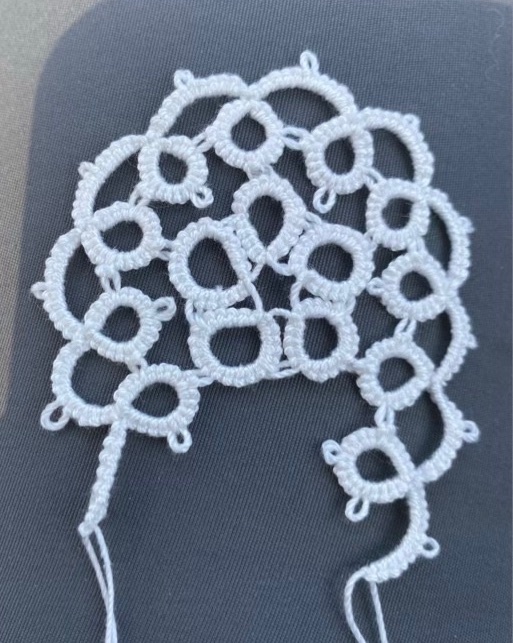
We recently took a flight for the first time (for me) in years. I was hoping to get some knitting done, but once I sat down in the seat, I could tell I didn’t have room for my paper pattern, yarn bag, and knitting with two circular needles. Nuts. I pulled put my emergency craft from my purse, which this trip was tatting shuttles and extra wound bobbins. This I could do within the confines of my seat. I pulled up my Pinterest Tatting list, and started on a round pattern. On the second round, I could tell I had a problem.
Photo description: tatting with white #10 cotton thread, the second round of Josephine knots is open
The way the pattern was laid out did not fit what I was doing; my second round could not lay flat and still connect to the beginning of the round. I could undo the second round and try something different, or clip out the center. Hm. I opted to clip out the center, literally, because I couldn’t have scissors on the plane so only had nail clippers.
Photo description: same work with the center clipped out, the picot loops teased out, and additional Josephine knots added until the project lay flat
After getting the second round to lay flat, I replaced the center with six loops done in rainbow thread, which worked out nicely and stayed flat.
Photo description: same work, but with a red, purple, blue, green, and orange variegated thread knotted into six loops and attached at every other picot to the outer round
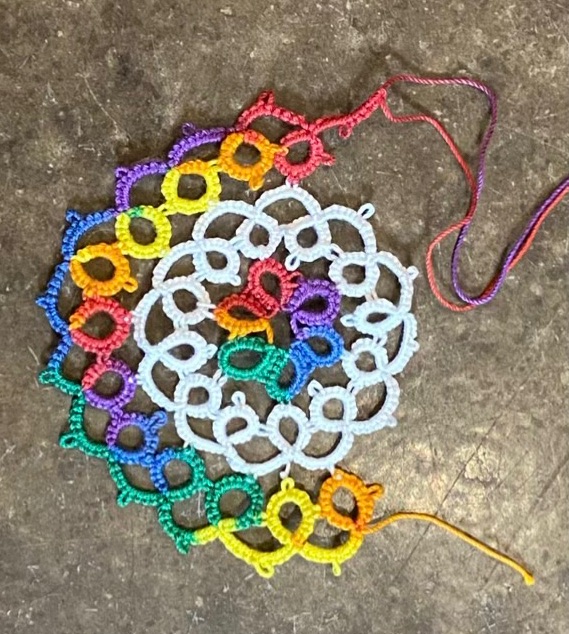
I started on the third round with the colored thread to balance the center color. To my horror, I ran out of thread. During travel. Luckily, Walmart carries cotton crochet thread, and there are Walmarts nearly everywhere in the states. They did not have the colored yarn, but they did have something I could craft with (that will be another post). The little coaster had to wait until I returned home.
Photo description: partially finished cotton tatted mini doily
At home, I loaded up a bobbin with the same colored cotton thread and was able to finish the third round and weave in the ends.
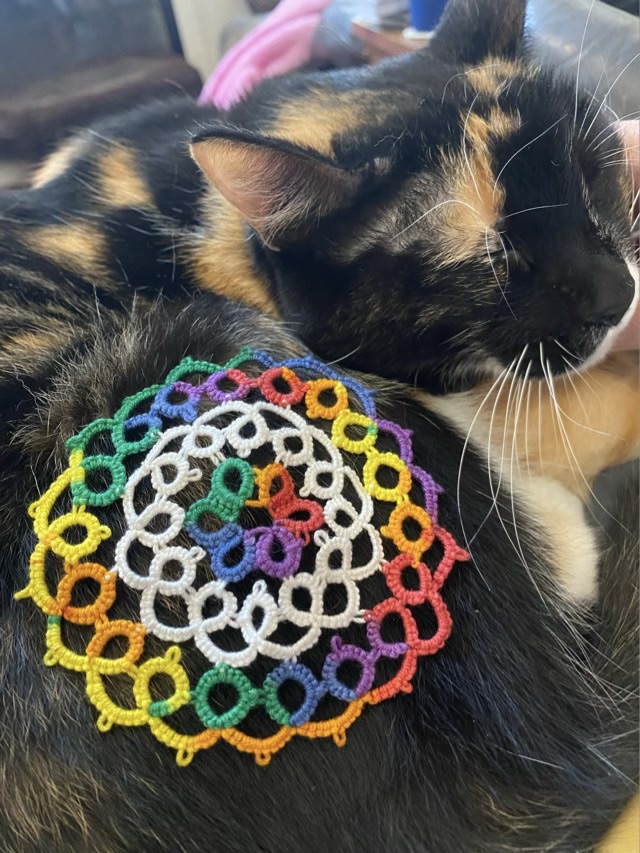
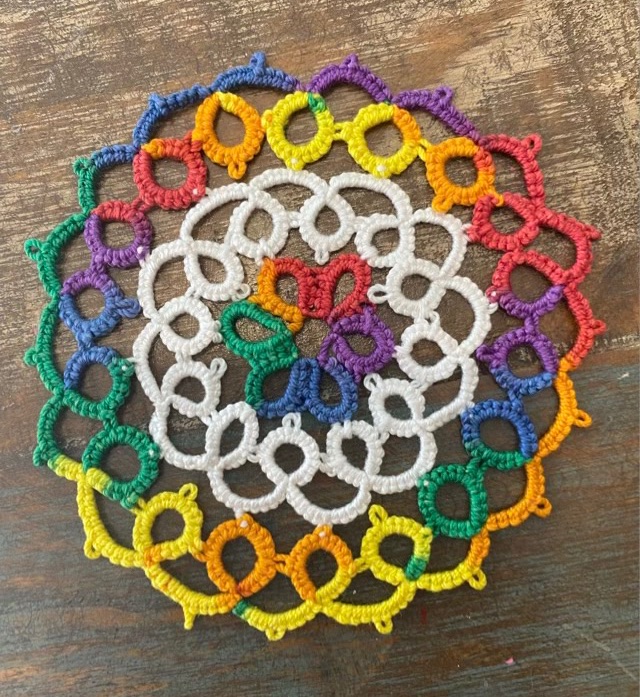
Photo description: finished tatted mini doily on a calico cat that is very happy to be back on my lapPhoto description: small tatted doily made from #10 cotton thread in white and variegated thread alternating three rounds, blocked by wetting and laying it flat to dry
The finished lace is a nice coaster size, and it amuses me to see a bit of lace peeking out from under my cup. Apparently I am a lace person down deep (but not a frilly person). I am finding the tatting to be soothing now that my skills are developing.




 Critters and Craft