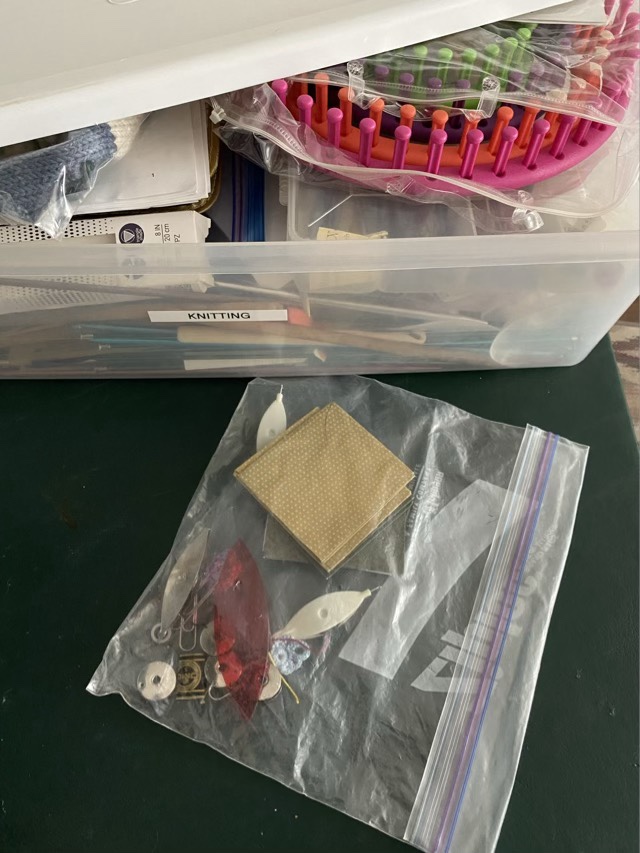
I went shopping in my craft room. I was fairly certain I had more than the one tatting shuttle I found, so I perused my shelves and found a baggie with five more shuttles! Score!
Photo description: Ziplock gallon bag with shuttles and bobbins lying on a table in front of a plastic storage bin filled with yarn tools labeled “knitting”.
I have inherited a variety of crafting implements over the years, so shopping in the craft room is a common occurrence. I did manage to make a lopsided star in tatting. Skill development in this area continues.
Photo description: White tatted five-pointed shape with some twisted stitches and curved points lying on my palm.
So tatting is a craft I have not previously attempted. I have not historically been a lace person, so tatting, which is a type of knotted lace, was not a high priority. Finding myself in Texas, where thick woolens are not required, I’ve come to appreciate the functionality of lace. Mainly, I can craft something that is wearable in the Texas heat. To keep it real, I took a picture of my failed first attempts.
Photo description: Tangle of cotton thread with misshapen circles made of knots.
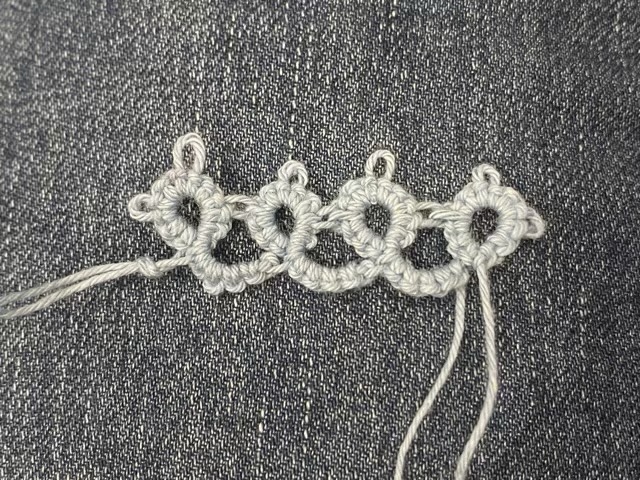
Not to cast a pall on all the fantastic lace work out there, but they all started with misshapen tangles of thread too. It is hard to learn new things, and the first products are not usually spectacular. It takes time and practice to develop the muscle memory and control for different hand crafts. Enjoying this learning process helps me not abandon the effort in frustration. Although it is not a bad idea to take frequent breaks, because it can be exasperating teaching our hands new skills. I did eventually produce a small chain of loops.
Photo description: Four knotted loops with picots connected with knotted chain, done with two threads.
I used the word “not” eight times in this post, see what I did there?
I have a new favorite way of making washcloths. Although I love the diagonal knit cloths, I really am a slow knitter. It takes me literally hours to knit one washcloth. Crochet however takes half the time for the same size cloth, and a simple single crochet, chain one pattern is easy to remember and makes cloth with a nice texture that is not so thick that it takes days to dry.
Photo description: Natural white cotton crocheted washcloth with loop.
I use a hook one size bigger than what is recommended on the label, then chain 30. In the second stitch from the hook, single crochet (sc), then chain (ch) 1. Skip a chain loop, and repeat the sc ch1 across. Turn the work, sc in the previous sc, ch1, repeat across. Continue rows until the fabric is square (test by folding it diagonally.) Sc around the outside, making a ch7 loop at one corner. I find 2sc in the other corners is sufficient to turn the corners.
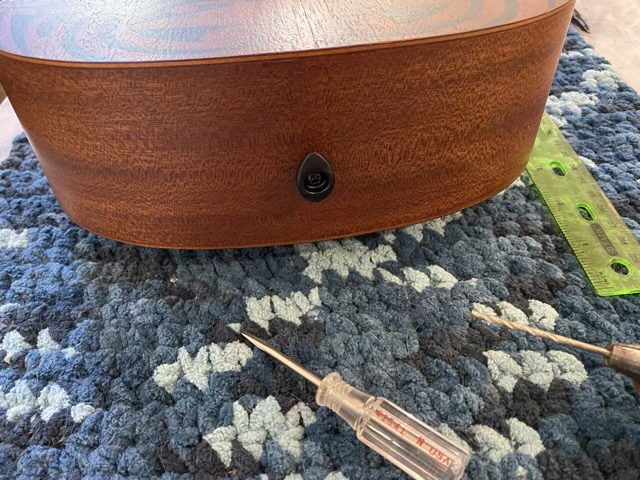
My ukulele did not come with strap buttons, so I found some elliptical ones from D’Addario and drilled pilot holes at the base (there is a block of wood inside to support the screw), and the back of the neck.
Photo description: Elliptical strap button installed on the bottom of a tenor ukulelePhoto description: Elliptical strap button installed on the base of the neck of a tenor ukulele
I trimmed the ends of my woven band (see yesterday’s post), and treated them with white glue to make them stable.
Photo description: Both ends of a tablet woven strap treated with white glue (shown on a post-it note) using a brush (shown).
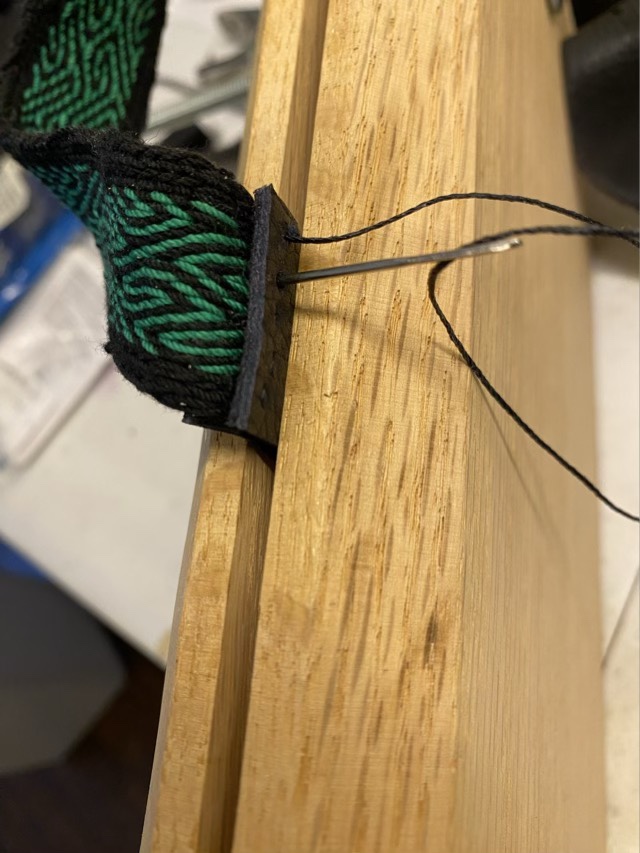
I found two metal slide buckles at the craft store and used one as intended, sewing on end of the strap to the middle bar and threading the other end over it. The other buckle I modified by taking out the middle bar and using as a ring in the fold of the strap. In my leather stash I had an old black belt. The leather was thick but flexible, and great for making the end of my straps. I folded, cut and carved tear drop shaped holes in the belt for the ends of the strap. One end I sewed on using waxed thread. The other I riveted together.
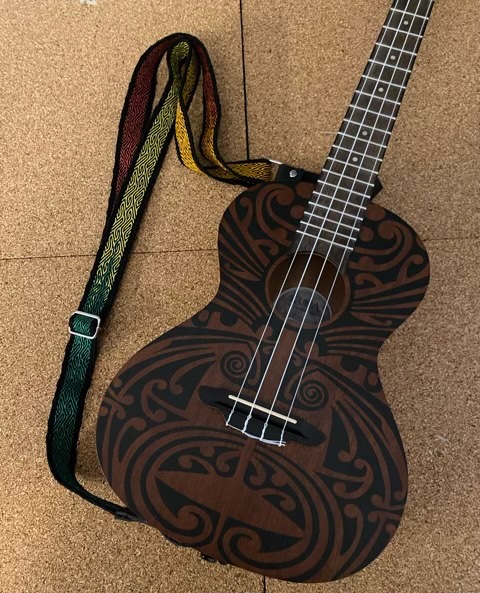
Photo description: Wood clamp holding the leather end and the woven end together so I could sew using the holes I punched into the leather.Photo description: Finished strap with leather ends and metal slidesPhoto description: Strap installed on the tenor ukulele.
I’m rather excited about having my ukulele on a strap since it makes it easier to hold at a good position for both my hands. I’m off to practice!
I decided my ukulele needed a strap. Maybe it was mostly an excuse to design a new card woven pattern, maybe it was to use up cotton crochet thread, most likely I decided to make it myself because I don’t have enough works in progress.
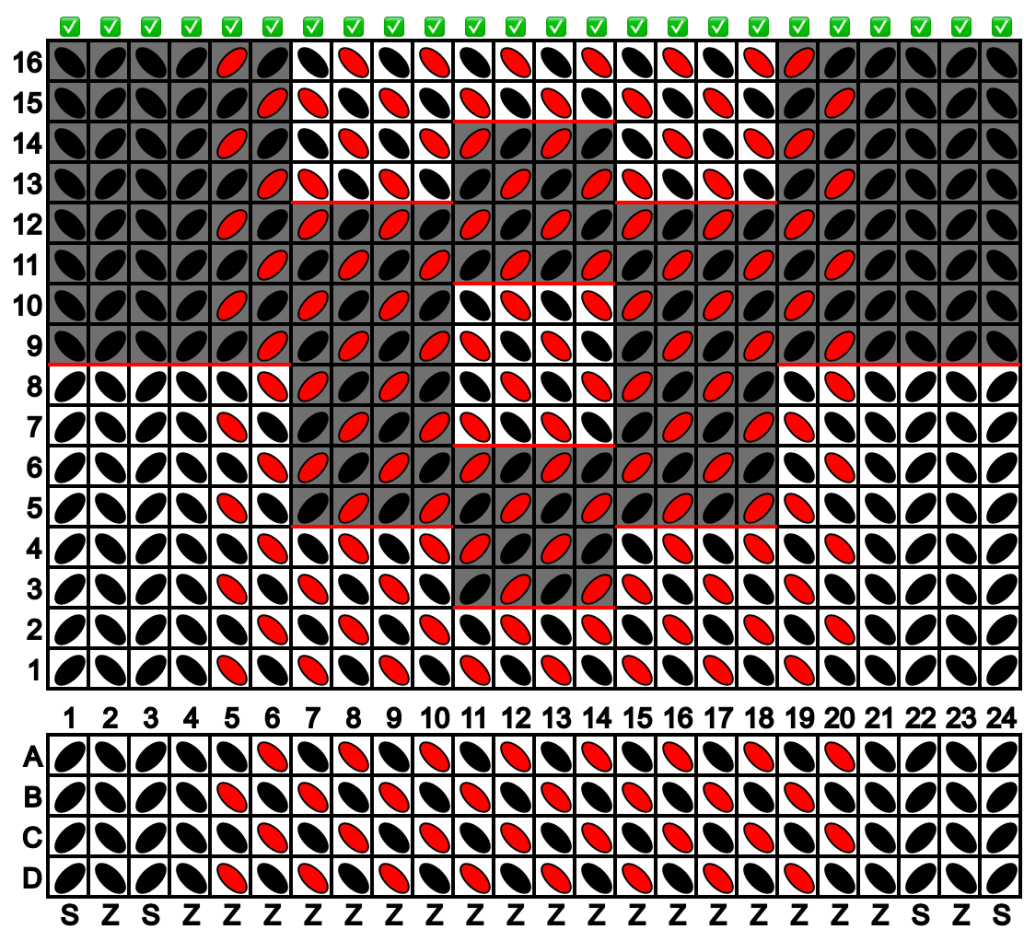
I used this tablet weaving designer, and came up with this pattern.
Photo description: Tablet weaving pattern diagram generated in Tablet Weaving Draft Designer v1.5.0. Diagram shows how to setup the cards in the tablet, and which way to turn each card for each pass of the weft thread.
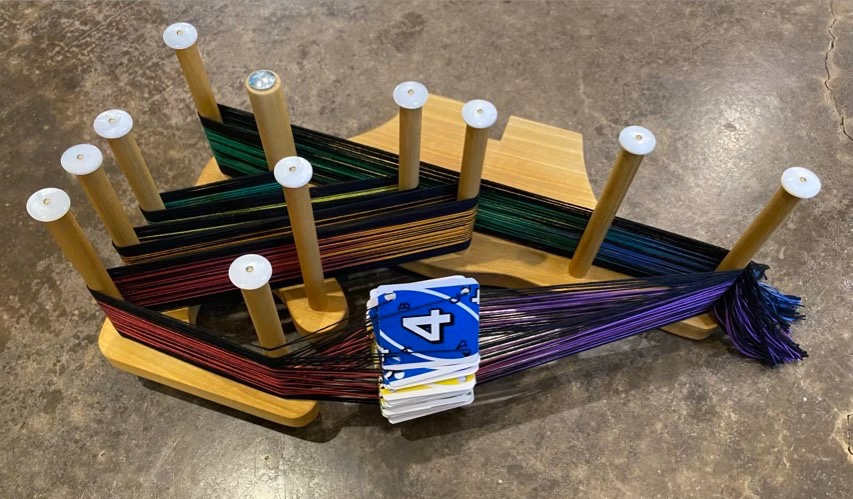
I warped my loom with #10 cotton crochet thread in black and rainbow. The rainbow warps I aligned by color. It was quite serendipitous that a color repeat in the thread was just a little longer than my warp length, so I could have all the colors, and very little waste.
Photo description: Handmade Inkle loom warped with black and rainbow thread with weaving cards made from an Uno deck.
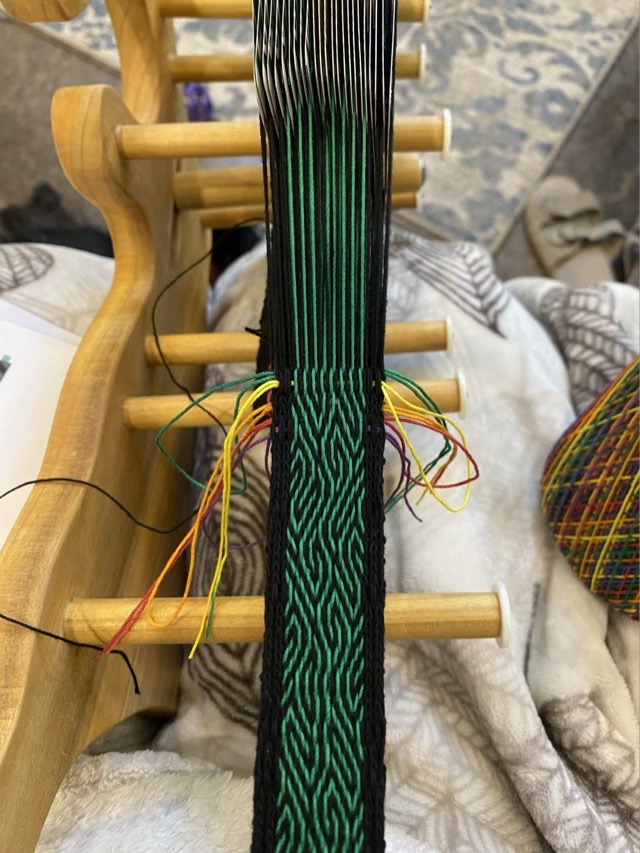
I used the black thread as the weft, and started with a few passes held straight with lengths of 18 gauge wire, then doubled the weft back on itself for several rows. To end, I used a loop method to draw the weft back on itself to help lock the weaving in place.
Photo description: Weaving in progress showing a wavy green and black pattern with solid black edges and rainbow colored loops along the weft pass to use to draw the weft backwards.
I love this pattern. It is balanced so the twist does not build up in the warp, except when I make a mistake. Even when I miss a turn or double a turn, it still looks cool, and it is double sided! Win! I love the middle, but the edges vex me because they are not even (an artifact of the balanced weave). I may try a plain woven edge next time around (my youngest has requested one for her uke.)
Photo description: Finished woven band with color changes along the spectrum in the same wavy pattern.








 Critters and Craft