Just keep spinning

I’m developing my skills with the Ashford Traveller spinning wheel. I’ve found it helps me evenly distribute the yarn on the bobbin if I separate up my roving into thinner strips and switch hooks on the flyer after I spin each strip.
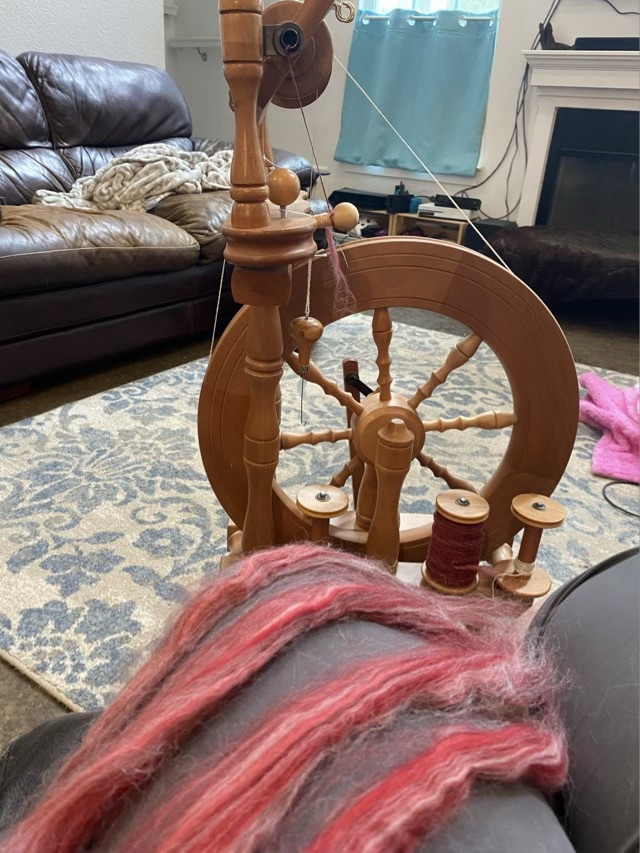
Photo description: four strips of roving laid out on my knee as I prepare to spin

Some spinners pre-draft their roving to make spinning easier, I find tearing off about 8-10 inches, then separating out sections has a similar function. Commercial roving is quite thick, and when spinning directly from a large bundle of fiber there is a tendency for the fibers to tangle, making it harder to spin consistently. Joining in a new strip is easier for me than untangling a mess of looped fibers, or managing a thick bundle.
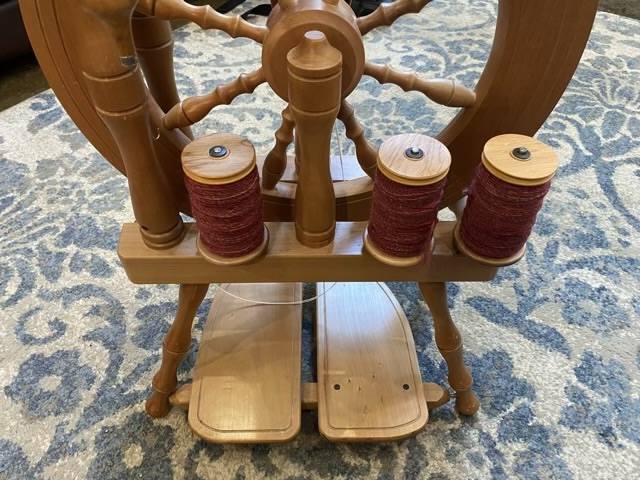
Photo description: Ashford Traveller built-in Lazy Kate holding three evenly filled bobbins of single spun yarn

I now have three full bobbins of yarn and am ready to try plying with the wheel!

Long alpaca spin

I finally combed and single spun the last of an alpaca fleece that I purchased and washed in 2020, and started spinning on my Befra Willy Spinning Wheel in 2022. I haven’t been spinning consistently over the last two years; there were many months that the fleece and the wheel were tucked away out of sight and definitely out of mind.

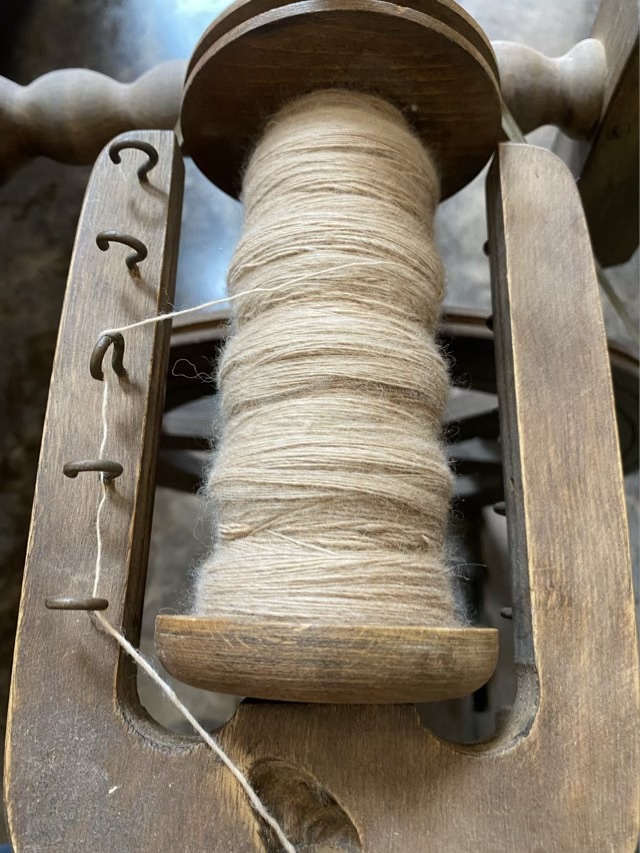
Photo description: Befra Willy Spinning Wheel with a bobbin full of single spun fawn colored alpaca fiber

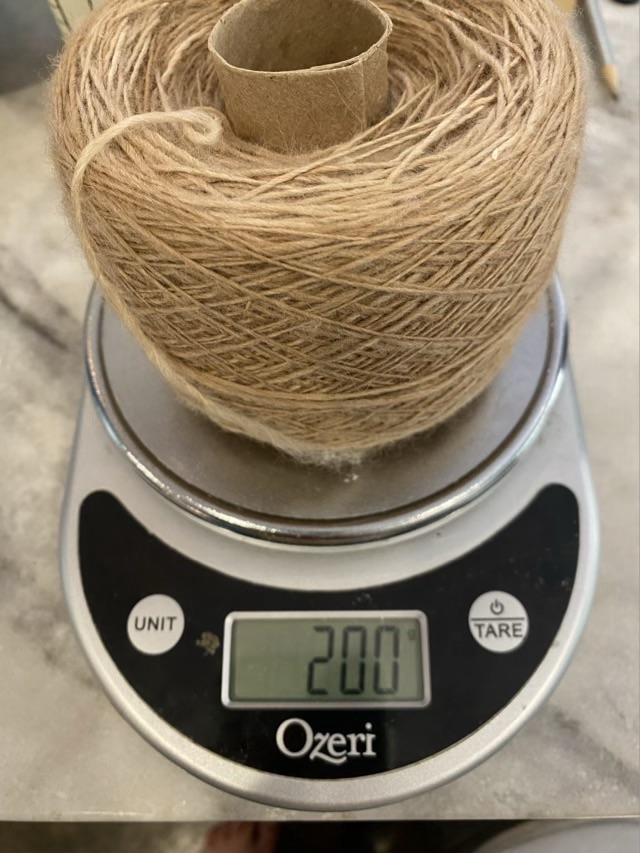
To free up my bobbin, because the next step is to give the wheel some TLC, I wound the yarn into a cake using my wool winder. I ended up with 196g of spun alpaca (the cardboard tube in the middle weighs 4g).

Photo description: cake of single spun alpaca fiber sitting on a scale reading 200g

I put the cardboard tube in to keep the yarn under more tension. Single spun yarn is not balanced, and I wanted to reduce the chance of kinks and tangles. I’m not sure how I want to ply this fiber, so it will sit until I have an idea. I did pull the start of the yarn and the end to compare thickness, and I did a fair job keeping a consistent spin over the two year span. There are some thinner and thicker sections, but not a wide spread.

Photo description: yarn pulled from the center (newest) and the outside (oldest) showing very similar thicknesses

This definitely counts as a forever project. I’m really getting my crafting money’s worth from this alpaca fleece.

Processing

I’m still working on spinning the fawn-colored alpaca wool on my vintage Befra Willy spinning wheel. I’d like to get it finished up so I can give the wheel a good rub down with Howard’s Feed-n-wax, but apparently my fiber basket is bottomless. (Or I get distracted…)

Today’s distraction is an evenly wrapped bobbin. There are all sorts of devices out there designed to achieve a smooth wrap, rather than the bumpy wrap produced by the hooks on the flyer. A smoothly wrapped bobbin makes taking the yarn off the bobbin easier, with less potential for breakage.

I’ve been thinking on this, and noticed that I can turn my hooks and get a slightly different take up angle on the flyer. This helps a little, and if I did this from the beginning I would certainly be closer to that epitome of bobbin wrapping that seems to be so coveted.

Photo description: closeup of a flyer mechanism on a Befra Willy vintage spinning wheel, with light fawn colored alpaca single wrapped around the bobbin and going through the hooks on the flyer. One hook is turned sideways. The yarn wound on the bobbin is thicker near the hooks, resulting in bumps.

Yarn cake

I have spun and plied all my blended fiber from Anniewhere. The blend is Merino wool, Blue-faced Leicester, Alpaca, Tussah silk, and Finn wool. I bought 6 oz and have been using it to test different spindles, so I’m frankly amazed that it turned out somewhat consistent. I joined the skeins with a braided join: split each end in two, then remove one of the four resulting ends, braid those three together, then moisten and roll between your palm. Here is a video.

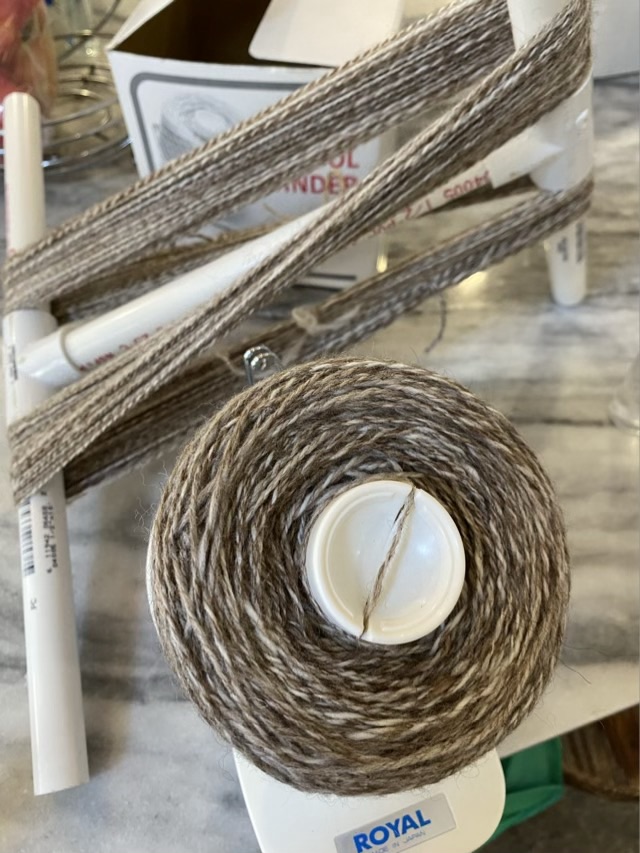
Photo description: yarn cake on a yarn winder with two additional skeins on a PVC niddy noddy in the background.
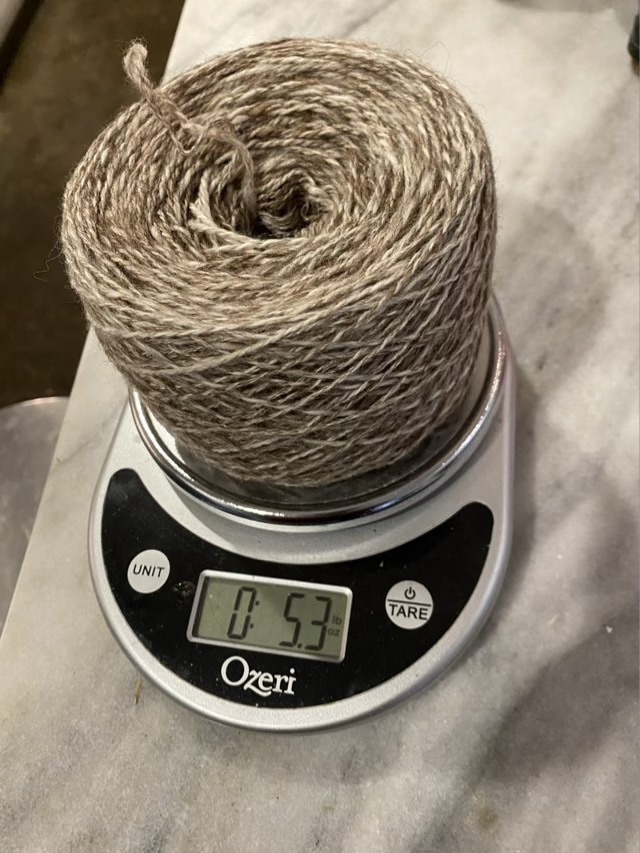
Photo description: finished yarn cake sitting on a scale reading 5.3 oz.

I joined all the skeins together because I intend yo do a knitted project. I spotted a free ruffled scarf pattern while I was spinning, and knew that it would be great for my yarn, so the pattern has been sitting with the fiber. I’m excited to cast on. (I’m might have to admit that I could be a knitter.)

Found!

I knew I had another box of blended fiber by Anniewhere, and I found it while looking for what to spin next in my prepped fiber box! Yay! I think I’ve spun 4 oz of this blend so far, which consists of Merino wool, Blue Faced Leichtester, Alpaca, Tussah Silk, and Finn Wool. I’ve been using it to test out different spindles, so I continued that and dug out a 3D printed Turkish spindle that I bought at a fiber festival. It spins beautifully and even though I have to use a half hitch at the top, rather than a hook or notch, I haven’t been dropping it as much as I feared.

Photo description: From the top, a rosewood ring distaff with cord and handkerchief, a 3D printed Turkish spindle with turned wood shaft and the start of a yarn turtle, bakery box full of carded and blended fiber.

I even used a small ball of a single spun from the same fiber that was left over from plying to start the yarn turtle, and in so doing had a gauge for how thin to spin, and saved more yarn from the scrap bin!