Glow Jellyfish Hat (free pattern)

Here is a fun project! A glow in the dark jellyfish that you can wear. Just think of all those lovely floating jellies in the park on a cold night! I’m happy to provide my pattern for free, please tag me on instagram @carynjhall if you make the hat, and be kind, don’t sell my pattern, but do share the link to this blog post.

Lion Brand Yarn is doing a Show Us Your Glow contest, so if you want to pop over here, you can vote until March 19th, 2025.

Photo Description: Two pictures of the same crocheted hat, one in natural light, one in the dark showing the glowing yarn

Materials:

  • one skein each of DIY Glow Cozy Lion Brand Yarn #LionBrandYarn, in white, pink, lilac, aqua, neon green, and neon yellow
  • size I-9 crochet hook
  • yarn needle

Terms:

  • ch – chain
  • sl st – slip stitch
  • sc – single crochet
  • scbl – single crochet in the back loop
  • sc2tog – sc two stitches together
  • dc – double crochet
  • CDCS – Chainless Double Crochet Start (I like Moogly’s method)
  • Row 1: with white ch 2, 20 dc in magic circle, sl st to first DC
  • Row 2: CDCS, dc, ch 2, *dc, dc, ch 2* repeat ** 9 more times, sl st to start (10 ch 2 spaces)
  • Row 3: Sl st to ch2 space, CDCS, dc, ch 2, 2 dc, *in next space 2 dc, ch 2, 2 dc* repeat ** 9 more times, sl st to start
  • Row 4: CDCS, *in next space (2dc, ch 2, 2dc), skip 2 dc, dc in next dc* repeat ** 8 more times, in next space (2dc, ch 2, 2dc), sl st to start
  • Row 5: CDCS, dc in same st, *in next space (2dc, ch 2, 2dc), skip 2 dc, 2 dc in next dc* repeat ** 8 more times, in next space (2dc, ch 2, 2dc), sl st to start
  • Row 6: CDCS, ch 1, dc in next st, *in next space (2dc, ch 2, 2dc), skip 2 dc, dc in next dc, ch 1, dc in next dc* repeat ** 8 more times, in next space (2dc, ch 2, 2dc), sl st to start
  • Row 7: sl st to 1 ch space, CDCS, ch 1, dc in same space, *in next space (3dc, ch 2, 3dc), in next ch 1 space, (dc, ch 1, dc)* repeat ** 8 more times, in next space (3dc, ch 2, 3dc), sl st to start
  • Row 8: sl st to 1 ch space, CDCS, dc, ch 1, 2dc in same space, *in next space (3 dc, ch 2, 3 dc), in next ch 1 space, (2dc, ch 1, 2dc)* repeat ** 8 more times, in next space (3 dc, ch 2, 3 dc), sl st to start
  • Row 9: sl st to 1 ch space, CDCS, 2dc, ch 1, 3dc in same space, *in next space (3 dc, ch 2, 3 dc), in next ch 1 space, (3dc, ch 1, 3dc)* repeat ** 8 more times, in next space (3 dc, ch 2, 3 dc), sl st to start
  • Row 10: in neon green sl st to 1 ch space, CDCS, dc, ch 1, 2dc in same space, *in next space (3 dc, ch 2, 3 dc), in next ch 1 space, (2dc, ch 1, 2dc)* repeat ** 8 more times, in next space (3 dc, ch 2, 3 dc), sl st to start, do not cut yarn
  • Row 11: in aqua sl st to 1 ch space, CDCS, dc, ch 1, 2 dc in same space, *in next space (2dc, ch 2, 2dc), in next ch 1 space, (2dc, ch 1, 2dc)* repeat ** 8 more times, in next space (2dc, ch 2, 2dc), sl st to start, do not cut yarn
  • Row 12: in liliac sl st to 1 ch space, CDCS, ch 1, dc in same space, *in next space (2dc, ch 2, 2dc), in next ch 1 space, (dc, ch 1, dc)* repeat ** 8 more times, in next space (2dc, ch 2, 2dc), sl st to start, do not cut yarn
  • Row 13: in pink sl st to 1 ch space, CDCS, ch 1, dc in same space, *in next space (dc, ch 2, dc), in next ch 1 space, (dc, ch 1, dc)* repeat ** 8 more times, in next space (dc, ch 2, dc), sl st to start, do not cut yarn
  • Band: Don’t break yarn with color changes, pick up the floats and carry them along in the stitches. In pink ch 8, turn. 7 sc. *In lilac sc2tog, turn. 7 scbl, ch 1, turn. 7 scbl. In aqua sc2tog, turn. 7 scbl, ch 1, turn. 7 scbl. In aqua sc2tog, turn. 7 scbl, ch 1, turn. 7 scbl. In neon green sc2tog, turn. 7 scbl, ch 1, turn. 7 scbl. In pink sc2tog, turn. 7 scbl, ch 1, turn. 7 scbl. * repeat ** until beginning is reached. Stitch sides of band together, weave in ends.
  • Tentacles: In neon yellow, join yarn to the bottom of the band, chain 50. Join neon green, ch1, 3sc in each of the next 13 chains. Join aqua, 3sc in each of the next 13 chains. Join lilac, 3sc in each of the next 12 chains. Join pink, 3sc in each of the next 12 chains. Bind off, weave in end. Note: I changed the number of stitches of each color on my tentacles to give some more interest, and made one tentacle per two color stripes. Make shorter tentacles near the face.

@carynjhall @LionBrandYarn #LionBrandGlow

Visible mending: striped clouds

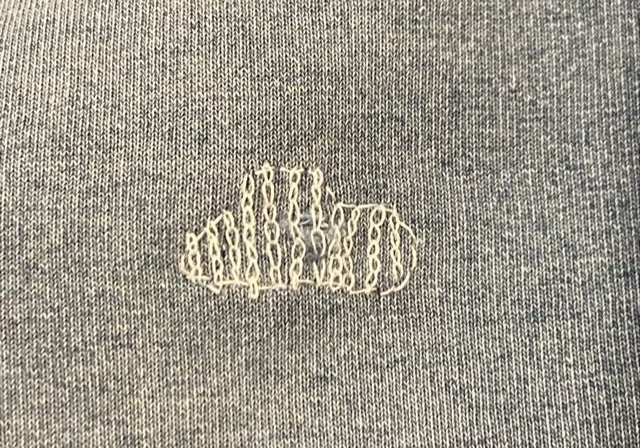
My youngest’s favorite stretchy jeans developed a couple holes that needed mending. I asked her if she wanted a colorful woven patch, or flowers. She said striped clouds. Um. Ok. Hm. That isn’t in my bank of mending pins on Pinterest, but I’ll give it a go.

Photo description: pin sized hole in knit jeggings, backed by a jar of cream I used as a darning tool

I tried outlining a cloud, then filling it with stripes of chain stitch. The outlining was meh, but the chain stitch was surprisingly well suited to the stretchy material, and it grabbed the edges of the hole and pulled it closed.

Photo description: white thread used to make a striped cloud with outlining

For the second hole, I didn’t bother with the outline.

Photo description: cloud stitched with white thread using a chain stitch
Photo description: picture showing both visible mends on the leg of the pants

The stitches do look better from a distance, more cloud like. I would use a chain stitch again for visible mending on stretchy material. Spirals might be nice.

Tatting swatch

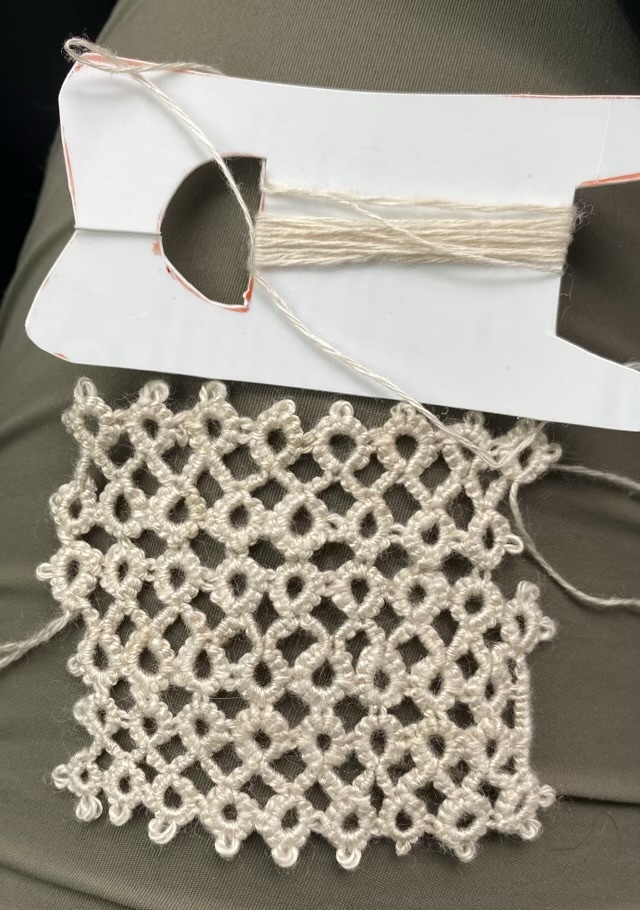
I decided to make a tatted swatch with my hand spun mint infused yarn. This is definitely the longest time I’ve ever spent on a swatch, all those little knots. I can attribute some of the unevenness of the knotting to variations in spin thickness, but my plan of attack also needs some adjustments. I tried making the first turn from row 1 to row 2, which turned out wonky. For row 3, I ended row 2, and started row 3 separately then joined it to row 2, which worked better, but still isn’t balanced.

Photo description: tatted square with uneven sides

I understand now why tatted doilies are worked in closed rounds (I don’t like cutting my ends, so have been resistant), and why running lace is popular. My next tatting example for my swatch book will be a length of lace rather than trying another square.

Diverter fail

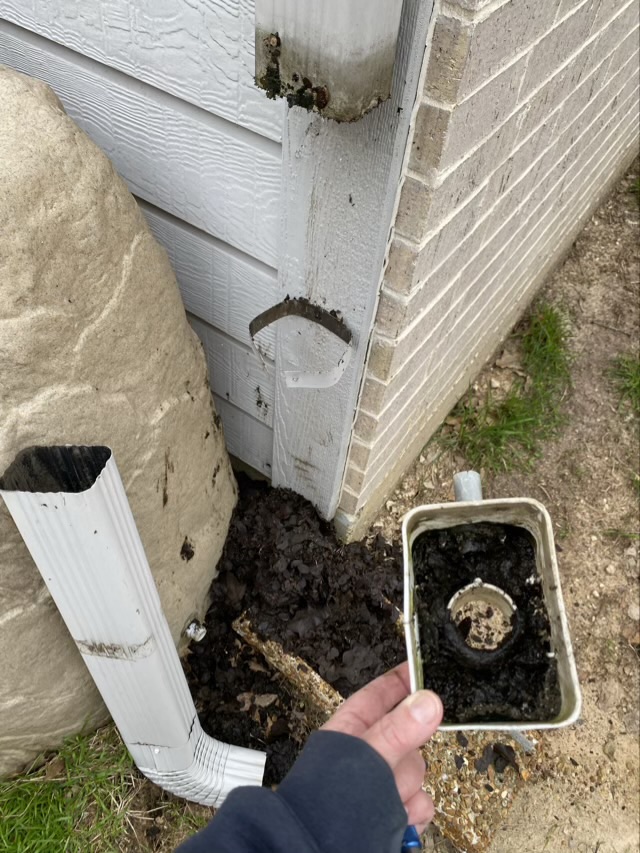
I’ve known for a while that the downspout diverter for my rain barrel wasn’t working. My rain barrel wasn’t filling, and even when it did the algae growth was so vigorous that the barrel wouldn’t drain. The design of the “barrel” mimics a giant rock, but there is no way to get in and give it a good clean, so the system sat until I could formulate a plan. Then I noticed that the soil was washing away from around the barrel. Hm. When it rained, no water was going down the spout. I took out the diverter and found an entire tube full of dirt made from decayed leaves and roof tile grit.

Photo description: failed plastic diverter (bottom right, rock rain barrel (left side), unassembled downspout (middle), and about 10 gallons of dark dirt (bottom middle)

I reassembled the downspout without the diverter and spread the new dirt where the rain had washed away the soil. I found it interesting that there was enough to fill the space.

I’m still working on a plan for the rain barrel.

Throwback Thursday: ancient fibulae

Here is an example of a picture without a thousand words from January 2013. As I was going through my album looking for Throwback posts, this almost didn’t make the cut because I didn’t leave myself enough information.

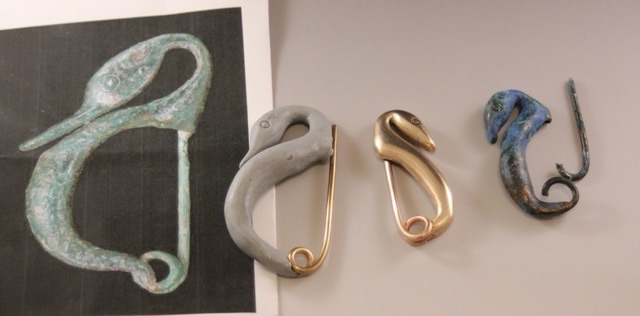
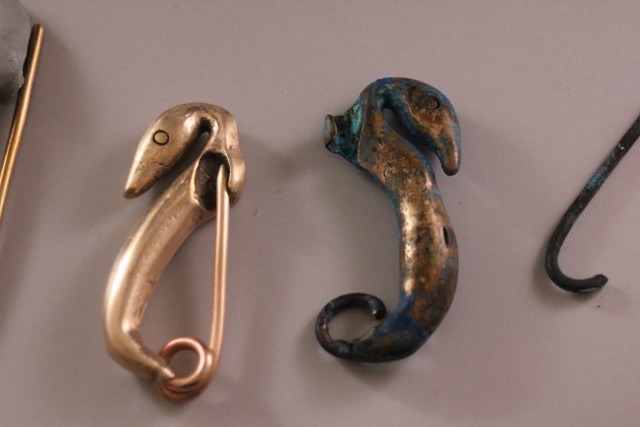
Photo description: printed image of an ancient bronze fibulae, clay model with wire spring, polished bronze clay fibulae (new), mystery fibulae (made by me)

At the time of the photo I was still experimenting with metal clay. My sister is an ancient historian and I suspected this was a project for her, so I pinged her for confirmation. She provided the name “fibulae” and an interesting article about their findings and use.

I can tell from my photo that I had a museum photo as reference, and I made a model with less expensive polymer clay, that looks more swan-like than my reference photo. The middle polished bronze clay fibulae I obviously spent more time on, but I’m not sure if I fired the clay with the wire in place or epoxied it in later (I’m already not using ancient foraging techniques, since I’m working with modern metal clay.) The last fibulae on the right is what raises the most questions. Did I not polish it? It is the same shape and style as the bright bronze, so I’m sure it is my work (my replication skills are not finely honed, especially then.) Did I try to antique it by adding patina, or is this how it came out of the kiln? Did I make this before or after the bright bronze fibulae? I have a feeling that I fired it with the wire in place and either the firing or the antiquing weakened the metal, causing the breakage. Did I do it on purpose? So many questions.

Here is a picture of the back, which answers the question of how the pin fastens.

Photo description: back of modern-made bronze-clay fibulae showing the pin pocket