Joy! I found another ironclad beetle! Alive! It was near the house, which is not a healthy place for insects, so I picked it up and relocated it out to some rotting wood at the edge of the meadow. It actually walked across my hand to move onto the wood, which was a cool experience. These guys are adept at playing dead, and to see it moving was very exciting. (Obviously.) This is the fifth beetle I’ve seen in the three years we’ve lived here.
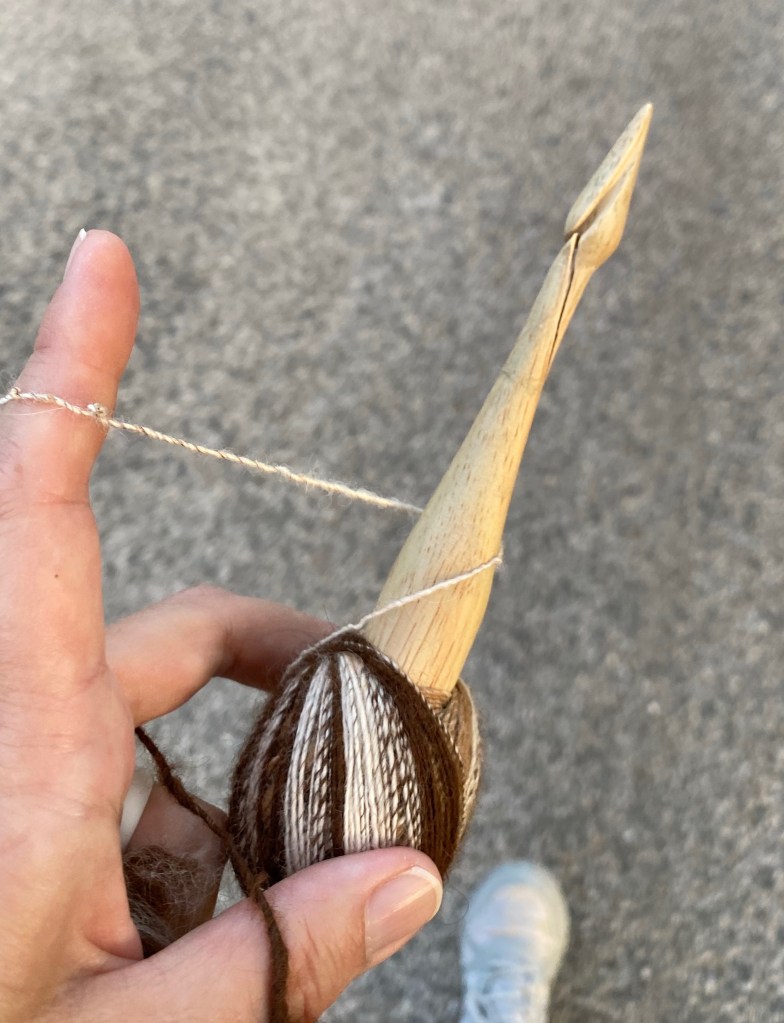
Ah, beware a change in properties. I have been spinning wool blended with silk, and just switched to alpaca with a bit of silk, which spins up slightly differently. I admit I was a bit cavalier and full of confidence, and was not as careful as I should have been at the start of a project. As a result, the spindle flew from my fingers and rather than bumping the base, the top tapped the asphalt. Crack. The wood split at the neck. Devastation.
Cracked spindle
The head of the spindle was still hanging on, so I took my yarn and wrapped it a few more times around the neck than I usually do. This allowed me to spin for the rest of my walk.
Makeshift “repair” to hold the crack together for the short-term
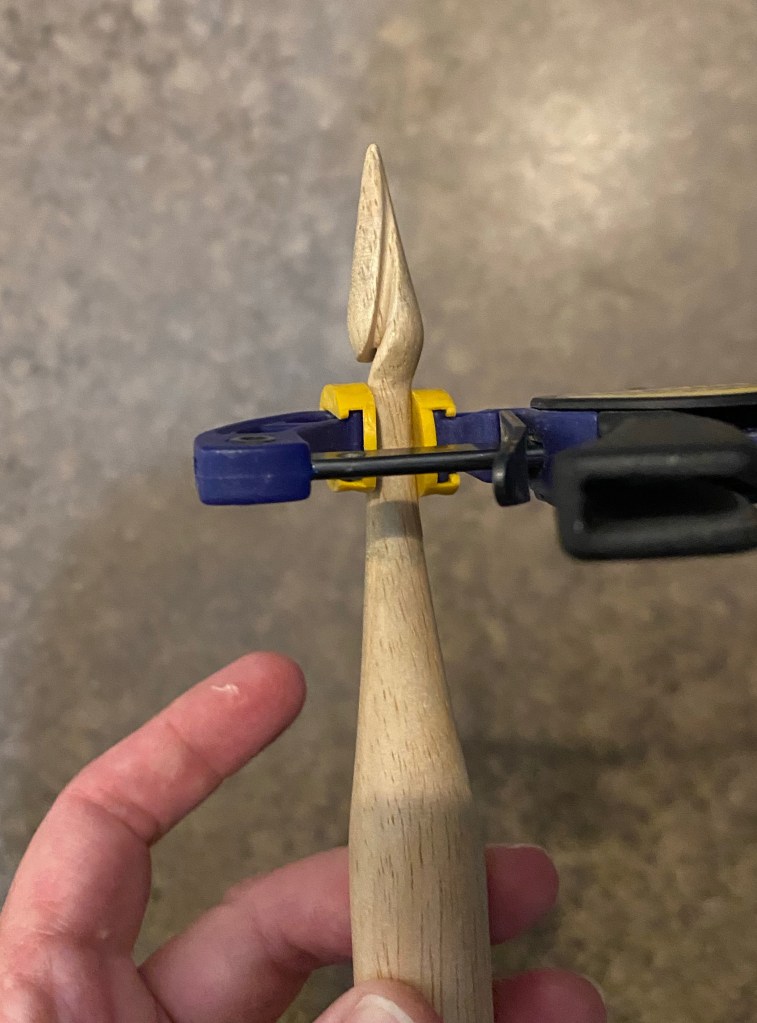
When I returned home, I put some wood glue in the crack and clamped it shut then wiped off the excess glue. When it was dry, I used 400 grit sand paper to smooth the area.
Clamped spindle
I love this spindle, even with the repairs and test holes. Apparently I need to make myself a backup!
On my walk I heard a crashing and thrashing in the woods, as if a massive beast was tearing through the undergrowth. Nope. Just an armadillo. They are definitely not quiet beasties, but I guess when you come fully armored, stealth is not an option. I paralleled him on his (her?) morning snack snuffle, then continued on my way.
I have three natural colors of alpaca fiber, all washed and ready for prep. How can I combine these colors? What are the effects of different preparation methods? I rather like marled (streaked) yarn, will these three colors combine well for that effect? Time for new experiments!
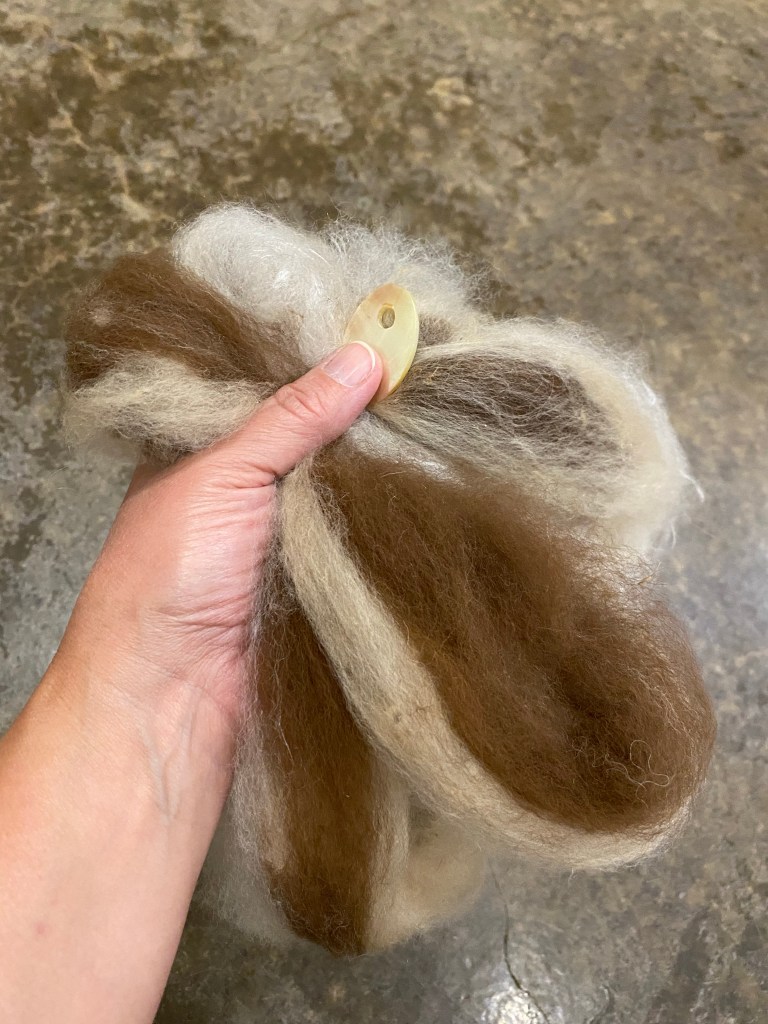
I carded one small batt of each color. Rather than rolling the fibers into rolags (which is the method recommended in the instructions, and rolls the fibers perpendicular to the fiber direction), I stacked the three batts together, then rolled them parallel to the fiber direction, then pre-drafted the roll. This distributed the colors randomly, which is what I was after. I did try using a shell with holes as a diz (which is used to pull fibers off combs to make roving), but found that pre-drafting with my hands worked just fine.
Roving made with three colors of alpaca fiber
I spun up two of these preparations as a clockwise single, then plied counterclockwise, then plied clockwise again to make a four-strand cable-plied yarn. All if this was done on my homemade spindle while I was walking the neighborhood (NOT, I repeat, not, in the same day! It took three walks.)
Cable-plied marled alpaca (with a bit of silk) yarn
The yarn has an interesting look. The next step is to see what it looks like in samples, probably with nålbinding. Ok, maybe I’m a little optimistic, the real next step will most likely be to see if I can replicate this process, then compare it to at least two other processes (because that is what is in my head at the moment), then make everything up into… something.
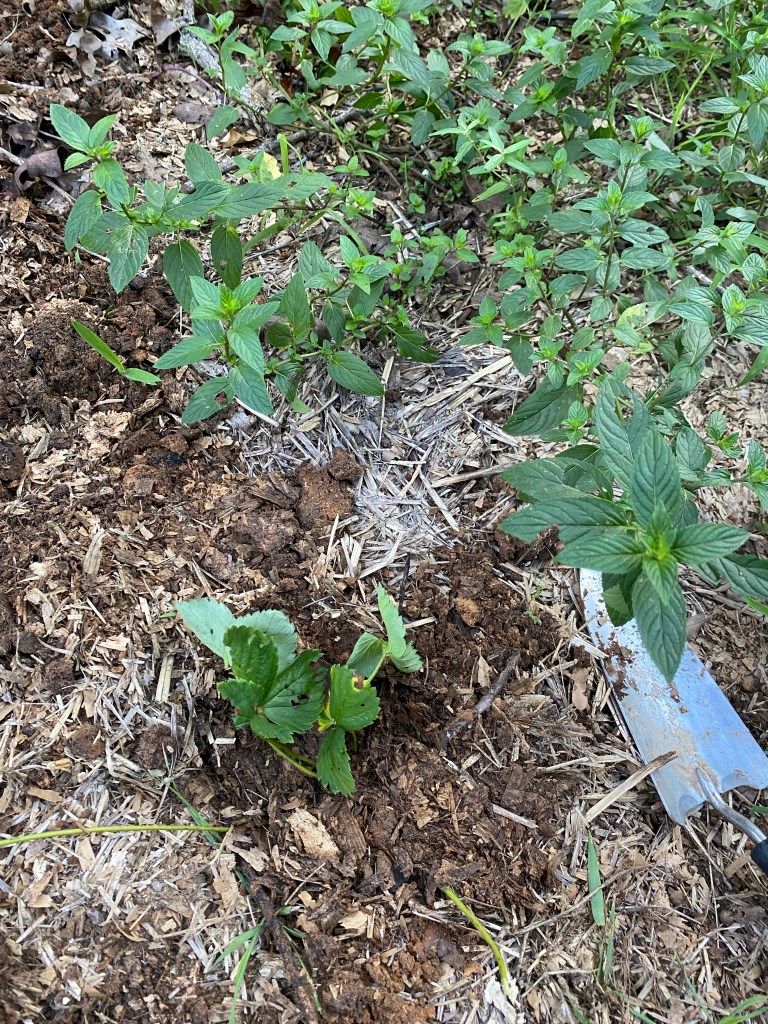
Mint and strawberries are prolific spreaders. I need some ground cover for erosion control on a slope in our yard so have been encouraging the chocolate mint plants to go wild. I recently was given strawberry plants from my uncle who has an amazing strawberry patch. I planted my bare-root plants in a circle around the mint, where it is sunny and they will get watered well. Mint is rumored to repel slugs, which would be good for strawberry production. The hope is that they both continue to propagate and fill in. It will be interesting to see, though, if I end up with a battle of the rhizomes.