I may need to give an official apology to the neighborhood cats and racoons. I maligned them, accusing one or the other of bringing down an unripe aspire melon awhile back. My eldest caught our dog Griffin in the act of eating an almost ripe melon that he had torn from the netting on the fence this week. Are you kidding me, dog?!?
The evidence and the guilty party
We gave it a good wash, cut off the parts that had teeth marks, and ate it anyway. Not quite fully ripe, but still very good.
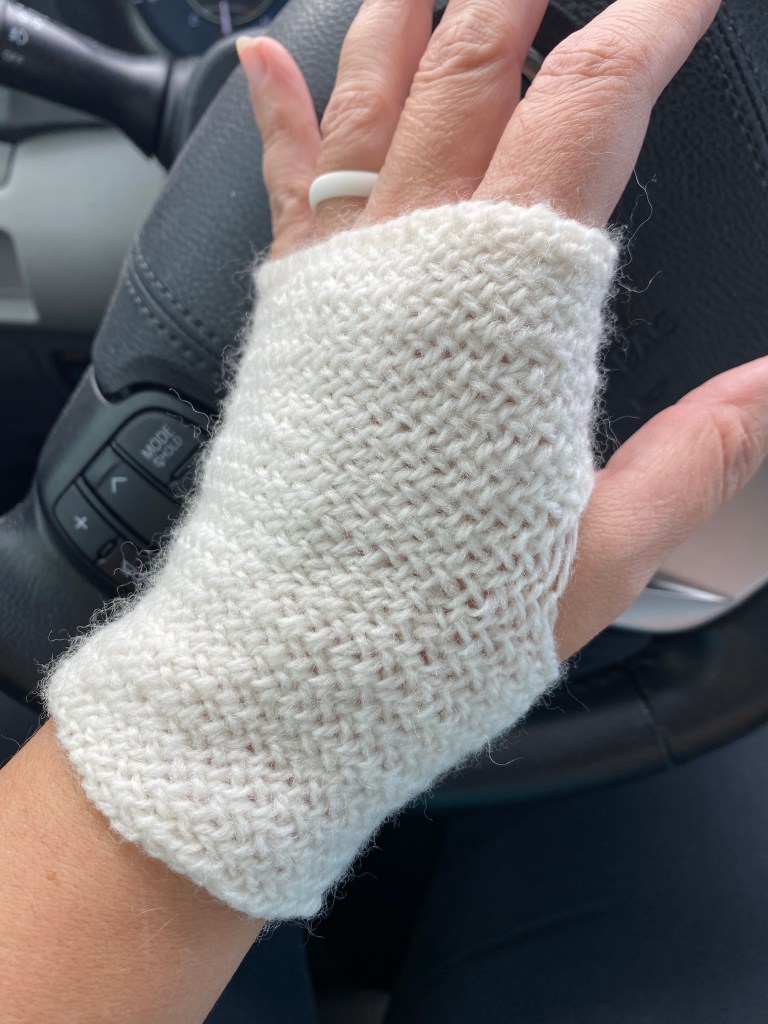
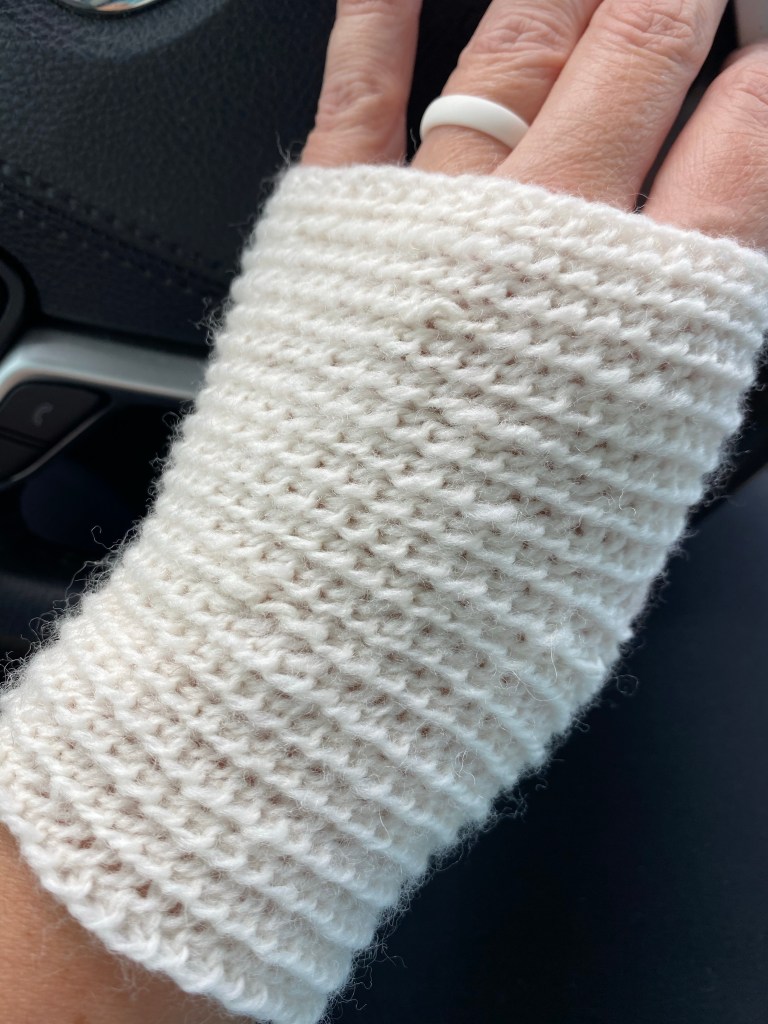
Ok, maybe a wrist warmer, not a full glove, but the reason I only have one is that this is a prototype for what I wish to make with my spun buffalo down. The super wash merino sock yarn I used for this wrist warmer is considerably less expensive, but has a similar weight to the buffalo yarn, which I spun with a tahkli spindle. I wanted to learn the Dalarna nålbinding stitch because I like the way one side looks woven, and I wanted to see if a sideways slit would work for the thumb hole. Testing the concept with white yarn (the buffalo is dark brown) allows me to see the stitches better as well, so I can get the feel of the stitch under my fingers with less struggling to see loops. I’m happy with how this came out, so now it is time to get out the buffalo yarn!
Wrist warmer prototype made with merino wool sock yarn (right side out)Wrist warmer shown inside out
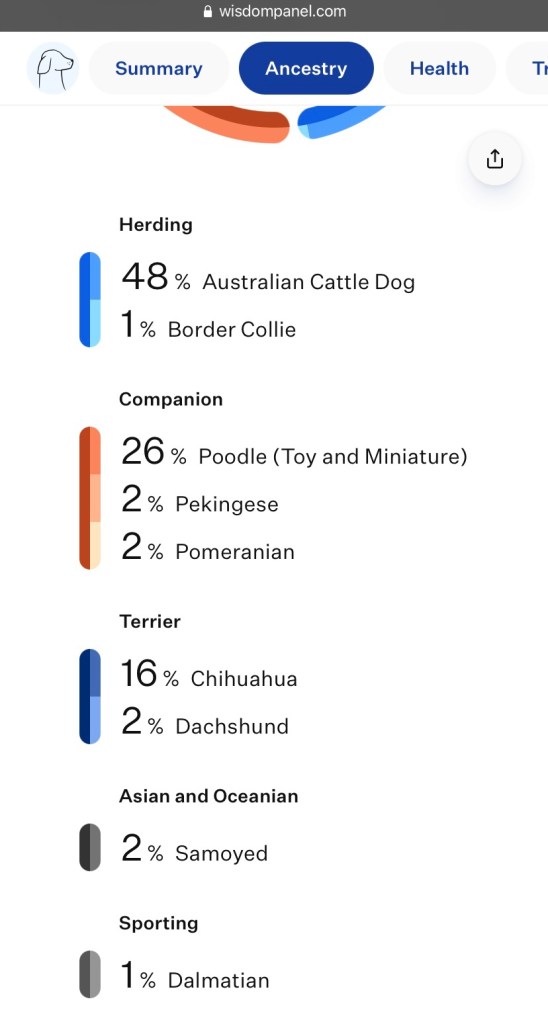
We had Missy the dog’s DNA tested shortly after getting her over a year ago. That test result said cattle dog, miniature poodle, bichon frise, and mutt. Widom Panel updated her results recently and the profile changed. I imagine that as they grow their sample set and the computer algorithms get better, things are going to shift, but I was surprised at the 16% Chihuahua. Hm. Let me adjust that, I was happily surprised there wasn’t significant Chihuahua DNA in the first result, because the rescue said she was a Chihuahua mix. The rescue was right. Looks like dad was cattle dog and mom was a poodle chihuahua mix.
Full body picture of Missy, whose attention is glued on a ball
She is a neurotic little thing. Happy and cuddly in the house, just still afraid of everything outside the house. The backyard is a gray zone because chasing balls is fun, but the creatures outside the fence can be scary. She has given herself a job, which is good for the cattle dog half. She is officially the disrupter of cat fights. If she hears a hiss, or sees a stalk, she is over in a flash, putting herself between the two cats. Probably because she thinks they are playing and wants desperately to play too. Whichever the reason it is a positive contribution to the household.
Griffin, our older dog, doesn’t get an updated result; his DNA test is too old. I think his would still show mostly lab and schnauzer. The shifts would be in the single digit percents.
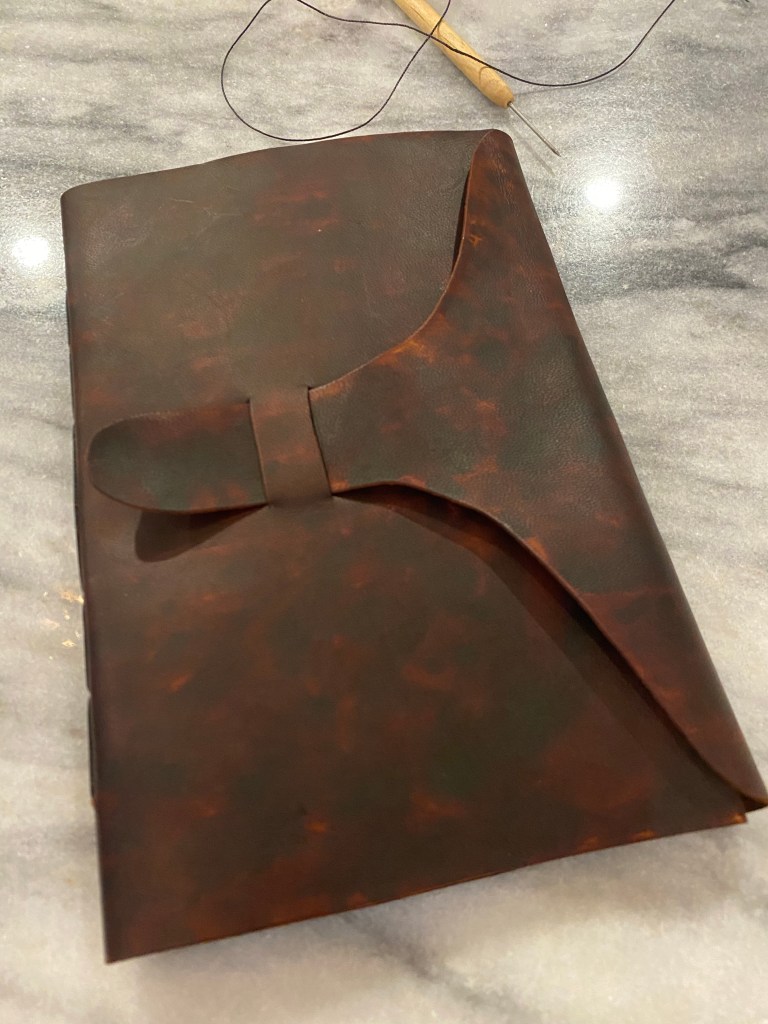
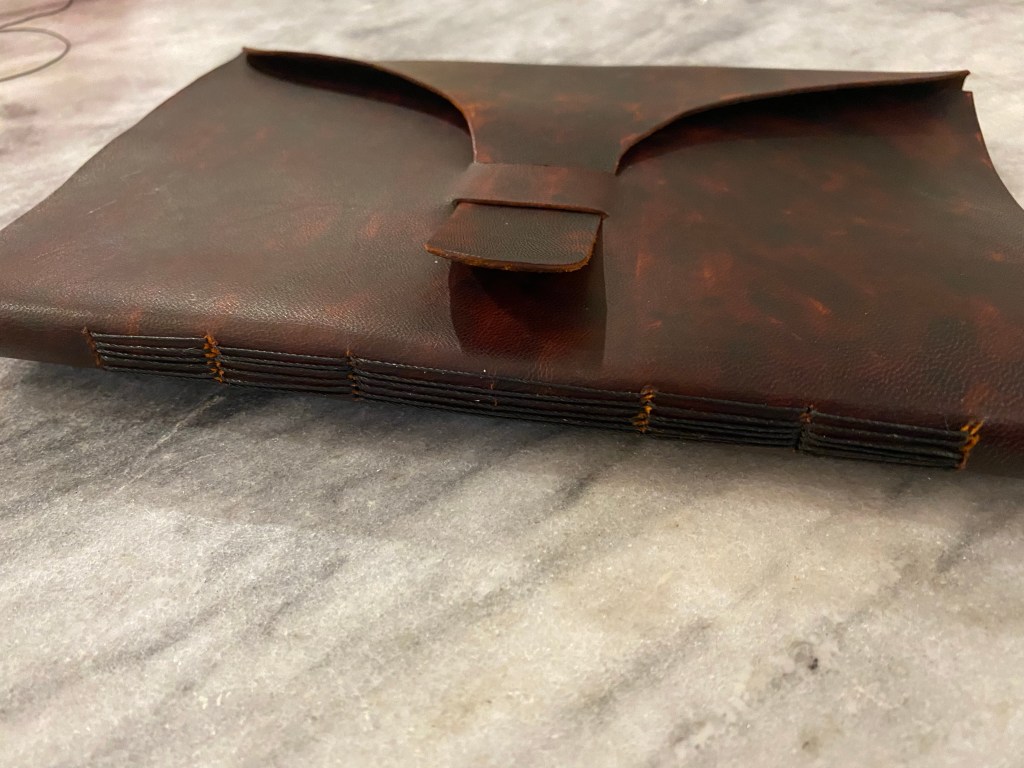
For a prop for a play set in the 1920s, I made a simple leather journal from 11×17 paper, goat leather, and waxed linen cord. I made a paper template to test the wrap and strap, then cut the leather and dyed it in a mottled pattern using a wool dauber. I finished the leather with a spray designed for leather and suede that should resist water and drying out and cracking.
Handmade leather journal
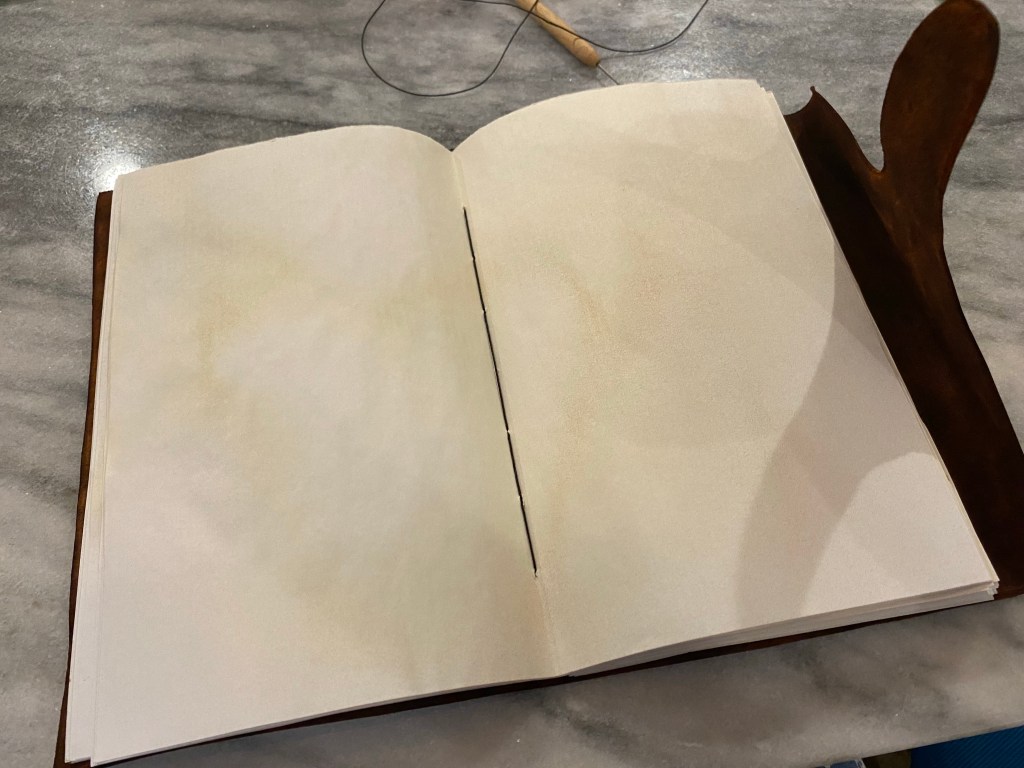
I use 11×17” paper because the grain of the paper goes the right way when it is cut in half (8 1/2 x 11”) and folded. (Try this yourself: gently bend a piece of paper length wise and then width wise. One direction will bend more than the other; this direction lies along the grain of the paper and the paper will fold or tear more easily along the grain.) Each signature (group of papers to be sewn) in the book is made from four sheets folded in half together. I marked the outside of the six signatures with pencil and marked the matching spots on the leather. I then used an awl to poke holes at the marks.
Here is where I erred. I was hoping to sew the signatures to the leather without long lines of thread on the outside of the cover, but the goat leather was too thin to support the stitch I wished to do, so I had to change my attack. I made an odd number of holes, but for the new method, I needed an even number. Lesson learned: when trying a new technique, have an escape plan. I ended up skipping the middle hole, which is not ideal, but still made a secure attachment.
Edge of leather journal showing stitches
For each signature, I sewed up and back following the holes, which made nice parallel lines on the outside. To finish, I tied the beginning thread and end thread together before snipping the ends.
Journal opened to the center of one signature to show the stitches
I have taken book binding classes and can do a hard bound book, but this was quicker and we had all the materials on hand. Plus, it looks really cool.
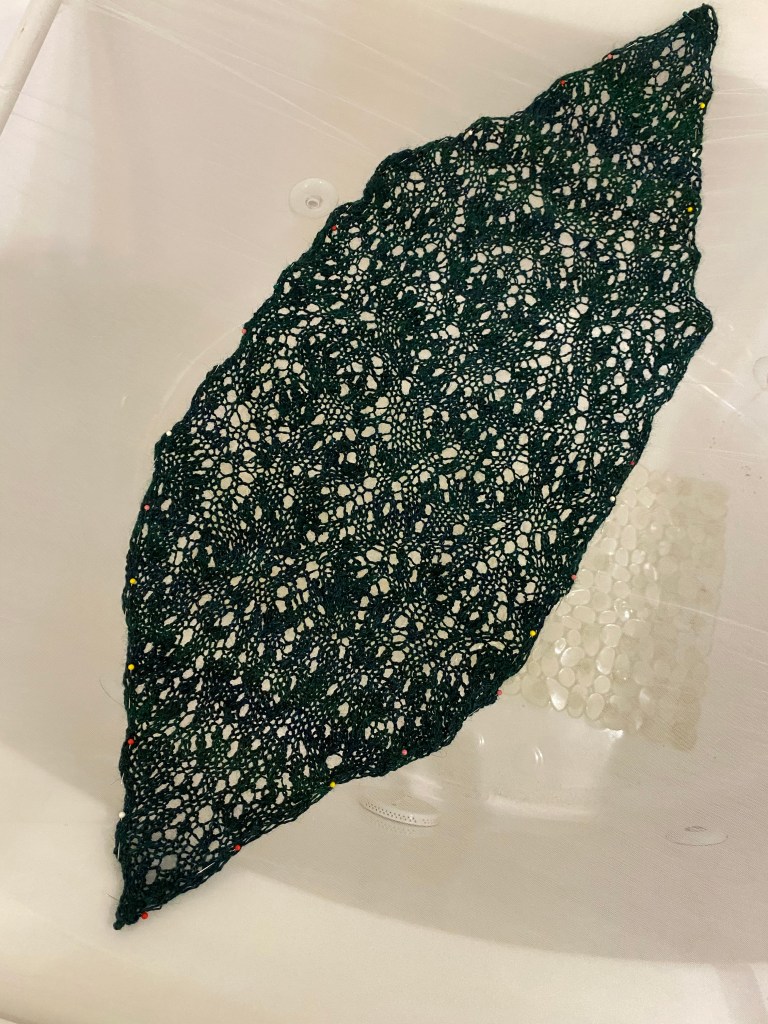
The Frabjous Fibers hand-dyed Blue Faced Leichester (BFL) and silk yarn I spun up in June has finally been applied to a project! I decided to do a random knit lace scarf, but with pointed ends rather than square.
“Balsam” colored BFL/silk random knit scarf
The random knit used a combination of increases (yarn over) and decreases (knit or purl two together) spaced with one to five knits or purls (depending on which side was toward me). The goal is to keep the same number of increases as decreases across the row. To do the shaping I added a stitch on each side of the knit rows only, then to narrow the end, I decreased on each side of the purl rows only. To keep the edges neat, I slipped the first stitch of each row.
I tried writing this all up in a standard knit pattern, but it then looks so much more complicated than it actually is. I will say that when knitting the technique using a block able yarn (such as wool or cotton) is key. It doesn’t look like much until I get it wet and pin it out flat on my netting and PVC drying rack.