If you don’t have a swift or a nostepinne (or don’t want to go upstairs then get them), the back of a chair and a roll of paper work fine to take yarn from skein to ball form.
Photo description: skein of hand spun cotton hung on the back of a wood chair, and center pull ball of yarn started on a roll of card stock, black dog looking on in the background
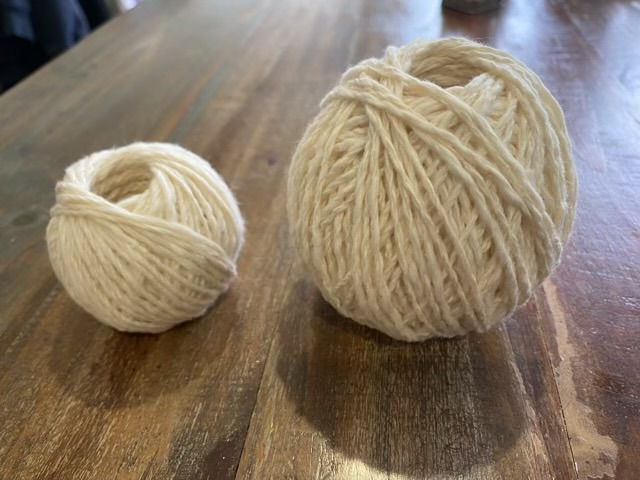
I rolled up two skeins of hand spun cotton this way. This is the cotton that I spun from raw bolls then three plied two ways: crepe and chain ply.
Photo description: two nostepinne style balls of cotton yarn, chain ply on the left, crepe on the right
I’m most interested in how these two preparations knit up. Yes, I’m looking forward to swatching. I’m weird like that.
We do get some cold in Texas. I went to clean the chicken water and found large ice crystals growing inside.
Photo description: edge of an empty chicken water container with large ice crystals on the side
I have had the large container freeze solid, but haven’t seen these slow growth crystals before, which was neat. I also have a heated water bowl, so the chickens always have thawed water, even when everything else is frozen.
Back in December of 2012 I was into cutting up wine bottles and heating them up to melting in my kiln. I made an ornament from the base of a green bottle, cut a groove in the side with my wet grinder, and wire wrapped it. Using an engraving tool I wrote the first verse from A Visit from St Nicholas by Clement-Clark Moore in a spiral out in tiny lettering.
Photo description: green glass ornament with spiral writing and organza ribbon
As I scroll my photo history, I don’t take every craft project for a throwback post. When I look at a photo, if there aren’t enough words in my head, it doesn’t get picked. There are some projects where I don’t remember what materials I used, or don’t have any in process photos to remind me how I constructed it. So I keep scrolling. Since I’m still picking projects from 13 years ago, I figure I have some leeway.
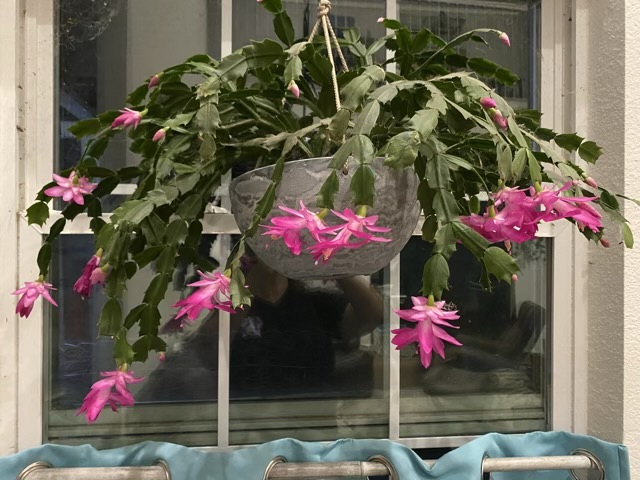
This is an update for my long time readers on my Thanksgiving cactus, which in my house blooms from December to March, approximately. It is growing! Since it is up against a north facing window, the growth is to the sides, but the stems touching the window get cold enough to trigger flower buds, then I turn it around so we can see the blooms. By the time it one side is done blooming, the other has new buds so I turn it back around.
Photo description: “Thanksgiving” cactus blooming in February because of window conditions
I water it once a week for a count of three, and occasionally remember to fertilize. No banana for scale, but the window is 35” inches wide.
Ok, I’ve reached perfection in the Stardew Valley game, again. I think now I can dial it back to occasional play rather than the obsessed dives I have been doing. I should return to more of my regular programming soon.
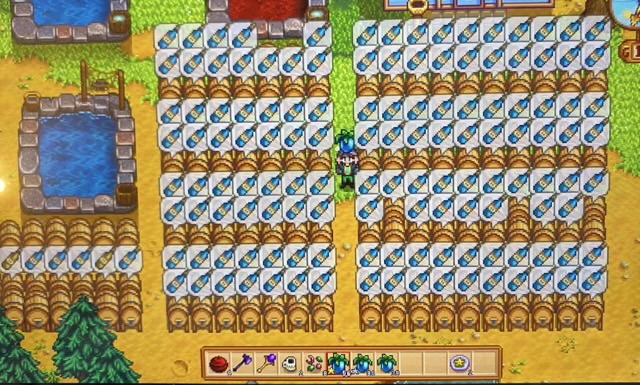
Photo description: Stardew Valley screen shot filled with kegs producing ancient fruit wine
The hardest part for me was building the money to get the golden clock. I spent frivolously (looking at you, statue of endless fortune), and somehow turned off Junimo collection at one point, so was wasting time harvesting. (If this happens to you, and your Junimos are wandering your field but not actually picking produce, go to their hut and look in, there is a button on the top right that turns collection on and off, credit to my eldest for the assist.) I did have several massive banks of kegs producing wine, and two large fields producing ancient fruit (the beach hut and house fill up with kegs nicely.) Still, I made it in year 5, which is definitely not a speed record, but faster than I did last round. I did not go for completion, I’m missing the polyculture achievement because I should have planned on growing 15 sweet gem berries from the get go. Oh, and I really suck at the in-game video games.
Sorry to those that this post is complete gibberish. I’ll get back to my regular esoteric vocabulary soon.
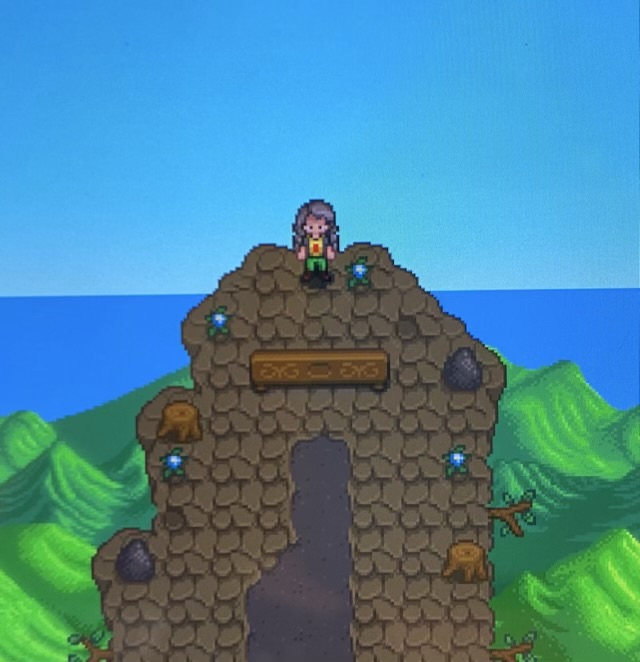
Photo description: my character standing on the summit in Stardew Valley after reaching completion, of course I caught the pic mid-blink