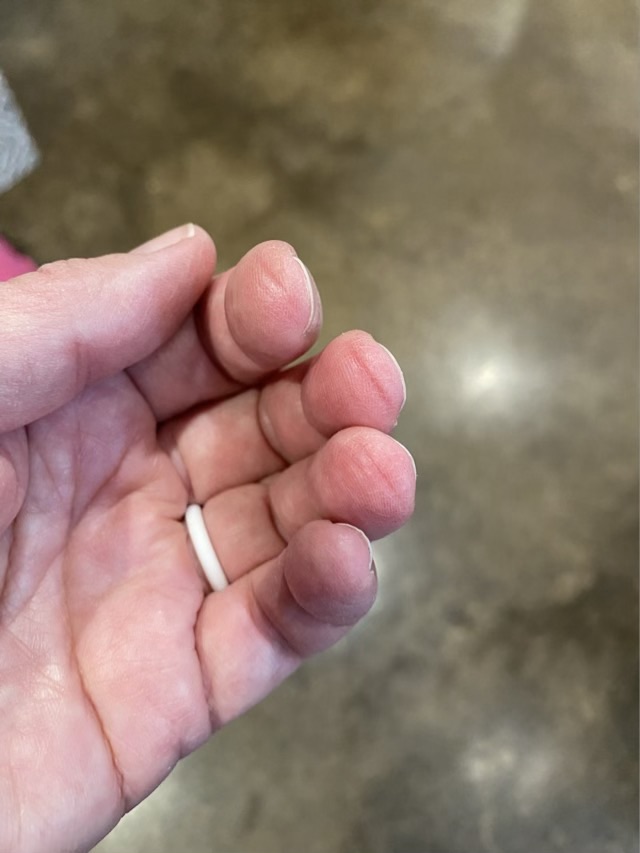
Photo description: the finger tips of my left hand with deep linear indentations
If you’ve read my blog for even a short while, it is clear that I am a dabbler. Many things catch my inquisitive attention, I like a puzzle, and I’m easily distracted. Making music takes more concentration, but I still can’t focus on just one instrument. My latest enamor is the ukulele. My kids gave me a tenor uke for Mother’s Day a couple years back, and I recently changed out the strings to make it a low G ukulele. I love it! I would like to build a small repertoire, to expand past the dabbling a bit, and my fingertips are reflecting the work. I feel that this fits in this blog because music is craft, even though it is hard to capture in photos.
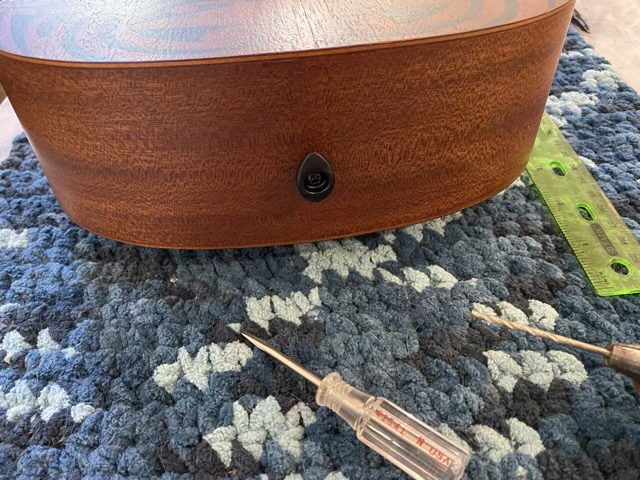
My ukulele did not come with strap buttons, so I found some elliptical ones from D’Addario and drilled pilot holes at the base (there is a block of wood inside to support the screw), and the back of the neck.
Photo description: Elliptical strap button installed on the bottom of a tenor ukulelePhoto description: Elliptical strap button installed on the base of the neck of a tenor ukulele
I trimmed the ends of my woven band (see yesterday’s post), and treated them with white glue to make them stable.
Photo description: Both ends of a tablet woven strap treated with white glue (shown on a post-it note) using a brush (shown).
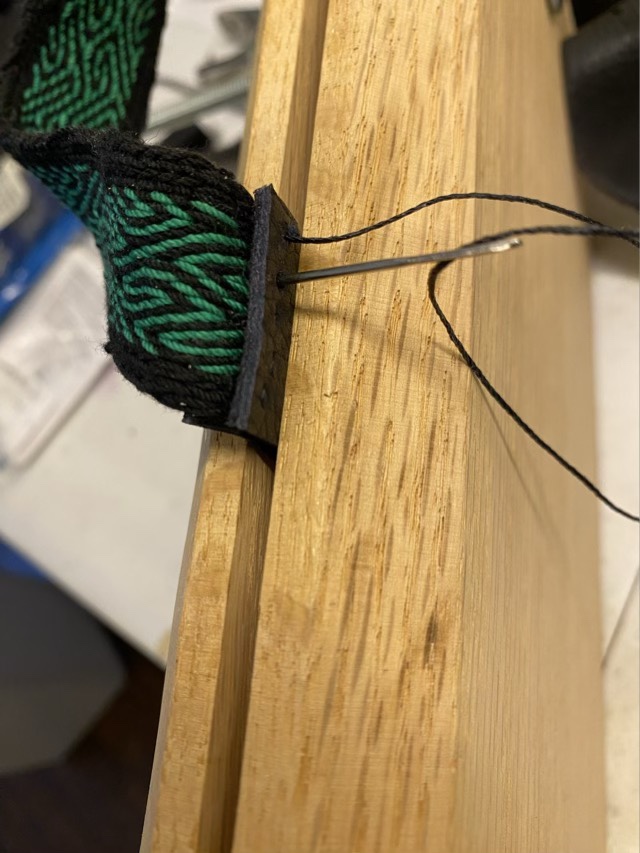
I found two metal slide buckles at the craft store and used one as intended, sewing on end of the strap to the middle bar and threading the other end over it. The other buckle I modified by taking out the middle bar and using as a ring in the fold of the strap. In my leather stash I had an old black belt. The leather was thick but flexible, and great for making the end of my straps. I folded, cut and carved tear drop shaped holes in the belt for the ends of the strap. One end I sewed on using waxed thread. The other I riveted together.
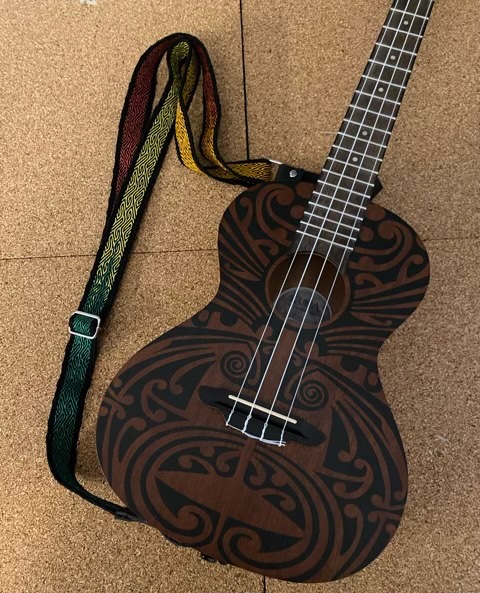
Photo description: Wood clamp holding the leather end and the woven end together so I could sew using the holes I punched into the leather.Photo description: Finished strap with leather ends and metal slidesPhoto description: Strap installed on the tenor ukulele.
I’m rather excited about having my ukulele on a strap since it makes it easier to hold at a good position for both my hands. I’m off to practice!
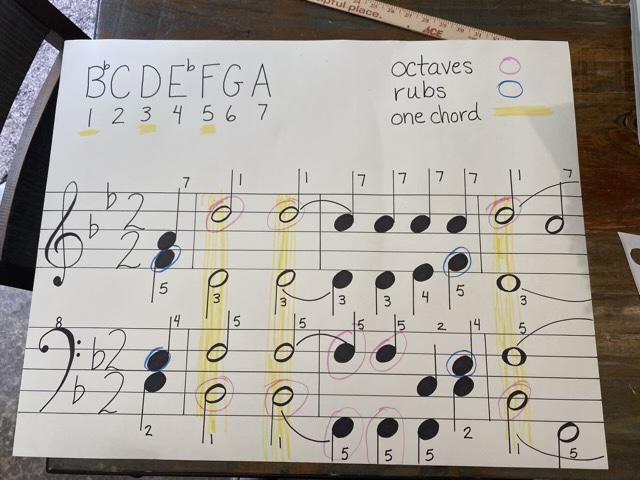
I geeked out at my chorus this week. We talked briefly about marking our music and some important things to notice when singing 4-part barbershop, and their homework was to go home and delve into their own sheet music (I did give them a cheat sheet). I made a poster. This was an old school poster layout, with a yard stick and rulers, done in pencil, then in ink. It gives examples of the tonic chord (or one (I) chord), rubs (notes next to each other), and octaves. My youngest wanted to help, so she marked the colored sections (bonus, she starts seeing the relationships too). Learning to recognize and hear these aspects helps us along toward making better music.
Photo description: hand drawn barbershop music score, first four measures of “How We Sang Today” with numbered scale, legend, and marked and labeled notes.
I admit I don’t use the colors, but I do use the numbers, and I’ve been naming as many chords as I can, not just the tonic. It is good practice.
Photo description: Gray tabby cat lays on a sheet of music on my lap. Music is partially annotated.
It is hard to write on your music as you are listening to learning tracks when the kitten jumps up and lays on the paper. He wasn’t there to cuddle, he heard the crinkling of paper, which is his second favorite sound after the opening of a can. He was ejected for foul play. I just need to remember that the claw hole is not a breath mark.
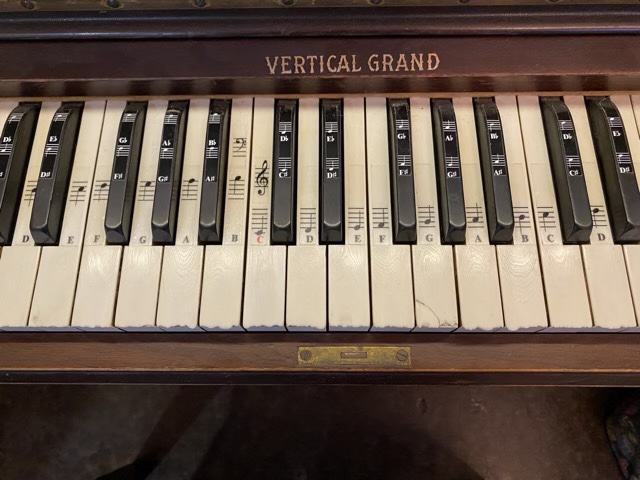
So I recently needed to reference a piano keyboard, and was too lazy to go to the piano, so did an image search. In the provided images was a tutorial on how to draw a piano, which showed that the black keys were not centered between the white keys. What? I took piano lessons starting in second grade, have had pianos around me most of my life (I can pick out a scale, but don’t have a ready repertoire), but when I draw a piano keyboard, I center the black keys between the white keys. Well, until now. I took a picture of my piano, just to verify the internet info. Yup. The space between the white keys does not hit the center of the black key. Except maybe on the G flat, at least on my piano. Now I’m going to be looking more closely at all the pianos I encounter. What a fascinating bit of trivia and insight on the workings of the human brain.
Photo description: Antique piano keys from D3 to D5, with chips in the ivory and note labels on the keys, and “VERTICAL GRAND” in gold.





 Critters and Craft