To keep my emergency meds on hand and organized, I bought a pill case, sanded off the day-of-the-week letters with an emery board, and wrote on the medicine names.
Photo description: weekly pill organizer converted to a mini medicine cabinet
This is not my idea, I saw it first from a friend who was very well organized. It certainly beats my previous method of a small plastic bag with random pills.
There are many times that I’m late to the proverbial party. I’ve been keeping my boxes of sealable plastic bags flat on a shelf in my pantry. I struggled with which size I was grabbing, and usually had to move the gallon bag box off to select something below it. I realized recently that the labeling on the boxes is designed to be seen at the top of the box. This works great if the boxes are in a drawer, or shockingly, standing on end on a shelf.
Photo description: snack square, snack, sandwich, quart, and gallon bag boxes arranged on a shelf with the openings easily accessible and the labels easy to read
The bags pull out easily from the box and it saves me a moment of frustration, which in some mornings is a rather large boon.
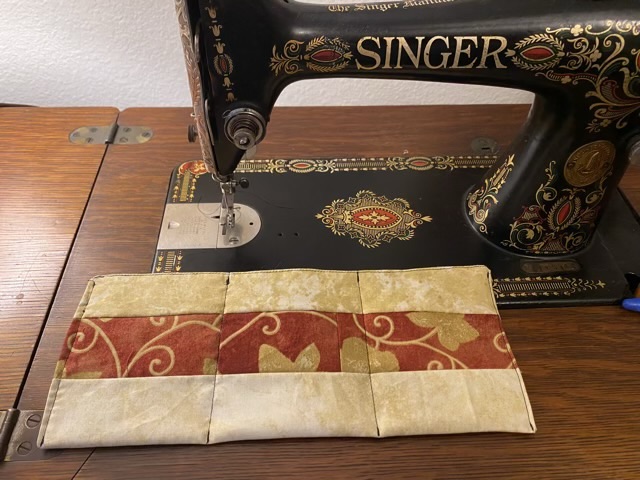
I recently learned another method for securing the start and end of a seam on a treadle sewing machine with no reverse. With this method, you make a few stitches, lift the foot, move the material to the beginning, and stitch over the first stitches.
Photo description: sewing machine foot moved back to the beginning of a seam after a few stitchesPhoto description: seam sewn on a Singer model 66 treadle machine using the lift and restitch method to secure the start of the seam
This trick joins my bag with two other methods. There is the turn-the-whole-fabric way, where you turn the fabric 180 degrees around the needle in the down position, put the foot down, sew a few stitches, then plant the needle, lift the foot and turn the fabric back to the original position, lower the foot and keep sewing. Also there is the tiny stitch method, where the stitch length is set to near zero to start and end a seam, but lengthened in the middle. All three methods work well to make it harder for the stitches to pull out.
On more modern machines there is a reverse button that allows the sewing machine to stitch backwards. Treadling an antique machine backwards will at best break the thread, or worse, make a tangled mess of your bobbin.
I repurposed the hanging chick feeder I made in 2019 to feed the wild birds. I do not plan on raising chicks again, and I do enjoy watching the birds come visit.
Photo description: Many things reused as bird and squirrel feeders: mason jar chicken feeder in a custom macrame hanger, old small tire tied up sideways to hold squirrel feed, parrot ladder leading to a mesh colander that now holds bird seed
I stole this idea from… somewhere? It seems everything has a similar scrolling format, so I’m not sure if I was in Pinterest or YouTube or what. Anyway, it is a great idea and works well to use Command strip hooks inside the cupboard to hang attachments for a stand mixer. They drive me crazy rattling around in the drawer and getting stuck.
Photo description: stand mixer paddle and whisk hanging from small white Command hooks (3 pound capacity) on the inside surface of an upper cupboard door