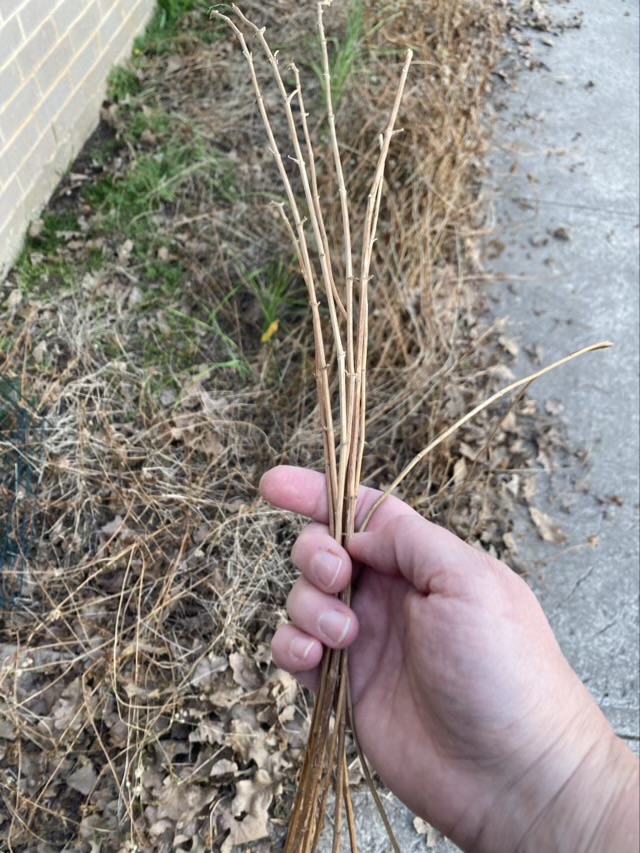
As I was wandering outside the dead stalks of last season’s Gregg’s Mistflower caught my eye. I love that the plant took over our front flower bed, and the local insects love the flowers that bloom from Spring to Fall. I started clearing the dried stems in preparation for Spring, and wondered if it would make good weaving material.
Photo description: dried Gregg’s Mistflower stems, stripped of leaves
I did an initial test by wrapping some stems in a wet towel. I left them overnight and in the morning tested pliability. They seemed flexible. The next step will be to harvest more and attempt some weaving.
It would be fantastic if my new favorite plant could also be a craft material.
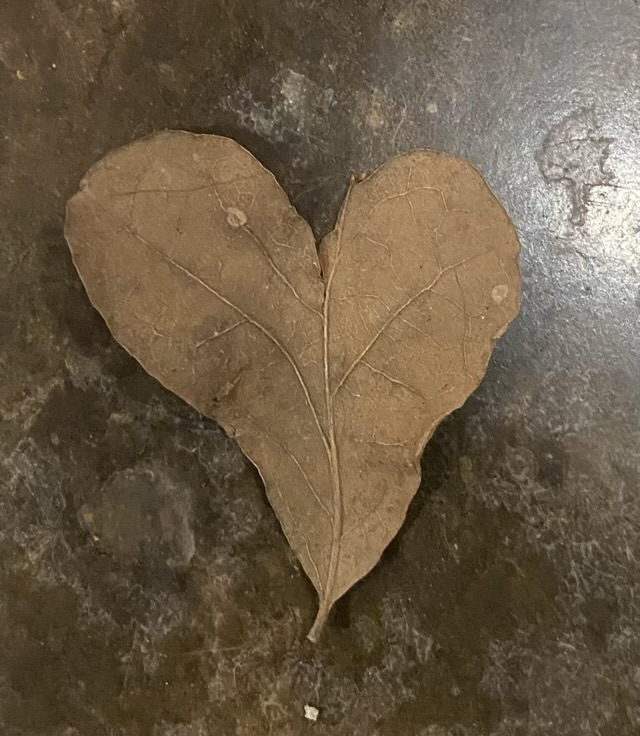
It is annoying when leaves catch a ride on a sock or shoe or paw coming into the house, but it is hard to stay irritated when the leaf is in the shape of a heart. Aw.
Photo description: Post Oak leaf in the shape of a heart, natural occurrence
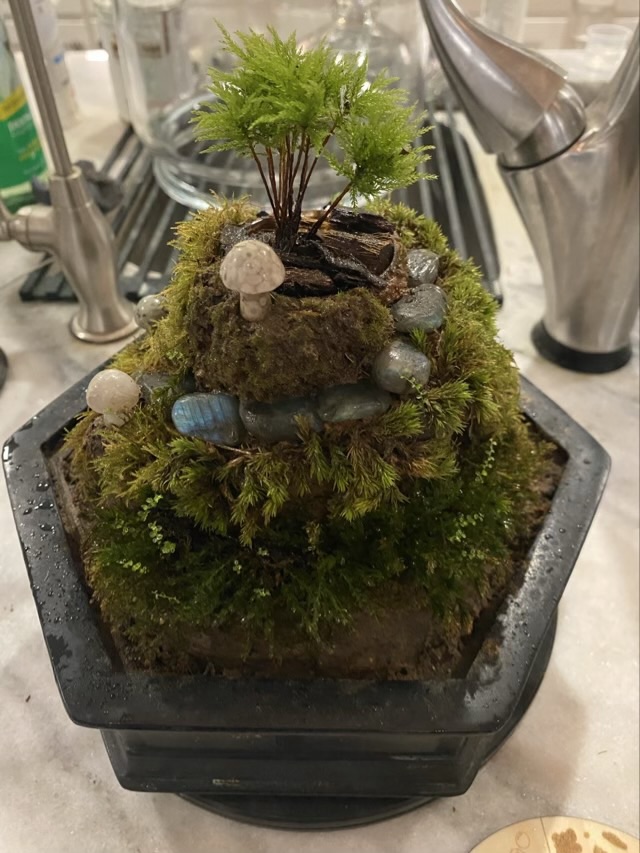
My little jewel orchid was not thriving in the terrarium; I don’t think it had enough light. The moss I purchased was thriving though, so I went looking for something relatively tall (1-2 inches) to crown my miniature hill. I found Climacium Tree Moss (Dendroides / Americanum). This moss grows a kind of trunk and looks like a miniature copse of trees. Adorable and perfect.
Photo description: mossarium without the glass cover showing the new tree moss on top and new growth on the moss near the base, stone “steps” of polished labradorite, and carved stone mushrooms
The jewel orchid lost its roots (probably too wet in the terrarium), so I put it in a jar with some living moss near a north facing window (no direct sunlight, but plenty of indirect). I’ll post an update on it as it recovers. I’ve read that an orchid can regrow roots from healthy stem and leaf, so I’m hoping.
I had been keeping the left over moss I purchased for my mossarium in the plastic container it shipped in, but I noticed some mold growing in there, so introduced the moss to an empty glass jar. I put some orchid substrate on the bottom, formed a loose ball with the moss, and tucked it i to the jar. Because it is a patterned jar, it doesn’t show the moss clearly, so looks… questionable.
Photo description: moss and substrate in an old glass jar with glass lid
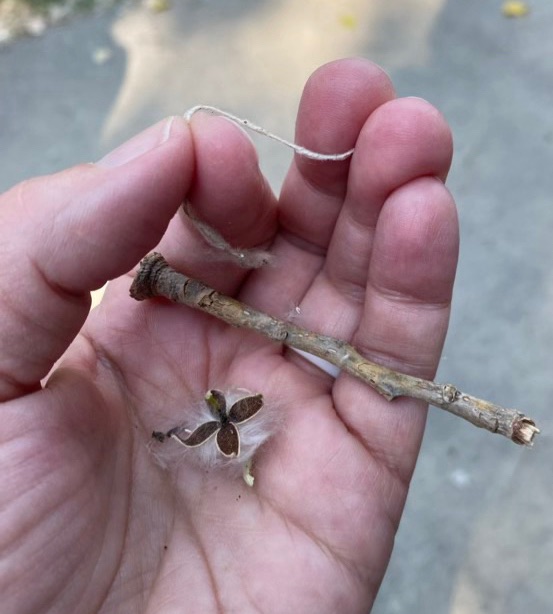
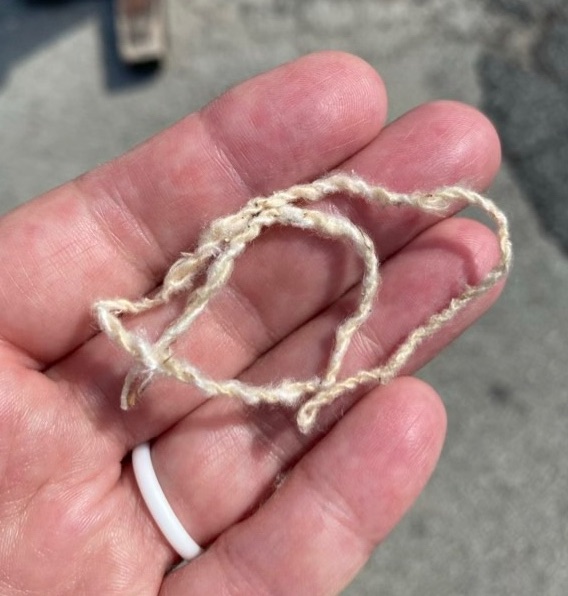
We visited a park recently covered in cottonwood seed fluff; of course I had to try to spin it.
Photo description: the start of twisting cottonwood seed into a singles yarn, with a stick to hold the yarn, and an open seed pod in my hand
There is good reason the cottonwood tree is named after the plant. The fluffy seeds look similar to the fibrous cotton seeds, but are much smaller. The fibers are short, less than an inch, which made spinning a high twist with a stick a challenge. It would have been better to use a tahkli spindle or chakra, which are designed for short fibers, but it was a walk through the park, so I used what was at hand. I also didn’t prep the material at all, but spun from clumps of seeds, taking out non-fibrous material as I went.
Photo description: small amount of single spun cottonwood yarn on a stick (different smoother stick)
It took me the better part of an hour walking the park to spin a small amount of yarn because I was not getting enough twist in and it kept drifting apart. When we were done at the park, I had my eldest help me fold the single in half, and I added some twist to ply it, just to see what it looked like. It was fluffy and soft with a pretty luster.
Photo description: several inches of two ply cotton wood yarn
Note, I am allergic to cottonwood, but is a nasal allergy, not a contact allergy, so I was quite sniffily by the end. I have spun it now, though, so can stop wondering if it is possible.