Turkish turtle

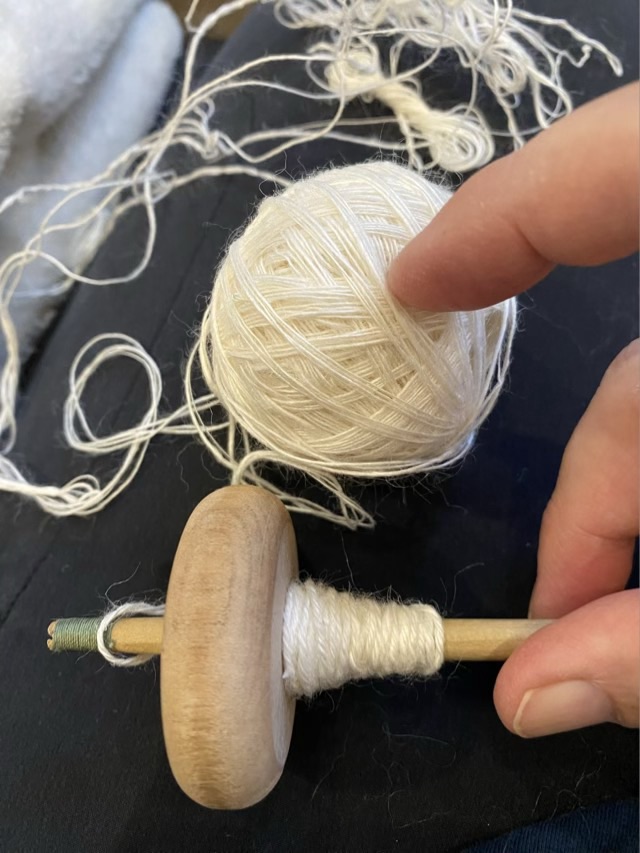
I finished spinning my pineapple fiber sample singles with a 3D printed Turkish spindle. I attempted to use the turtle of yarn to make a two ply yarn.

Photo description: Turkish style drop spindle with two ply yarn coming from both ends of a single ply turtle of yarn sitting on a table decorated with old newspapers and sitting next to a cup of chai at my favorite coffee place.

I had an unpleasant revelation. As the yarn comes off the top of the turtle a whole layer of wraps pops off, making a tangled mess. So I stopped trying to go directly from the yarn turtle, and instead made a nostepinne style winding ball with two strands.

Photo description: yarn turtle unraveled from the top showing how a layer lifts off. The yarn is being wound onto a card stock tube into a center pull ball.

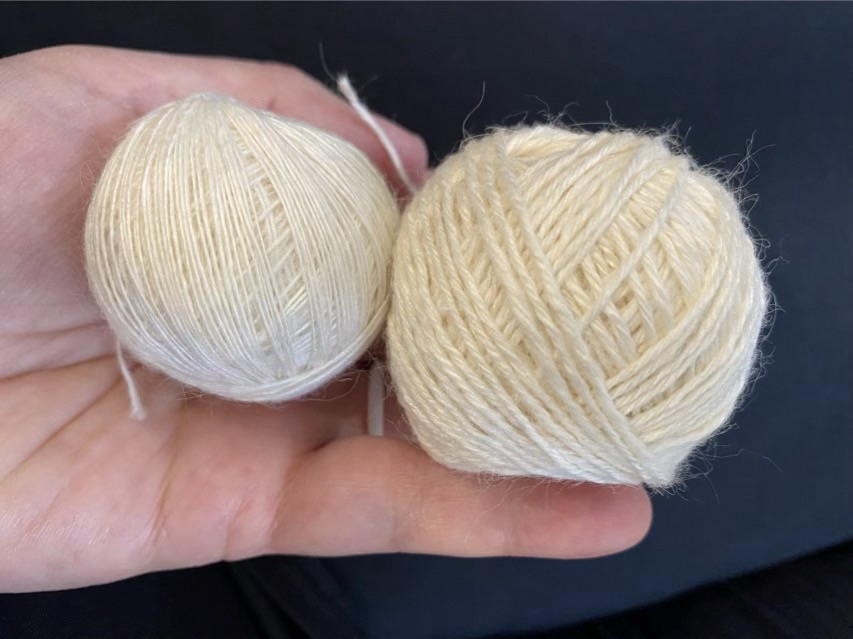
After my yarn was neatly arranged, I was able to ply it without dealing with heavy tangles. There are spinners who consistently make plying balls, and I can now see the appeal.

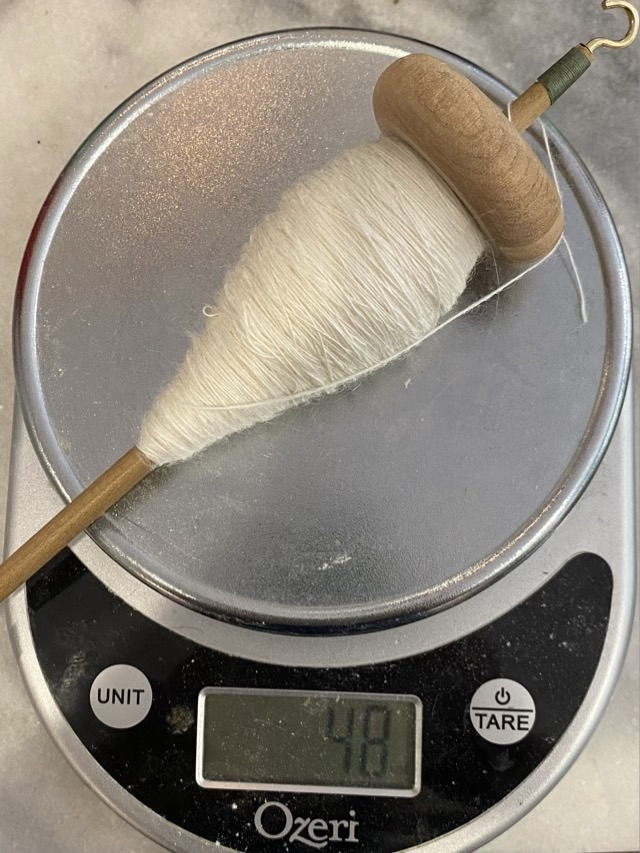
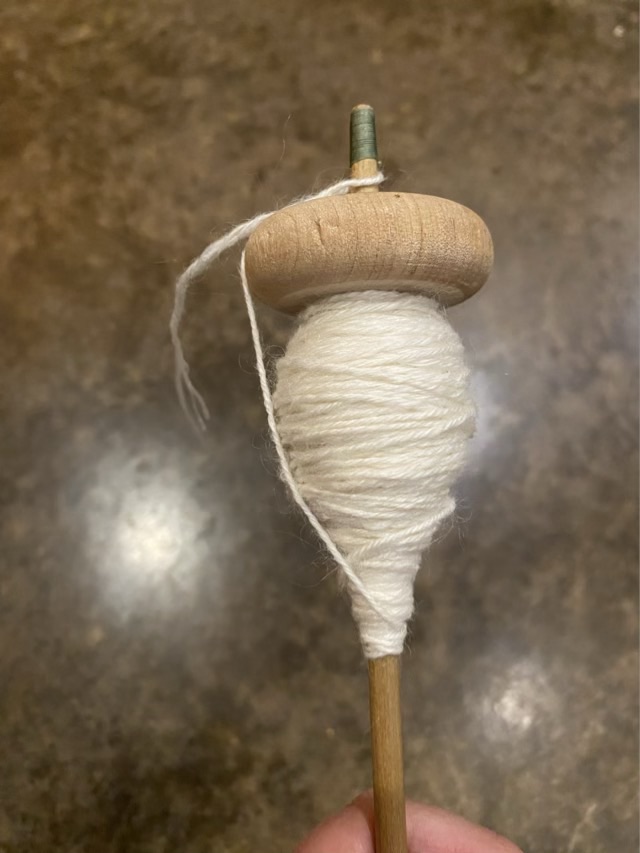
I finished plying and my Turkish spindle wrapping technique is improving. Since I’m going to work directly from the center of the yarn turtle for the next step, I don’t need to rewind. The Turkish spindle turtle does very well as a center pull ball.

Photo description: top of the yarn turtle on a Turkish style drop spindle showing fairly neat wraps.
Photo description: bottom of the yarn turtle showing overlapping layers. Dog and ball in the background because she thinks I should be kicking her ball all the time.

Throwback Thursday: play mat

Now we are getting into the children years for Throwback Thursday, at least digitally. Maybe someday I will flip through my pre-digital era, but for now now, we’ll just move forward. In January of 2006 my first child had started to crawl, so I attempted a large play mat with animals, tracks, and habitats.

Photo description: large cotton sheet with drawings of a bear, beaver, deer, duck, rabbit, and squirrel on the left, and corresponding tracks leading to drawings and f habitats on the right

I took some unbleached cotton fabric and made iron-on images with my printer. The idea was cute, but the thin cotton didn’t hold up well to a new crawler, and all of the images washed out when I laundered it. I still have the fabric, it became a drop cloth for art projects.

As an interesting note, my eldest is now in college with a major in wildlife. Hm.

Microkits Theremin

I love musical instruments, and have a collection of sound makers. Newest to the collection is a tiny DIY Theremin.

Photo description: the unboxed parts from Microkits to make a Theremin

The kit was very well assembled and the directions were easy to follow. Within a half hour I had a small working theremin and could change pitch within an octave and control the volume with a motion of my hand.

Photo description: finished Theremin with the wire sensors and exposed breadboard

I have a few ideas for a case, to add to the sound quality and aesthetics, as well as contain all the parts.

Ah

I started the cat hammock using polyester craft cord. Using the hook size recommended on the label (which is smaller than my test swatches), I made a chain the length I needed for the narrow side of the mat. (Don’t do this, chain length is drastically different than the length after a couple rows. I should have swatched (ironic), obtained gauge and done a chain based on the calculations.) I did my first row of single crochet stitches in the back loop of the chain. There are many ways to insert the hook in a chain for crochet, this is my favorite and uses the bump-like loop on the back of the v-like chain. It makes a very symmetric first row.

Photo description: crocheted band of craft cord after the first row of single crochet, a very aesthetically pleasing result with the parallel opposing chains.

Testing crochet stitches

I really like to make swatches, which probably puts me in the minority of crocheters and knitters. I like to see how different stitches, yarn, and needle sizes affect the overall fabric. This test involves polyester cord. I want to make more hammocks in the catio, and polyester is more UV resistant than other man-made fibers and even natural fibers, and is mildew resistant. I have made hammocks using outdoor fabric, but they retain water for quite some time after the rain. I’m hoping a crocheted hammock will let the rain pass through and dry quicker. I had some left over polyester macrame cord and did two test swatches, one with a simple single crochet repeat (American terminology), and one with alternating single crochet, chain one, repeats.

Photo description: two small rectangles of crocheted cloth, on the left a single crochet pattern, on the right a single crochet, chain one pattern. K sized crochet hook above the swatches.

Even though I really like the texture and look of the single crochet and chain one fabric, the holes are a little bigger than I think the cats will like when weight is applied. The holes are about toe bean sized, which seems uncomfortable. I do like that this cord has some shape memory, and retains a curve when stretched.

Next for a full-sized version.