Not historical nålbinding

My experiments with nålbound bracelets continue. I tried para cord, which I did not like at all because the stitch method puts a twist into the cord, and para cord changes visually when twisted.

Photo description: orange and purple para cord nålbound with the Dalby (UOU/OUOO) stitch, showing changes in texture and width as the cord picks up twist

Although untwisting the para cord for every stitch is possible, I don’t like that the white core of the cord shows through on sharp bends or snagged sections. I do like the Dalby stitch as well as the Telemark stitch for flat interesting single row weaves. I tried some stiff finished leather cord as well, which did not work because the leather couldn’t make the bends required to lay flat. I will try it again with unfinished leather cord so I can soak it into submission.

I went back to my favorite satin cord, also called rat tail or mouse tail depending on who is doing the labeling. It is made of solid color nylon, has a nice drape for this work, and melts readily with a thread zapper.
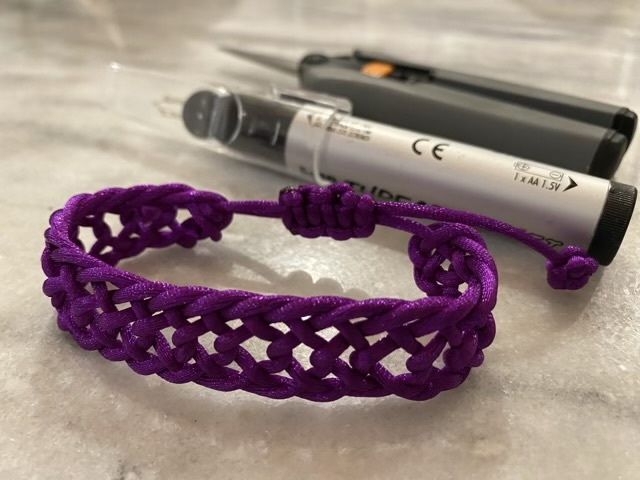
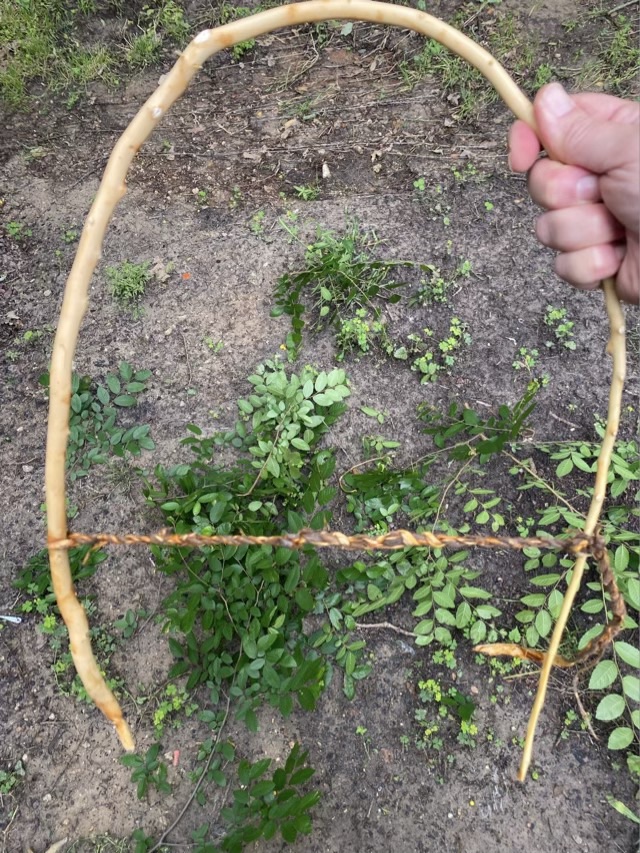
Photo description: purple satin cord bracelet done with the Dalby stitch and finished with a macrame square knot slide and Celtic button knot end stops.

Bent cane weaving frame

I was trimming the yard, and took down a sapling (iNaturalist identified it as a type of elm) growing near the AC units where it didn’t need to be. I noticed that the diameter was similar to some bent cane weaving frames that have been popping up on my Pinterest feed. Because I am easily distractible, my next task became making my own frame. As I stripped the side branches off, I noticed that the bark peeled off easily, like that of a mandarin orange. The bark was flexible, strong and fibrous, so I roughly split it into thick strands and twined the strands together to make a primitive rope. I used this rope to keep the branch in a nice curved shape while it dries.

Photo description: stripped elm cane bent into a narrow arch and secured with elm bark twine

I think this frame is on the small side for the kind of weaving I want to attempt, but it was a good exercise, and I have an acre of woods to source longer cane.

Happy Mother’s Day

Happy Mother’s Day to all those that mother! I did some experimentation with Copic markers and stencils for Mother’s Day cards this year. Fun things, Copic markers. Expensive, but for good reason.

Photo description: two cards with “Happy Mother’s Day” written in blended inks from red to green, Copic markers in the foreground, Cricut cut stencil in the background

Throwback Thursday: Cribbage board

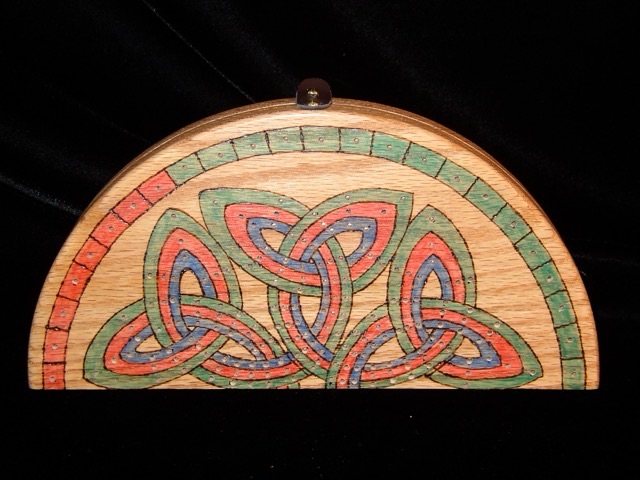
I went all out on this custom cribbage board back in December of 2004. I designed the Celtic knot triple path, shaped the oak board, carved storage recesses, installed hinges and a custom leather clasp, and even handmade the pins from twisted wire capped with blown glass.

Photo description: cribbage board shown paying side up, with three colors of glass pins, red, green, and blue to match the paths of the Celtic knot
Photo description: cribbage board shown closed, with half the pyrography design visible
Photo description: cribbage board shown open with storage compartments

Decembers before kids are a treasure trove of throwbacks. This board is pretty, but it hard to actually use, especially when there is alcohol involved. Those loops and whorls make counting a dizzy prospect.

Spindle weight

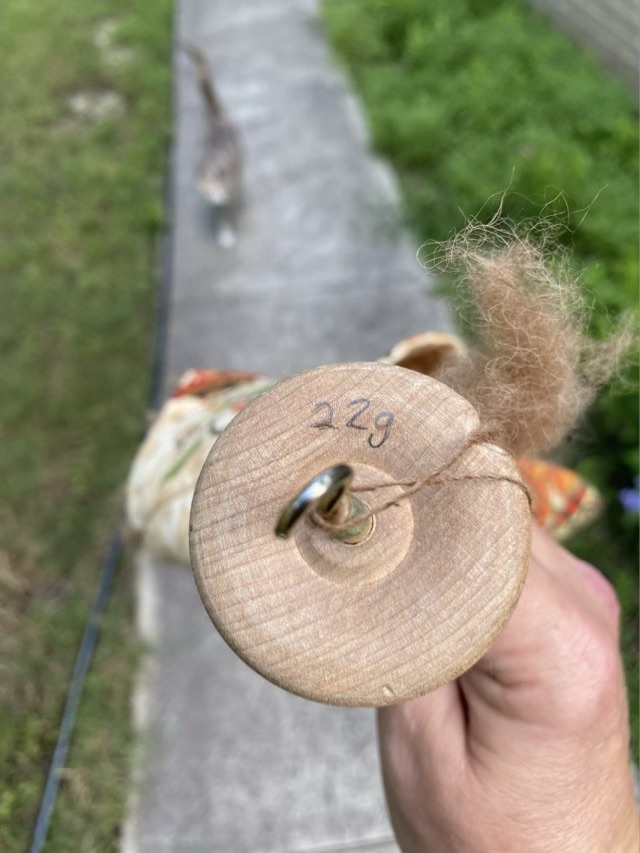
I wrote down the tare weight of my spindle so I could track the amount of yarn I’m building up.

Photo description: 22g written on the whorl of a hand made drop spindle, camel fiber and arm bag visible behind the whorl, calico cat on the sidewalk in the background

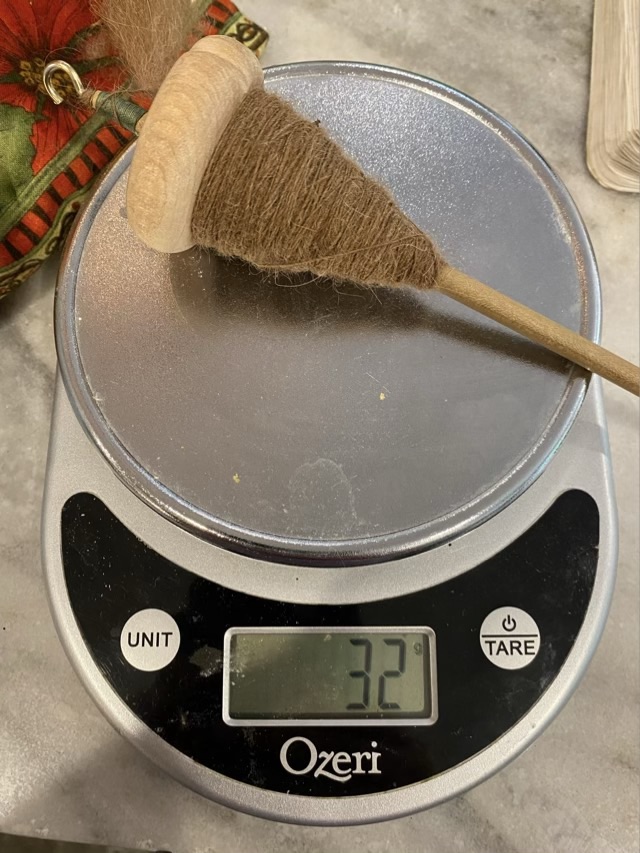
I’m working on a camel bump, which amuses me. Camel fiber is quite soft, and the mill processed it into a “bump”, which is roving wrapped into an oblong, much like how yarn is sold in the big box stores. I’m spinning it on my daily walks, then recording the weight.

Photo description: drop spindle with brown camel single spun yarn in a cop below the whorl, sitting on a digital scale that reads 26g
Photo description: same spindle the next day, and the scale reads 32g

My efficiency is improving, or I’m walking longer, which are both valuable outcomes. I spun 4g of fiber the first walk, and 6g on the second walk.