My youngest gifted me two skeins of yarn last December. I cast on with size 11 knitting needles at the end of February, thinking that a nice wide scarf would be cozy. Hm. Two skeins does not make a very long, wide scarf.
Photo description: knitted rectangle with purple and teal stripes (yarn was self-striping)
So the scarf became a shrug. Sewing the ends together for a few inches formed short sleeves, which help keep the shrug in place.
Photo description: knitted shrug with now vertical stripes
It works! It is now a garment that gives a little extra warmth, and as a bonus, doesn’t wrap around the neck. This isn’t the first time, and won’t be the last, where I have had to pivot the purpose of a project. This one definitely came out better than the original idea.
Today we look back at August 2013 and the library bulletin board to welcome kids back to school. I did a concept test on a regular sized sheet of paper, using strips of sand paper for sand, and ribbons for water. The kids love running their hands on the bulletin board, so I thought the sand paper would give them something nice and tactile.
Photo description: beach scene on black paper with paper umbrella, paper book stack, strips of sand paper, twisted ribbons, and paper sun and cloudsPhoto description: full sized bulletin board with a bonus book cover and I added a crumpled texture to the sun and clouds
The fun part of the full board is that there was a vent that blew air across the surface, making the ribbon move and giving motion to the ocean. I did not use backing paper; I was still fire shy after the previous year’s board was deemed a hazard by the fire marshal.
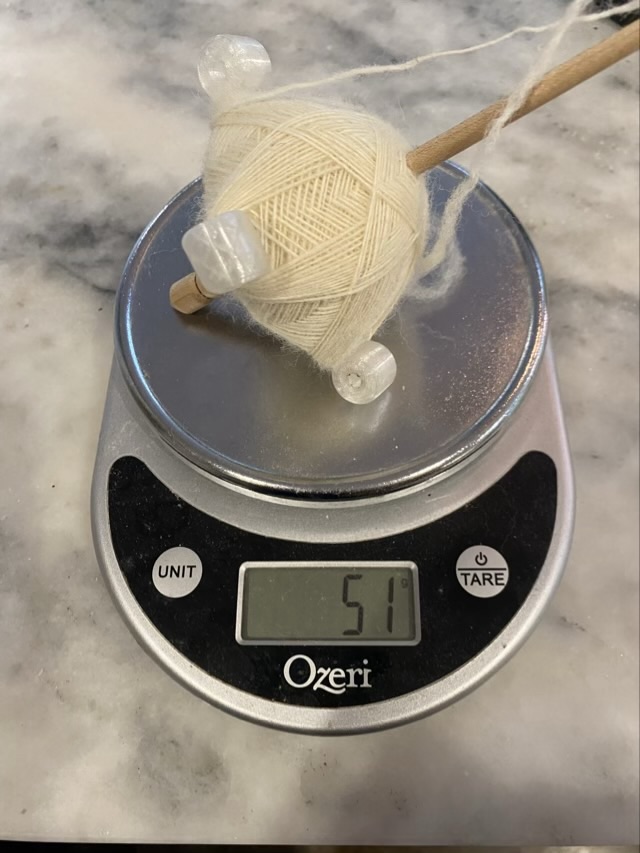
I have 4 ounces of Southdown top from Camaj fibers and it came with a Shave ‘Em to Save ‘Em sticker. Southdown is a heritage sheep that just came off the Conservation Priority list in 2024, which makes my sticker not count toward my threatened breeds list, but does show the power of the Shave ‘Em to Save ‘Em initiative and others like it. It is a British breed from the Chalk Hills near Sussex, England. You can read more about them here. I am spinning my portion of fiber with a 3D printed Turkish style drop spindle. The fiber drafts easily and spins fine. It takes me longer to do the geometric wrap around the spindle “turtle” than it does to spin the length of yarn, but the aesthetics of the winding has its own therapeutic reward.
Photo description: off white Southdown fiber spun fine and wrapped “under one, over two” on a Turkish style spindle. Calico cat sitting on the side walk in the background.
This spin is going to last me awhile between the amount of fiber, and the way I’ve chosen to spin it. 4 ounces doesn’t sound like much, but I’ll probably be walking with this fiber for months.
I found this wicked looking thorn laying in a parking lot. Most likely it stuck to a tire and fell off in route, and I’d like to say I picked it up so no one impaled their foot, but the was a secondary benefit. Really I wanted to see what I could make with it.
Photo description: approximately 4” thorn cluster with opposing spikes 1-2” long held lightly in my hand
I used my pocket knife to cut the side thorns off. The tips are wickedly sharp and hard, so I wanted to try to make a needle. I approached it as I would for carving solid wood. The center of the spikes are soft though, so the needle hole didn’t have enough support when I whittled both sides down.
Photo description: single thorn with the end carved into a needle eye, which broke, pocket knife on the side of the picture
If I were to make the attempt again, I would put the needle hole in the outer bark, and not reduce the integrity of the thorn by cutting the bark away.
I don’t like the U shaped travel pillows. I’ve tried several, and the bulk pressing against the back of my neck (really anything around my neck) drives me nuts. So I made a different kind of pillow. It is ideal for reclining chairs because it has two side pillows so my neck doesn’t twist too far, and no stuffing behind my head. The best part is that I made it with one fat quarter, some thread, and poly fil stuffing.
Photo description: fat quarter (18”x21”) of quilting fabric with a pineapple motif
To make the pillow, fold a fat quarter in half lengthwise, right sides together (9” x 21”, doubled). Sew along the edges, leaving two 4” gaps on the outside thirds of the long edge (for stuffing later).
Photo description: fat quarter folded in half and sewn with two gaps on the far edge, on a model 66 treadle sewing machine
Clip the corners and turn the pillow right side out. Fold the case in thirds, mark the line, then sew seams along the lines. This divides the pillow into three parts.
Photo description: pillow case divided into thirds and being sewn using the fold as a guide
Fill the outside sections with stuffing, then sew the gaps closed. I usually do this by hand, but the foot on my model 66 has such a nice tiny toe, I thought I would try on the treadle sewing machine. It worked well.
Photo description: sewing the pillow gap closed using a treadle machine fitted with a standard footPhoto description: finished travel pillow laying on the work surface of a 1916 Singer treadle sewing machine
It amuses me that the fabric coordinates with the “red eye” decals on the sewing machine. I can report that the pillow works great, especially for naps.