As a Thank You to Sugar the Samoyed’s family for sharing Sugar’s fur for my fiber study, I sent them a crocheted heart and the remainder of the yarn.
Photo description: small hank of Samoyed yarn and a crocheted heart with a leather center with the name “Sugar”
I designed the leather heart using Adobe Illustrator, then cut it from vegetable tanned tooling leather. Having precision cut holes was awesome to make a blanket stitch around the edge. I then crocheted into the stitches using a single crochet in the back loop.
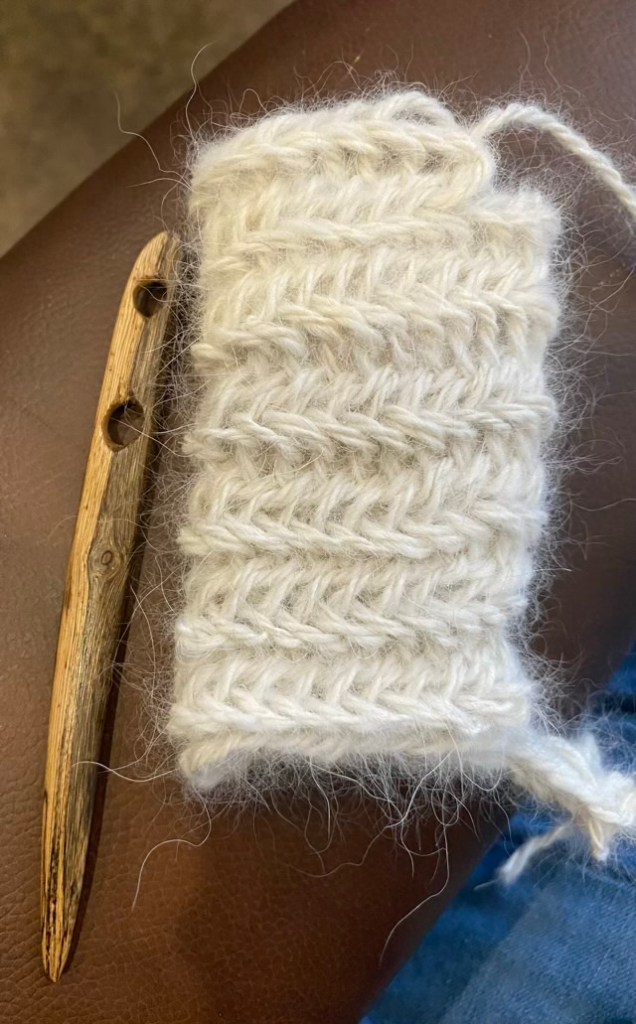
I am happy to report that the Samoyed dog yarn I spun does well in nålbinding. I was afraid the yarn wouldn’t felt, and my favorite way to join in yarn for nålbinding is to unravel a section on each end, trim the ends so I have two sections on one side and one on the other, build up twist in the short end, linearly braid the ends together, let the twist come back into the braided section, then rub it between my hands to lightly felt it. (Hm, that sounds more complicated than it is, I really need to do a blog post on it specifically.) It is a belt and suspenders and sticky tape way to join yarn, but it is strong, and almost undetectable, especially after incorporating it into the work.
Photo description: Nålbound tube using a Finnish 1+2 stitch and Samoyed three-ply yarnPhoto description: tube cut open to make a rectangular swatch
This is one of my favorite nålbinding stitches. It is easy to remember and I feel like I have a connection with my Finnish and Scandinavian DNA.
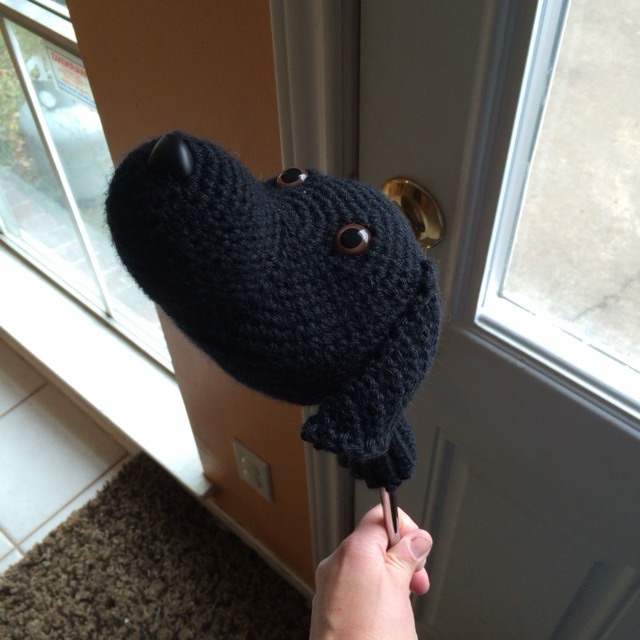
In February 2015 I finished crocheting a driver cover for my Dad, in the shape of a black Labrador head.
Photo description: Crocheted black lab head with safety nose and eyes, on a golf club
The neck is a crocheted rib, the ears are single crochet triangles, and the rest is single crochet in the round with a small hook in the style of amigurumi (although I don’t think I knew that word at the time). The nose is stuffed, but the skull is provided by the head of the golf club.
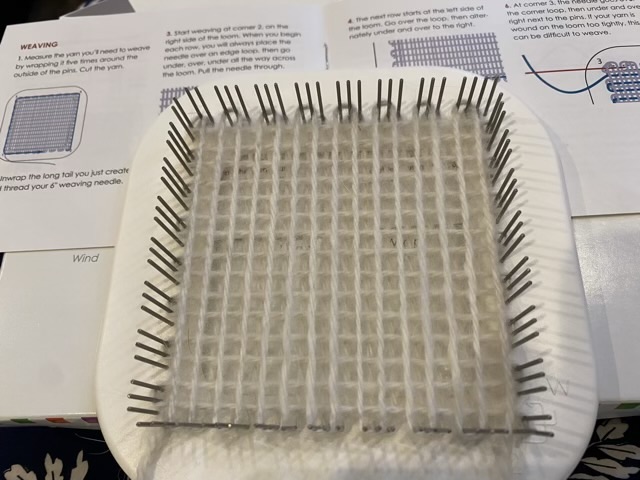
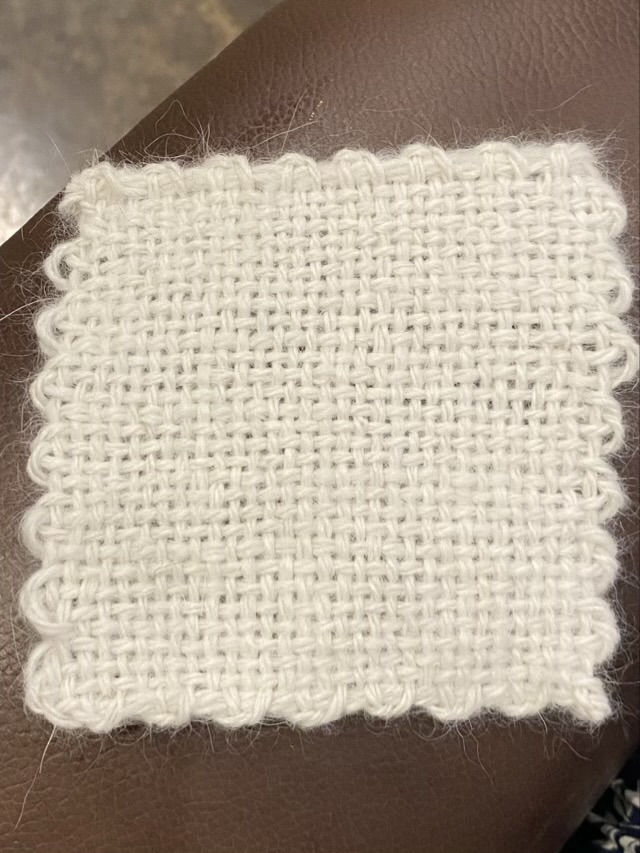
I have had a Zoom Loom on my wish list for a couple years. I finally purchased it and am so glad I did. This is an ingenious little loom that makes a 4 x 4 inch, four selvage woven square by wrapping three layers and weaving a fourth to achieve a plain weave.
Photo description: 4”x4” Zoom Loom by Schacht with the first three layers wrapped with hand spun Samoyed three ply yarnPhoto description: weaving started on the Zoom LoomPhoto description: finished woven square
This just made my weaving swatch the fastest swatch, outpacing both knitting and crochet. I use the swatches for my fiber book pages for each fiber I spin, but this went so fast I’m intrigued by the design possibilities that are now open to me!
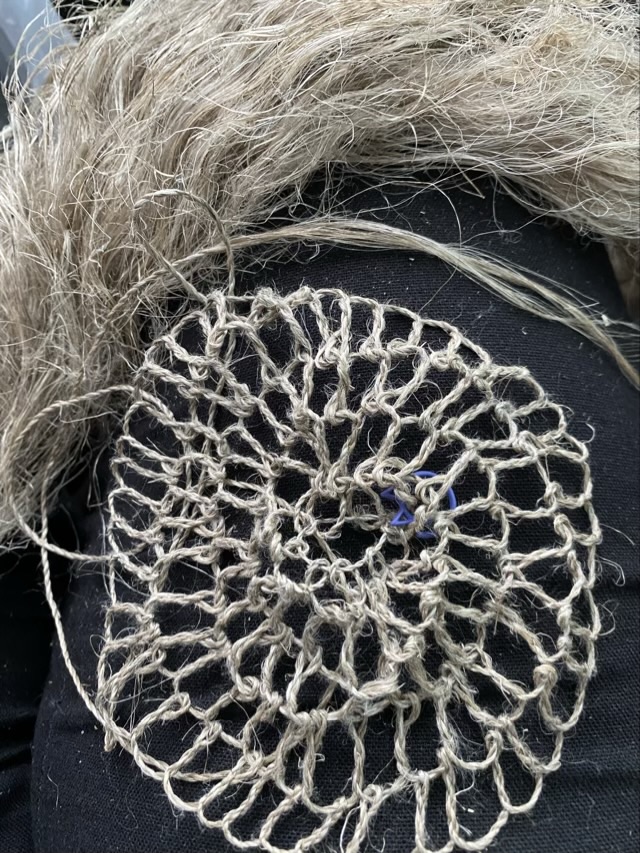
I’ve started a new project using the processed flax fiber from Sally Pointer’s twine kit. I’m making a twisted loop bag and twining the cordage for it as I go.
Photo description: two strand twined cordage made from flax fiber (in the background)Photo description: the start of a twisted loop bag made of flax cordage, approximately six hours of worktime
I started the project as a car riding diversion. I like the twining because I can do it mostly without looking, which allows me to watch the scenery going by.
I learned to twine with a Z twist, which is opposite of the S twist that Sally Pointer demonstrates for beginners. This is fine, but when I went to start the twisted loops for the bag, the technique makes Z twists for each loop. I thought my bag would be happier (less twisty) if I made S twists to balance the Z cordage, so had to adjust the way I made loops by going in the opposite way from the video. It took some brain power, and I’m going to have to be careful going forward to keep the same stitch direction, but I think it will be worth it.
I’m not using a needle for this project, just flax and my hands. I started with a nalbinding needle, but it kept slipping off, which was irritating, but the newly made flax cordage is stiff enough that if I fold the end, it is easy to thread through the loops.
Last thought on this post: flax cordage is strong. The line I’m making is fairly thin, about four-five strands doubled, but I cannot break it with my hands.





 Critters and Craft