How to make a lucet cord, no turn method, splash screen from video
Since I’ve been making lucets, I thought it was appropriate that I make a video on how to use them! I marked my yarn with colored dots to help the viewer see how the yarn moves around the lucet and how the loops are tightened. I talk about starting, tension, lengthening, and finishing (and have marked the sections so it is easy to skip through the video).
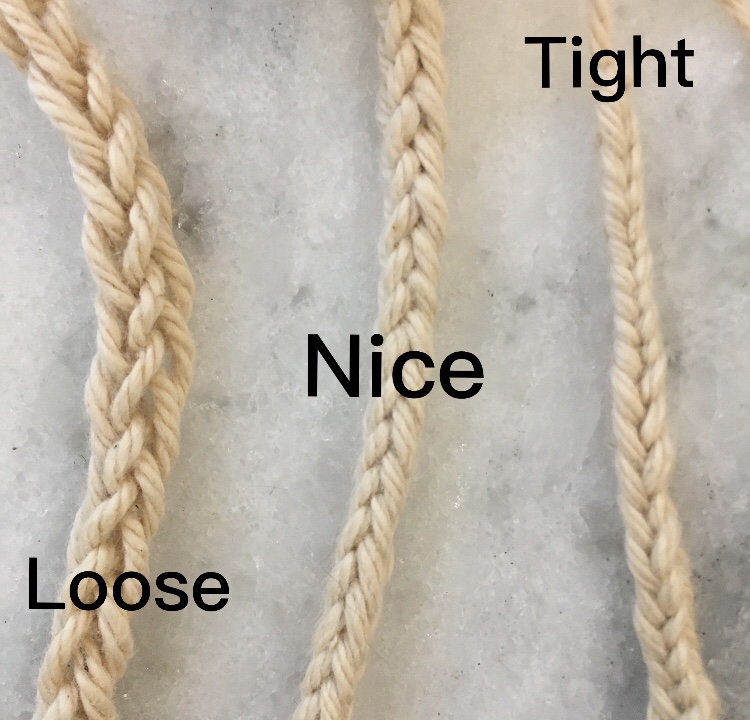
Lucet cord showing loose, nice, and too tight tension and loop size
Above is an image of how the lucet cord looks with different tension issues. If you pull the loops too tight, it is very difficult to make new loops because it is harder to pull the yarn through. Too loose and the cord doesn’t have the classic look. A classic lucet cord is square and even. Making the cord is also relaxing and a little addictive once you have the moves down. I’m thinking of keeping a ball of yarn and a lucet in my bag for moments I need to fidget!
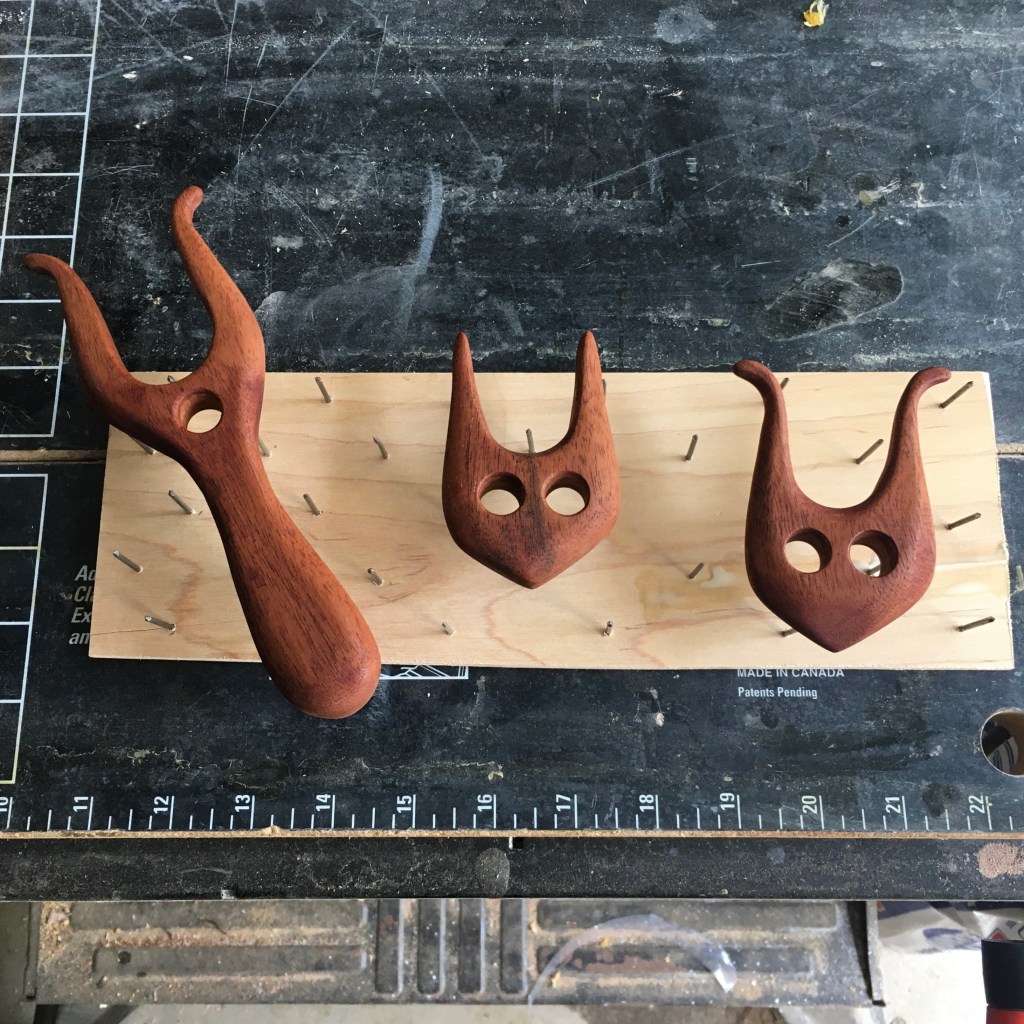
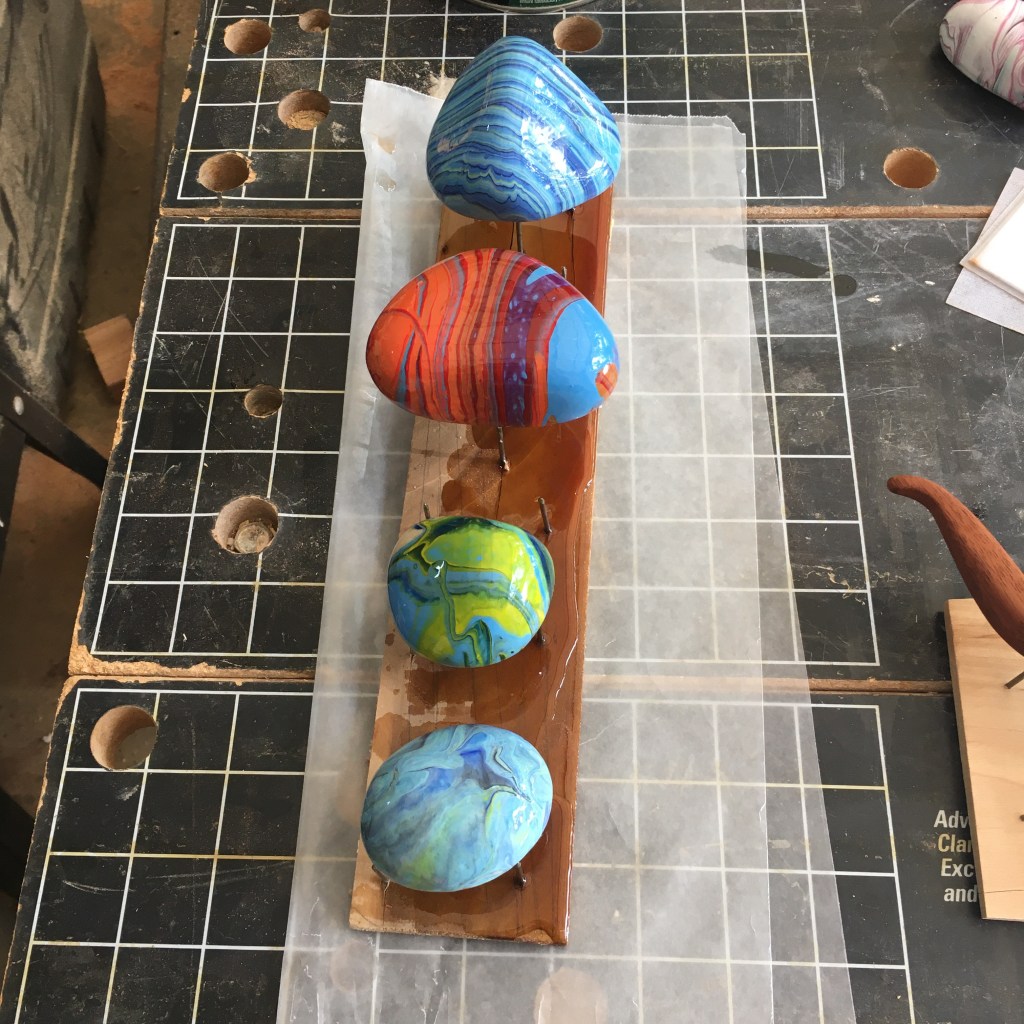
When I am applying finish on small items, such as lucets or painted rocks, I like to coat all surfaces then place them on a drying rack. The drying rack uses nails to minimize contact and keep the finish nice on the bottom of the piece. I had the idea after seeing how potters prop up their pieces for firing after coating with glaze.
Lucets with one coat of tung oil sitting on the drying rack (left lucet is a commissioned piece, the other two are available on my Etsy site)
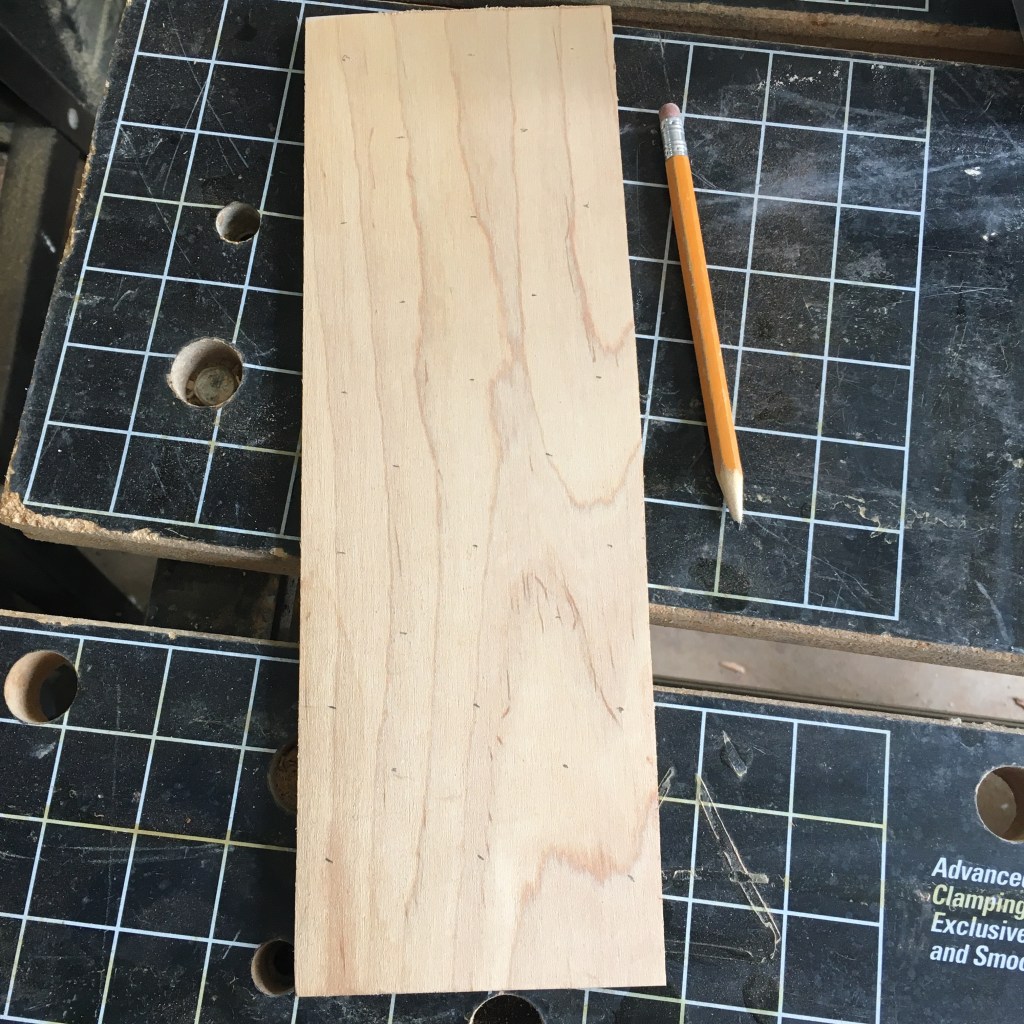
I start with a thin rectangle of wood, and mark out the hole pattern with a pencil. The hole pattern doesn’t need to be precise, in fact, having areas of different sizes helps for pieces of different shapes.
1/4” birch plank with pencil marks for hole pattern
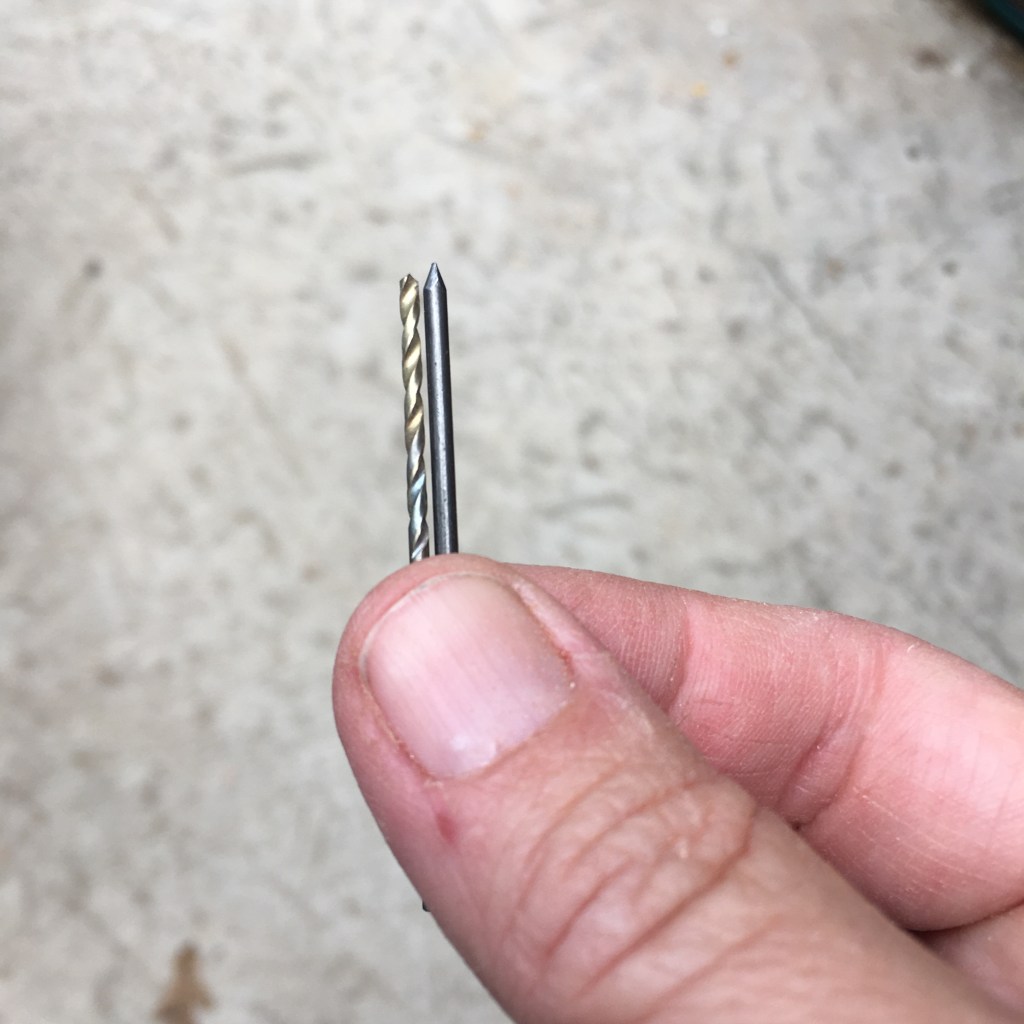
I pre-drill the holes with a bit that is slightly smaller than my finish nails. Pre-drilling reduces the likelihood of splitting the board (it still can happen though, so go slow, watch carefully).
Drill bit slightly smaller in diameter than the finish nail
Using a clamp work bench, I support the sides of the board and drive the nails in on the back side of the piece. The open space insures that I don’t nail the board to the workbench.
Hammering the nails through the board supported on a split work bench
After I made my new drying rack, I spotted the one I thought I lost. Sigh. It had fallen under the work bench and was hiding. I pulled it out, dusted it off, and used it for putting a clear coat on painted rocks. But hey, I was able to do a post about making one, with pictures! And now I have two.
Painted rocks with a thick coat of clear urethane on a drying rack. Wax paper is for accidental seepage.
I have never been able to wear the loop style headbands. They just slip off the back of my head. Ironically, buttoning a mask to the headband keeps my mask on and my headband on. The things we learn. The physics are all proper with the opposing forces and all that, it is just funny. I like that with the ear loops snug to the buttons, the elastic doesn’t push my glasses forward. I trialed a thinner headband, so thought I would try some waistband elastic and a wider tube of fabric. It works just fine.
When learning a new craft, the initial pieces are usually… well, let’s just say wonky. The value in these works is what we learn from making them, even if they aren’t aesthetically pleasing. Although I wasn’t enamored with weaving at the beginning (as I completely was with spinning), it is apparently going to wiggle its way into my life because I can’t get it out of my mind. I do not have the money or floor space for a large fancy loom, or even a medium one, but I do have many sticks. I found references to back strap looms, which are used throughout the world to make intricate and beautiful textiles. With sticks. And string.
Initial test setup of a back strap loom
The back strap goes around the weaver’s hips, and the other end is secured to a stationary object, or the weaver’s feet. I had some dowels taken from a recycled toy rack, and some nylon rope in the garage, so I grabbed those, then gathered smaller dowels in my craft room, a piece of fabric for a back strap, and yarn. The only thing I made was a beater stick, which I cut from some 1/8” maple I had in my wood bin.
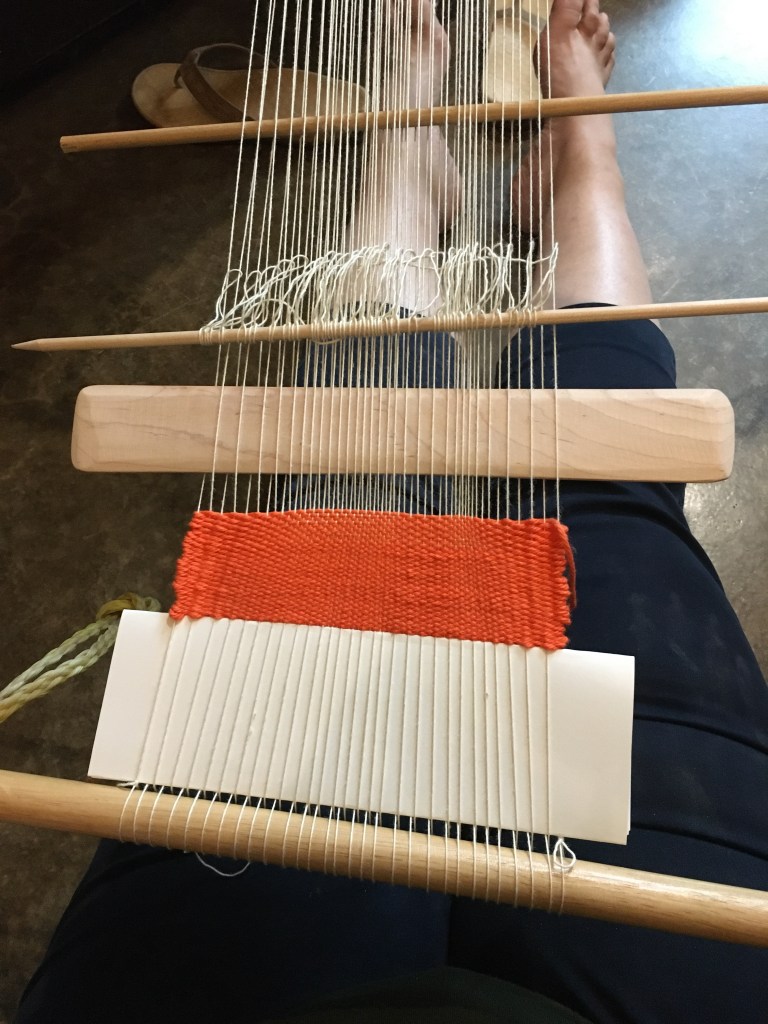
Attempted weaving, very wonky
My first attempt was confounding. I use online resources, videos, and pictures, and I’m not sure why my middle is tight and the edges are loose. What I did learn, though, is how to make a continuous string heddle stick, which lifts opposite warp threads than the shed stick, and makes weaving much faster as you don’t have to pick up warp threads on the back pass each time. This knowledge was completely worth the wonkiness. I decided to try again.
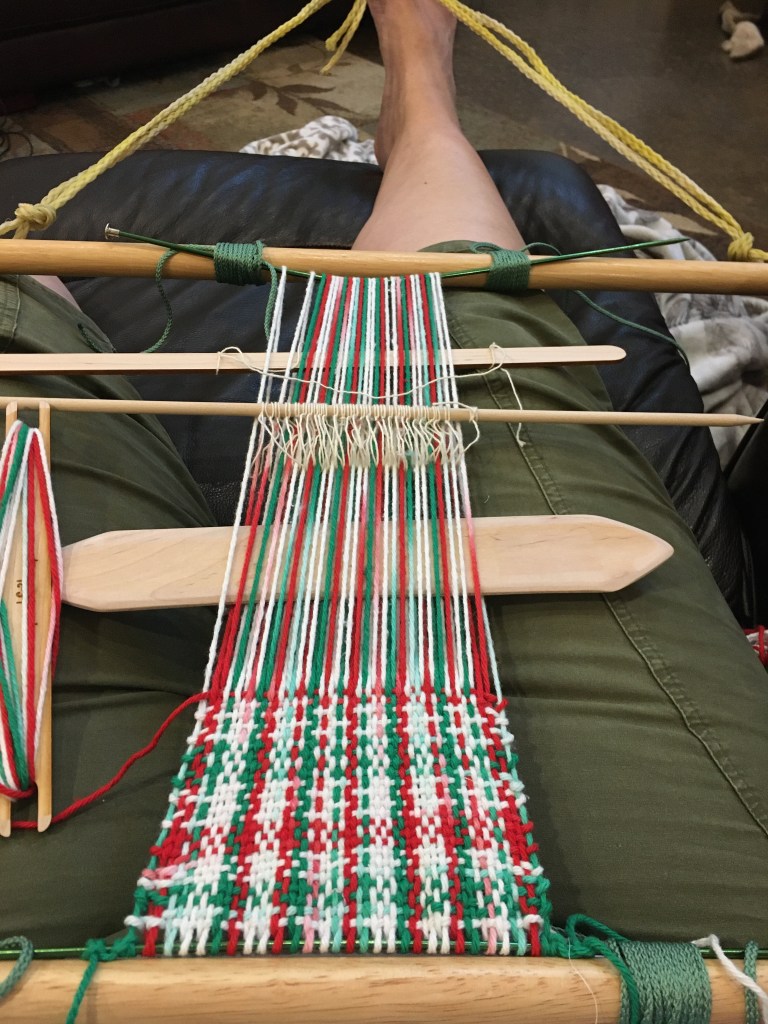
Second attempt at weaving with a back strap loom
With my second attempt I set up the warp with the same yarn as I wanted for the weft, and I used my foot for tension. (Because I am not used to sitting on the floor and it hurts, setting up this way lets me sit in my recliner. Cushy!) I also refined my sticks and used some knitting needles to hold the warp. What I learned this time was that the knitting needles are aluminium, not steel as suggested in the tutorial, and my tension may be a problem as I bent the needle on the far end. Oops. I also learned that all yarn is not created equal. The string I used for the warp and heddle the first time slid back and forth just fine. Sliding the heddle string along this different warp yarn felted the heddle and the warp together, making it inoperable.
Heddle string and warp yarn felted together
I shall try again, maybe after looking at some more pictures and videos.
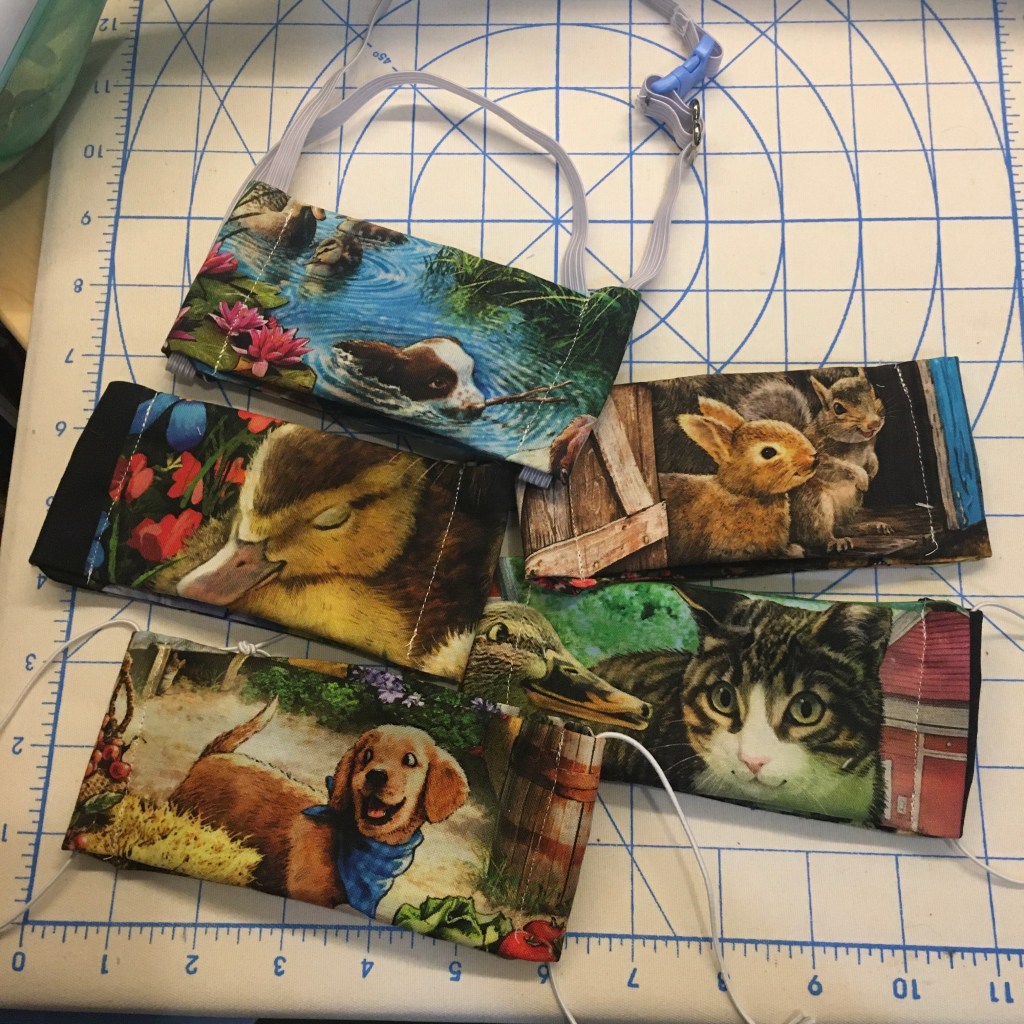
I found some cute barnyard animal panel fabric (large images printed on fabric rather than a smaller repeating pattern) at my local quilting store. I was trying to find fabric for masks for my nephew (this is not a quilting store that sells PawPatrol) and thought it might work with some fussy cuts. In quilting, a fussy cut is one where a piece is cut to capture a pattern or image in a certain way, rather than to maximize fabric usage. It usually leaves quite a bit of waste fabric, and making masks is no exception! Still, I was able to eek out five nicely composed kid-sized masks. It was an interesting experiment, but had too much waste for regular production.