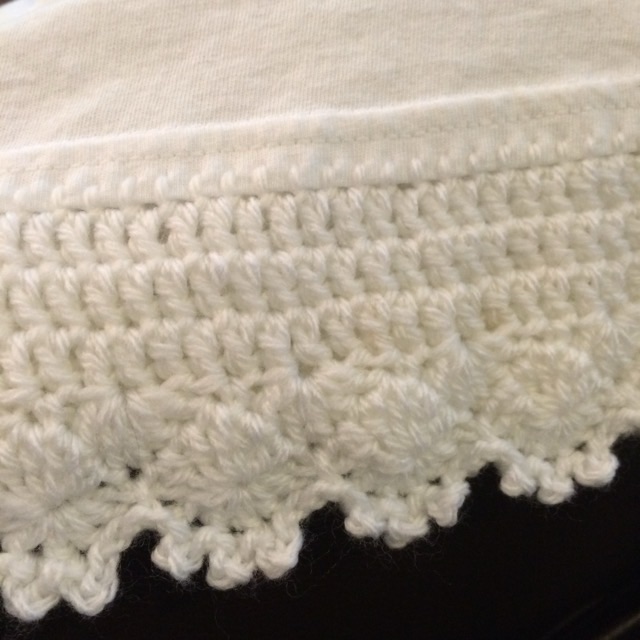
In August 2015 we bought white t-shirts for my kids to decorate with fabric markers and paint. The shirts were a little short, so I crocheted along the bottom hem to give them some length.
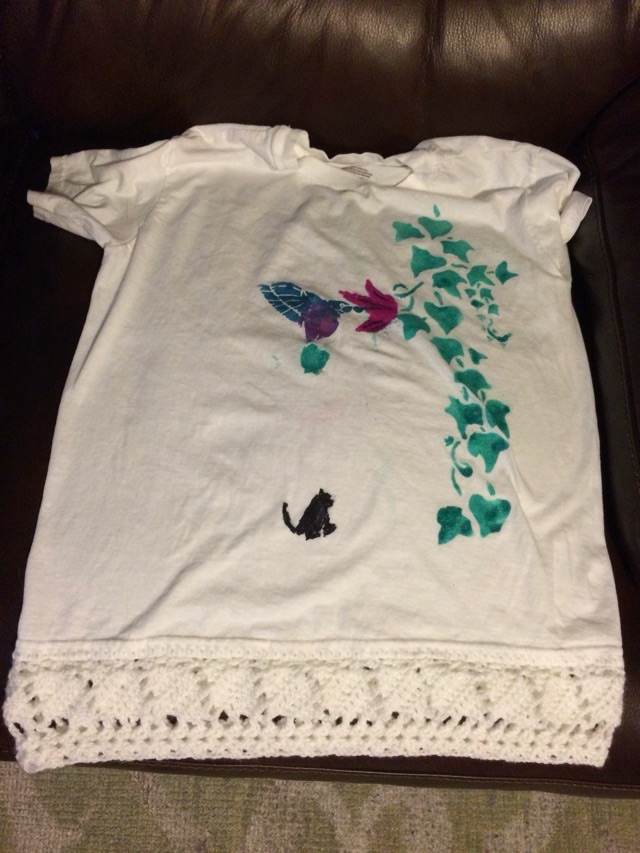
Photo description: white t-shirt with the handwritten words “It doesn’t matter what species you are to be friends”, with drawn hand and paws and wings and legs, with a crocheted bottom hem about three inches wide using double crochet, shell stitches, and picotsPhoto description: close-up of crocheted edge showing a blanket stitch base on the original t-shirt hem, three rows of double crochet, two rows of shells, and finished with slip stitches and picotsPhoto description: different white t-shirt with ivy and hummingbird stencils, and a small black cat, with a different style crocheted hem
I don’t have a closeup of the second shirt’s hem, but it does show one of the problems that can occur with an applied edge: drawing in. I prefer my shirt bottoms to be straight, or even flare out, rather than draw in, but I do like the leaf pattern. I think my kids wore their shirts at least once before they outgrew them?
When I’m not sure how much yarn I have, I try to pick a pattern that is flexible. This circle vest from LazyTCrochet Designs fits the bill. It is crocheted from the inside out, and the circle can expand. One downside of the pattern is that it only has two sizes, s/m and l/xl. It has instructions for expanding the circle for coverage, but that only goes a few more rows. The idea is expandable though, and the pattern is inexpensive.
Photo description: in-process circle vest crocheted with hand spun Jacob’s wool, pattern by LazyTCrochet Designs
I used the darker of my hand spun Jacob’s wool yarn for the center, then the lighter color for the next band. This is as far as my Jacob’s wool could take me, aside from a few small scraps. The vest needs more rows, so I’ll add some hand spun Teeswater wool for the next row. I just need to finishing spinning it first. Both Jacob sheep and Teeswater sheep are on the endangered list and part of the “Shave ‘Em to Save ‘Em” initiative by the Livestock Conservancy. I’m considering calling this my “Shave ‘Em Two Save ‘Em” vest since it will have two breeds from the list. Unless I end up needing a third breed, then I’ll have to rethink the pun.
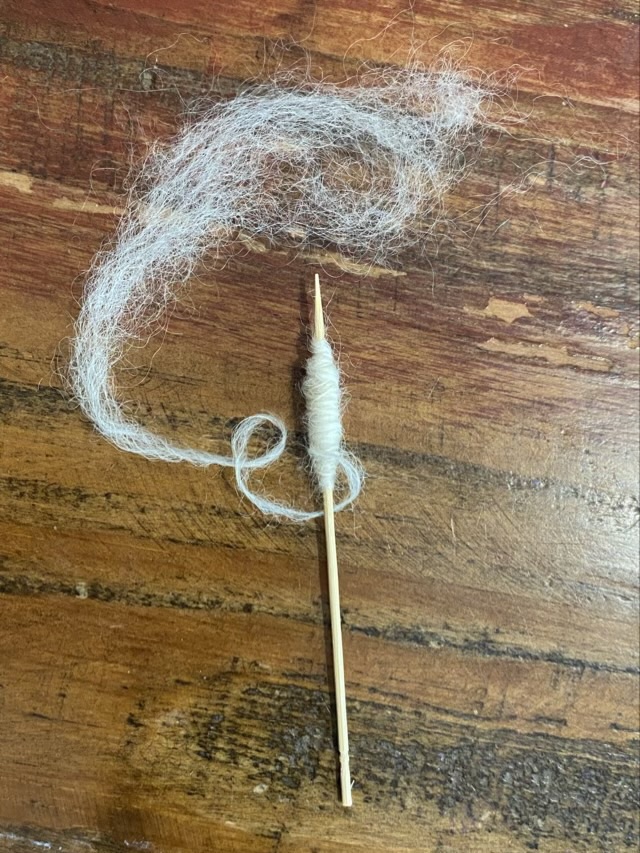
I have a spinning demonstration coming up and I want to have small give aways that promote and encourage people to try spinning. While it is possible to spin without a spindle by rolling fiber along your thigh, tension management is more difficult. Tooth picks resemble small spindles, especially for cotton, and are inexpensive. Can I spin using a toothpick?
Photo description: combed cotton spun into thread using a 2.5 inch toothpick
I started with combed cotton, and was pleasantly surprised that while spinning the toothpick in one direction with my fingers I could spin. It isn’t fast, but it is possible. As the cop of thread built up, though, it was harder to spin the short toothpick.
Photo description: Teeswater long wool spun on a 4 inch toothpick
I tried a longer toothpick and some longer staple wool, and found spinning much easier. A small bit of wool also goes a long way when making thread! My plan is to make small bags with a fluff of wool or cotton, a 4 inch toothpick, and a small card with basic instructions and a link to a video.
One of my hanging plants started leaking from a crack in the bottom. I’m not entirely sure how a hanging pot cracks, but it definitely wasn’t leaking plant water last week. I had a spare pot, but it wasn’t hanging, so I attempted a macrame pot holder. I used cotton macrame cord leftover from a different project, and divided it into six strands. I folded these in half and secured a loop in the middle with a knot. I then used macrame style square knots to make the net part of the hanger. It took a few tries. I found that I need to leave enough room from the loop to the first knot for the pot to slip through. The knots aren’t perfectly spaced, but they are functional, holding the oval shaped pot securely. I finished the bottom by gathering all 12 strands and lashing them together with a separate strand of cord.
Photo description: very basic macrame plant holder for an oval pot
The zebrina plant looks sad because I had to cull 90 percent of it to get it into the hanger. I took cuttings from the culled sections to root out. This plant regularly goes from sad and spindly to lush and full, so I’m not worried about it.
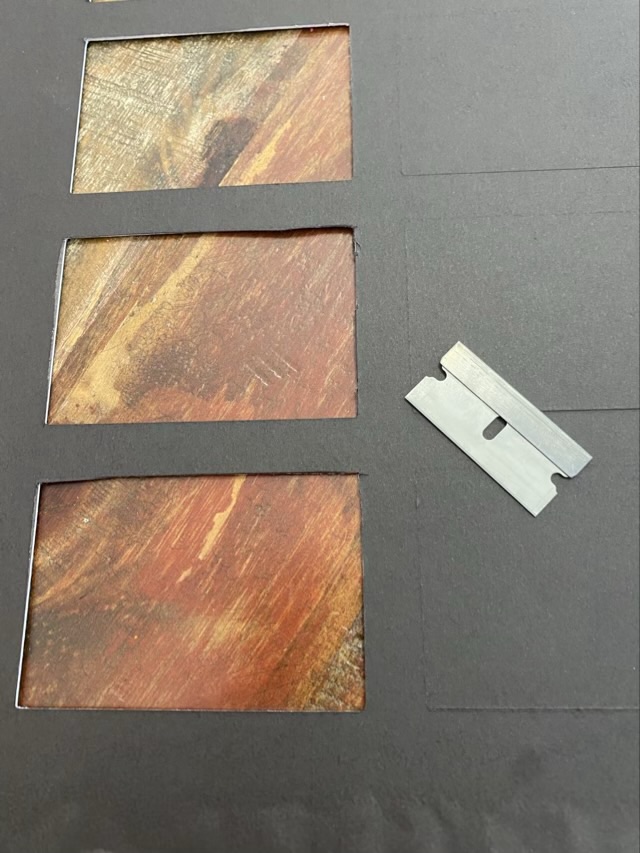
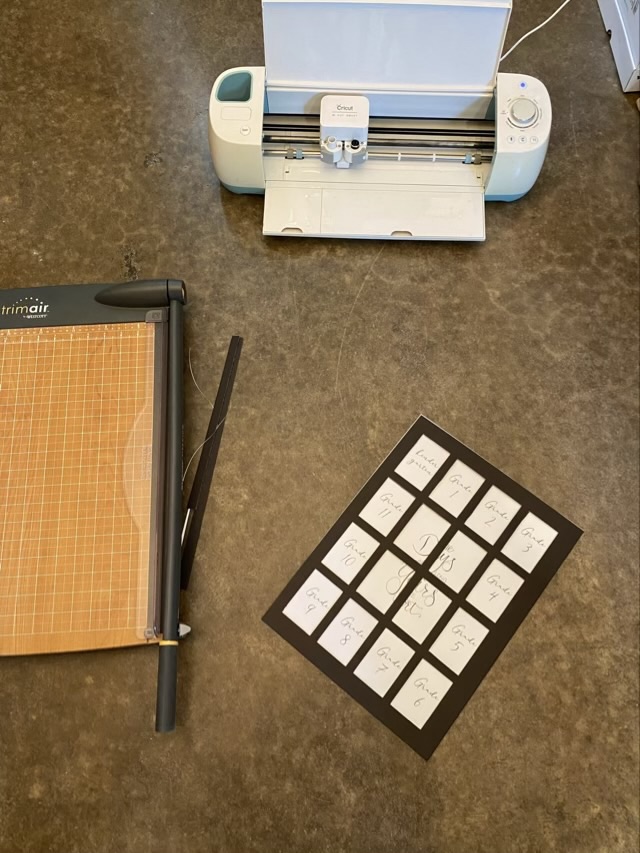
I took my Cricut cutter to extremes to cut a photo mat. The material is a little thicker than recommended. I used the deep cut blade, a 12×24 inch mat, more pressure, and a setting that traced the pattern twice. It didn’t quite get all the way through the mat board, so I used a safety razor blade to finish the cut.
Photo description: using a safety razor blade to finish cuts in mat board, the matboard cover lifted a bit when removed from the Cricut mat, but it is on the back
The resulting mat has spaces for 16 2×3 inch photos for my youngest’s school photos. All the commercially available mats only had 13 spaces, kindergarten through 12th. I needed spaces for preschool too. I bought mats larger than the frame, which allowed me to trim down the outside with my paper cutter and make sure the Cricut cut rectangles were centered.
Photo description: finished mat over the original 13 space backing to show the new divisions, my paper cutter and my Cricut on the floor because that is the only space that can accommodate a 24 inch cutting mat (not pictured)





 Critters and Craft