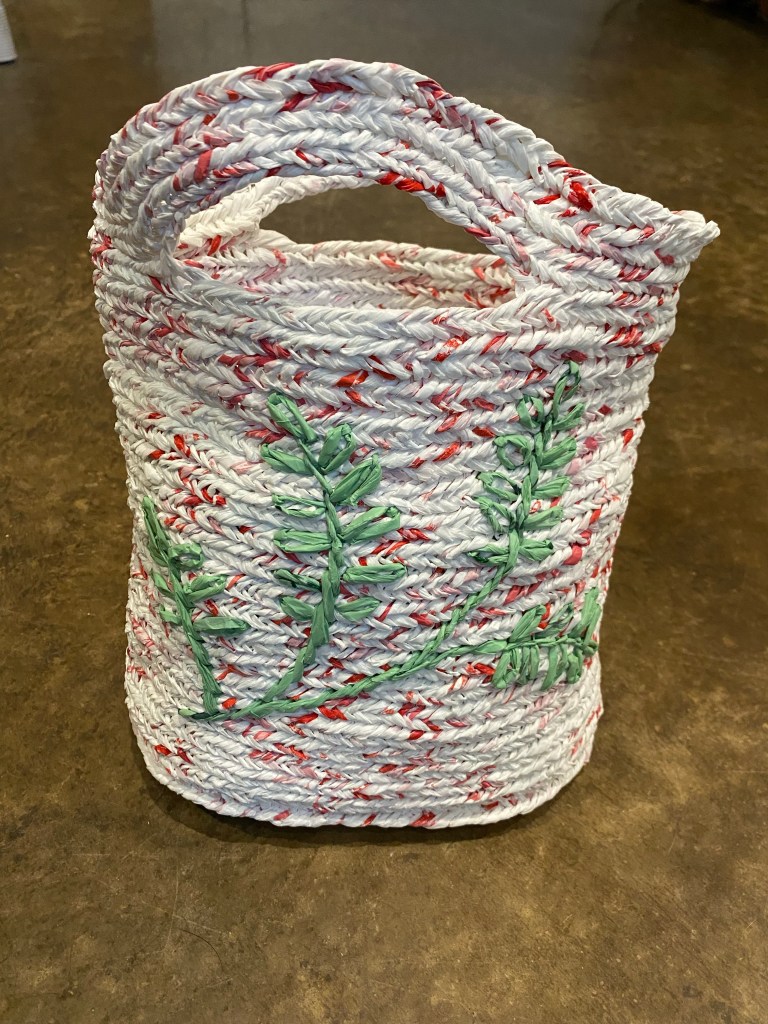
I finished another nålbound bag! I used loops of grocery bag plastic, and added some embroidery using loops from a different color bag. I learned that doubling the loops makes a very stiff fabric (the base was made as an oval with doubled loops, but is a bit wonky because of the stiffness). The sides were done with single loops thumb tensioned (meaning the loops are the diameter of my thumb) done in Finnish 2+2 with an F2 connection (here is an excellent resource site). The sides are much more flexible than the base, but still sturdy enough to stand tall on their own. (Although I did stuff the bag for the picture.)
Nålbound bag (9”x10”) made from plastic grocery bags
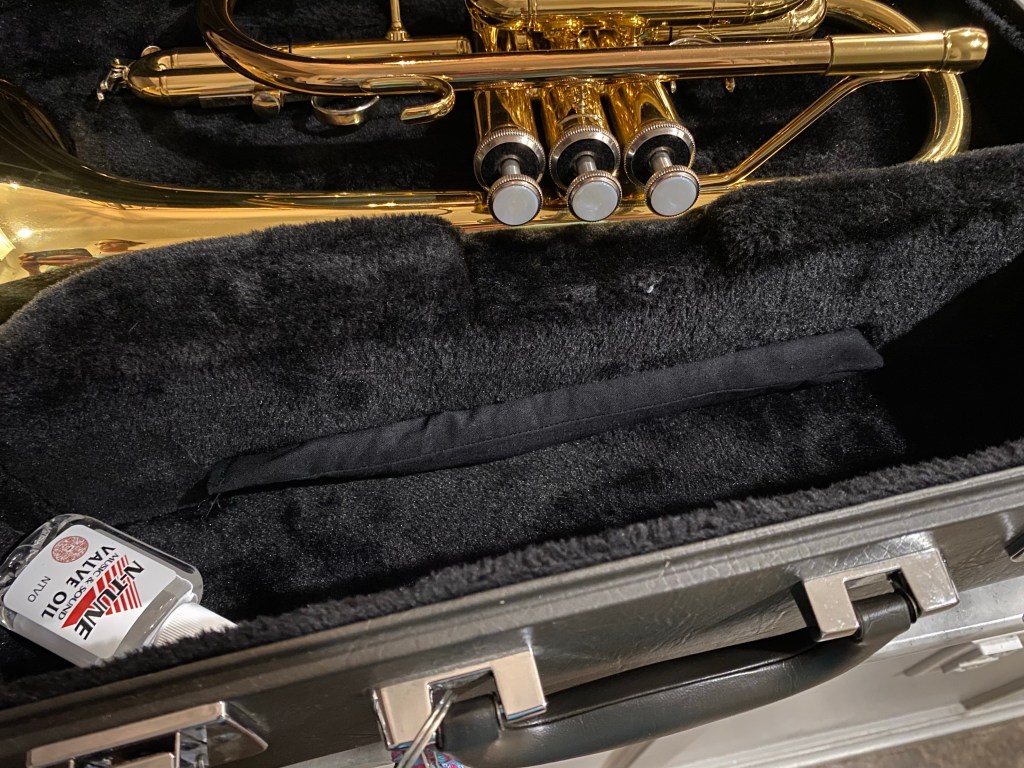
My youngest has taken up the coronet in band. Her case for the instrument is well made, but has a mysterious hole under the instrument that devours small items. Once a bottle of valve oil slips into the depths, it is really hard to retrieve. The hole is big enough to hold music, but the angle of access prevents putting a lesson book in. Truly mysterious. So I plugged it. I made a small pillow from black fabric in my stash and stuffed it into the hole. At first I tried a stuffed tube, but it didn’t hold well, so tried a rectangular pillow the length of the hole and about four inches wide, then stuffed it to get an inch and a half of depth. It is removable, does no damage, and keeps the case from eating tubes of slide grease.
Home made block for hole in coronet caseBlock installed flush
Hm. I think I may have figured out the purpose of the hole. When the block is installed, and the case is carried, the small items end up all around the coronet. So the hole is a catch to keep small things from banging against the instrument. Ok, well, it is still too deep. So I pushed the pillow farther in, to make a shallow hole just deep enough to catch the bottles. The same effect could be accomplished with a small folded towel, I suppose, but little pillows are easy to make.
My kids have been begging me to do the Mentos and Diet Coke experiment for years. When my eldest needed two liter bottles for her Food Science class, I relented, because the bottles were needed and the soda was not. I rigged a delivery system out of a 1” PVC pipe by cutting channels on the sides for a trap door and sanding out the inside to fit over the top of the soda bottle. The “trap door” was a small plastic ruler with a hole in one end (I intended to use a popcicle stick. Where are all my popcicle sticks?) To make sure it was an experiment and not just an excuse to make a mess, I bought a bottle of Diet Sprite and a bottle of Diet Coke. We took the supplies out into the meadow and loaded the tube with Mentos, and pulled the trap door from a safe distance using a thread tied to the ruler. Fail. The trap door worked, the soda bubbled up, but there was no epic geyser. We repeated with Diet Coke. Still a fail. The video is rather off center. I really anticipated a high fountain and framed for it.
Very fuzzy still taken from the video
So what happened? I believe that only a couple Mentos actually made it into the bottle, and the others were stuck on the bottle lip then were pushed out of the tube by the lack luster bubble surge. In addition, the channels for the trap door acted as additional exits and reduced the pressure, resulting in a lower than expected eruption. So it really was an experiment, although a disappointing one for the kids. We’ll see if more 2 liter bottles are needed in the future, and we may even purchase a better delivery system that reduces the flow to cause a higher geyser. And find a different area for the experiment that doesn’t involve running across a chigger infested field. (By the way, Texas A&M has a great resource on chiggers here.) So itchy.
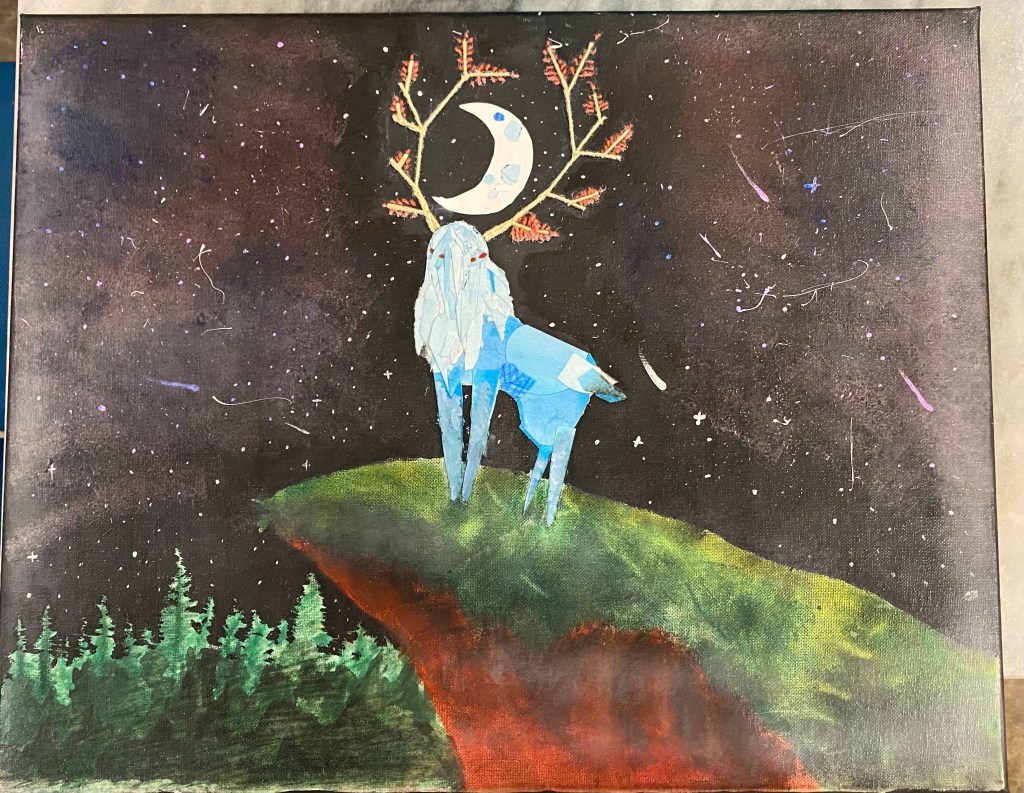
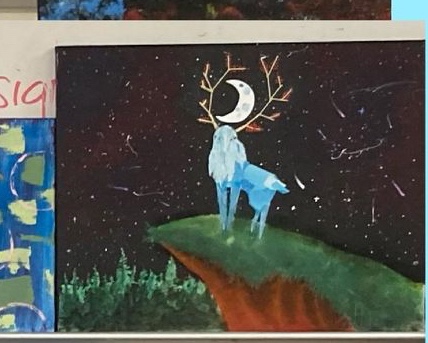
My eldest brought home one of my favorite artworks of hers from last year, an ephemeral glimpse of a mythical beast on a moonlit hill. As she got in the car she announced: “Do NOT touch the hill!” She did the canvas in mixed media, and the hill was pastels and was rubbing off on anything it touched! I assured her we could fix it, as I had a can of clear spray at home. First coat looked good, so I followed directions for the subsequent coats. An hour later, to my horror, a film of white bloomed across the painting. My eldest was very chill about it, but I felt awful. We tried to rub it off with a bit of water, carefully avoiding the watercolor trees, which looked great, until it dried. We also tried using a hot hair dryer in case the bloom was from humidity. No change.
White bloom on a black acrylic painting caused by an aerosol clear coat
Rather than risk anymore unexpected changes, I made up a test canvas by painting it with acrylic then spraying it with the same clear fixative. There was a light white bloom, so we used that to test putting a layer of Modge Podge over it.
Test canvas with black acrylic and clear coat, Modge Podge tested on the edges
It seemed to work, so I did the same treatment on the canvas. It did not remove the white. But, the way the white happened on the canvas, it made it look like a tattered fog, and intentional. Lessons learned: applying a clear coat to a mixed-media art project is fraught with peril, especially for dark colors. If faced with the situation again, I would purchase a high end fixative and spot check. If doing my own mixed media piece, I would make a waste canvas with the same selection of media for testing.
White bloom caused by a flat crystal clear coat sprayMixed media mythical beast by my eldest; acrylics, pastels, watercolors, cut paper, embroidery on canvas, as displayed at school
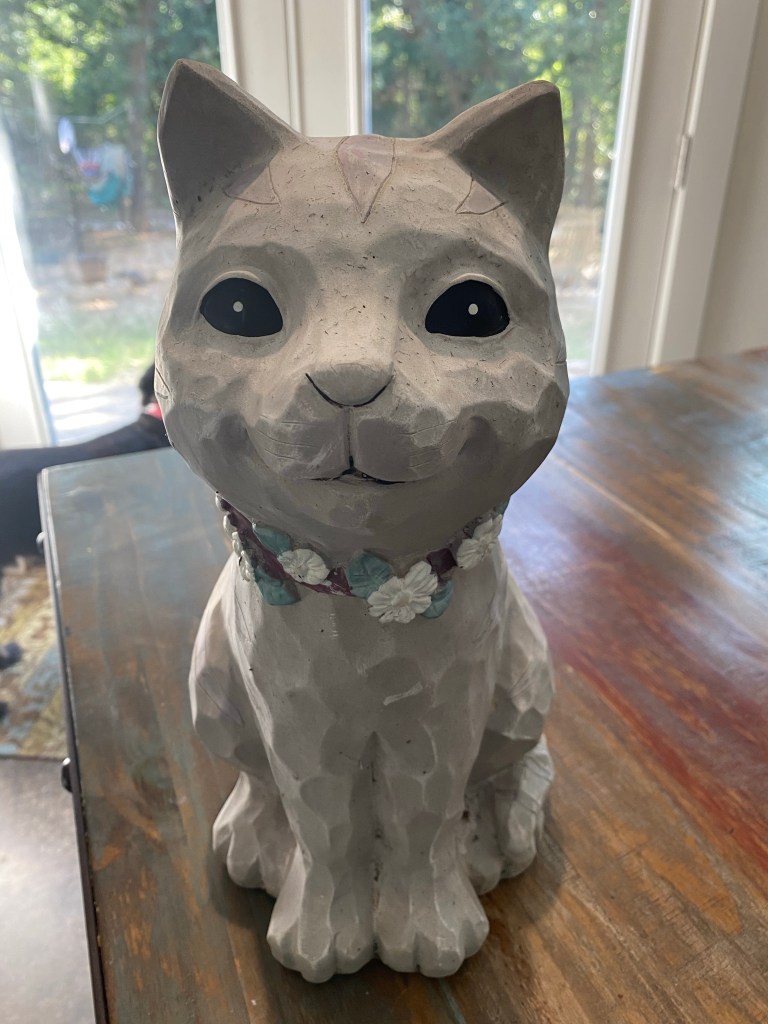
I have had a cat garden statue for a few years. It started out orange with orange stripes and has slowly faded in the elements. But the eyes have always been… creepy. For some reason I couldn’t take it anymore and something had to be done. (Probably the thought of housework and it was convenient for procrastinating.)
Garden cat with black eyes
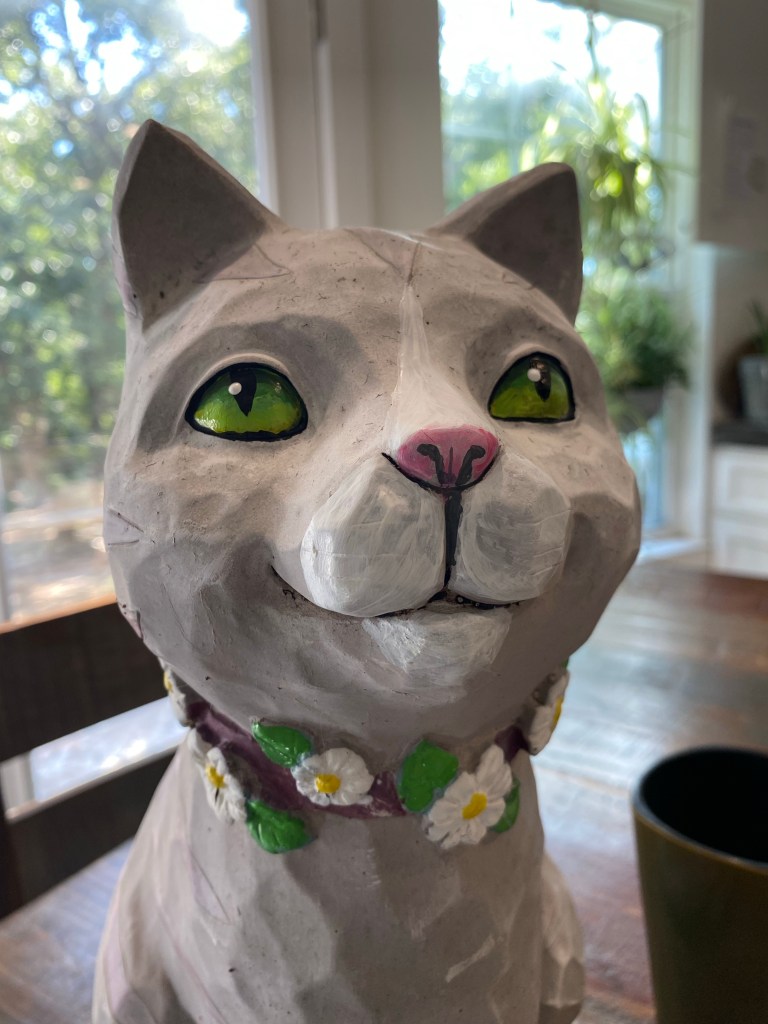
I used acrylics and covered up the black. As I waited for layers to dry, I added a little white to the nose, and touched up colors in the collar. The eventual plan is to convert it to a calico, but for now, at least it is looking instead of blankly staring.