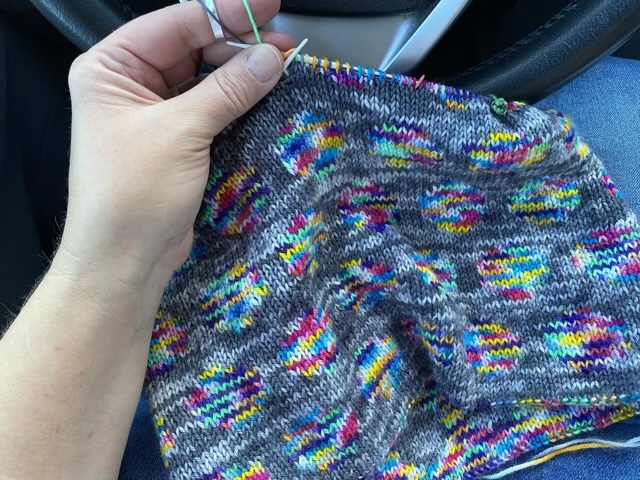
My waiting project is progressing. My original idea was a cowl double knit with polka dots. I chose two variegated yarns, which is making the pattern muddier than I envisioned. On the plus side, it looks like an old school monitor glitch, which is cool in its own right.
I needed a new fiber page for my spinning book, so I made five. Honestly, it is easier to make multiples for most things, since the tools are out and the groove is worn. I chose five because that is how many end papers I had when I cut the fancy paper to size. Random, but effective. I chose the colors to go with the end paper as well.
Newly constructed fiber pages
Getting the pages in the book has proven a bit more difficult than prepping the pages. I need longer metal posts, and something to space out the pages in the spine, to match the thickness of the page. Hm. That means I need to venture into a craft store. In December. With the other thousand people that need to do the same. Hm.
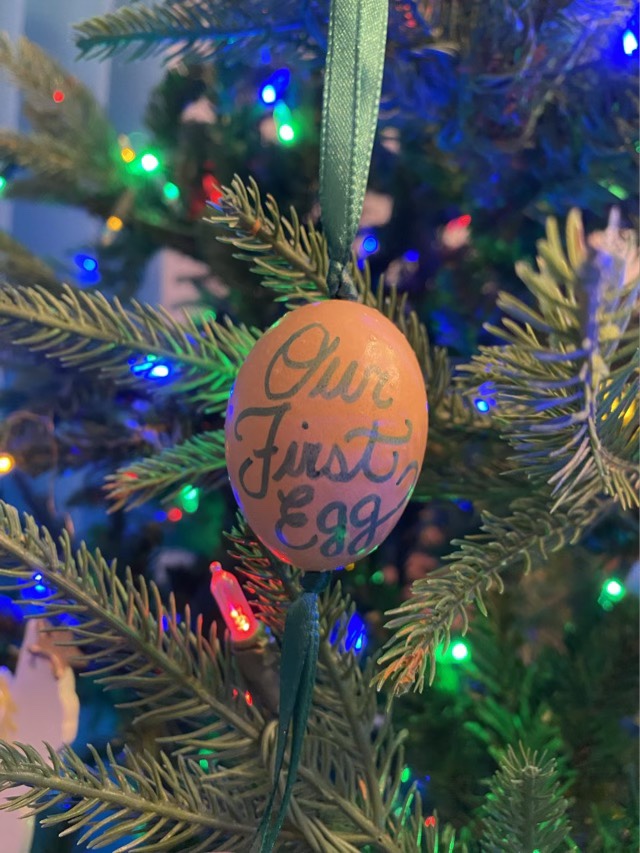
We put up the tree this week. We decorate with ornaments collected over the years, no theme, no ribbons, but bits of memory hung on the branches. So for Throwback Thursday, here is the ornament I made in 2019 from one of the chicken’s first eggs. I actually made three against the ravages of time and accident, but all three are whole and hung.
Ornament made from a blown out chicken egg coated in Modge Podge
I’m continuing my quest to spin all the things, and I grabbed my purchased prepared flax roving and set out on a walk. Hm. Flax does not spin like wool.
Loose roving and a short drop spindle is a difficult way to spin flax.
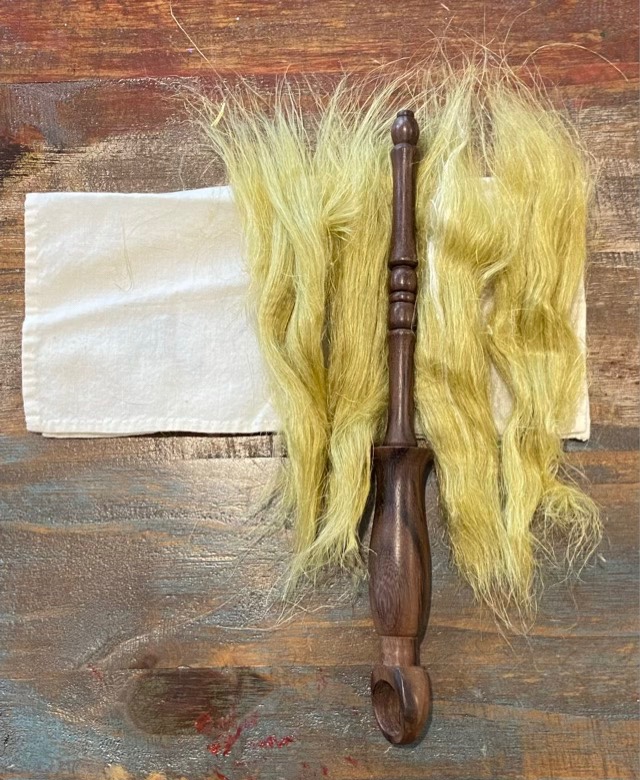
After the initial (abysmal) trial, I pulled up a book on spinning flax (and yes, I often do my research after trying on my own). There are several different preparations of flax. I did not have the yard-long fibers, I had combed top roving, which has a staple length of about 5-8 inches. The Practical Spinner’s Guide – Cotton, Flax, Hemp recommends using a distaff to hold the fibers. My sister gave me a distaff, but I hadn’t successfully used it yet. So I separated out sections of roving, pulled out the distaff, a handkerchief (also from my sister), and some cord, and “dressed the distaff”.
Flax fibers aligned on a handkerchief with distaffDressed distaff with flax and long shaft top whorl spindle
I changed up spindles as well. The freshly spun flax single is stiff, and the book’s author (Stephenie Gaustad) recommends wrapping the yarn at a low angle along the shaft to minimize bend. So I pulled out one of my top whorl student spindles with a long shaft. Drafting is different too. I tend toward worsted draw (short draw, keeping fibers aligned) but do rely on a little twist to draft out the fibers. Most spinners fall somewhere on the worsted to woolen draft spectrum as a default. Spinning flax I need to pull out the fibers, hold them, then let the twist in. It is a two handed operation (or at least a four opposing digit task). Flax also doesn’t need or want as much twist. If I spin the spindle too vigorously the thread snaps. I have dropped my spindle many, many times. I’m learning to give a gentle spin. It is enough.
Current progress on flax spinning
I am gaining a deep sympathy for the miller’s daughter in Rumpelstiltskin. If it was flax she was spinning (which honestly looks like straw and is spun into valuable linen), and her Dad had a tendency to the poetic embellishment, and the king was literal minded and greedy… well. Stuck in a room full of the wrong kind and preparation of straw with a spinning wheel (that was also probably the wrong kind), I can see her despair. It is still too bad that her cleverness didn’t extend to explaining metaphor, but not all of us are quick with the spoken word.
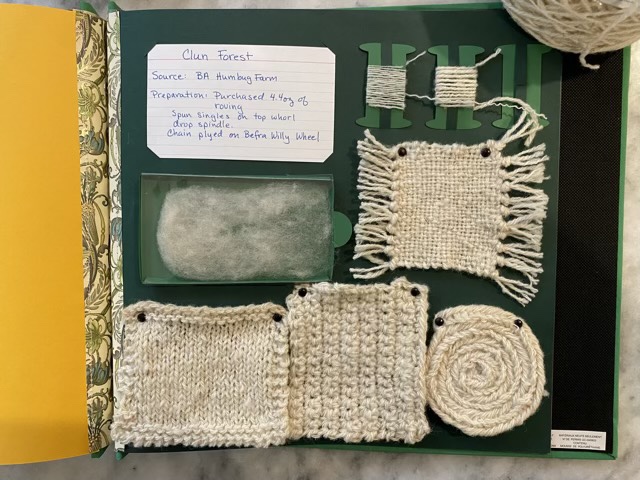
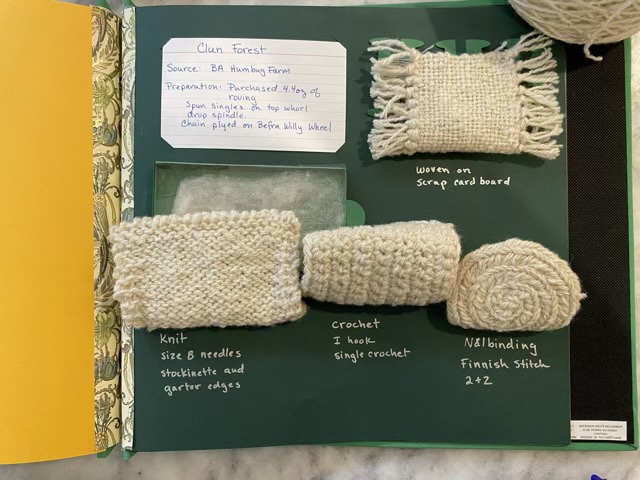
I have finished my Clun Forest hand work samples and mounted them on a page in my fiber book. I made swatches by knitting, crochet, nålbinding, and weaving.
Clun Forest wool fiber pageWith descriptions
I would not make a garment out of this yarn, a rug, yes, or basket maybe. I think though that I overspun the singles. This article talks about how Clun Forest is the best for hand-spinning and produces a “very soft yarn”. My yarn sneers at “very soft” with its fists up. Perhaps on a spinning wheel with low twist some loft would be obtained, but my drop spindle spinning produced a sturdy single. Sturdy, not soft. Hm.
Nålbinding produced the squishiest swatch, and with a liner would produce a respectable hat which could potentially deflect plummeting white acorns. I just noticed that I mounted my nålbinding round wrong-side up. Hm. Easy to fix with the brads. Easier than taking a new picture. Ha.





 Critters and Craft