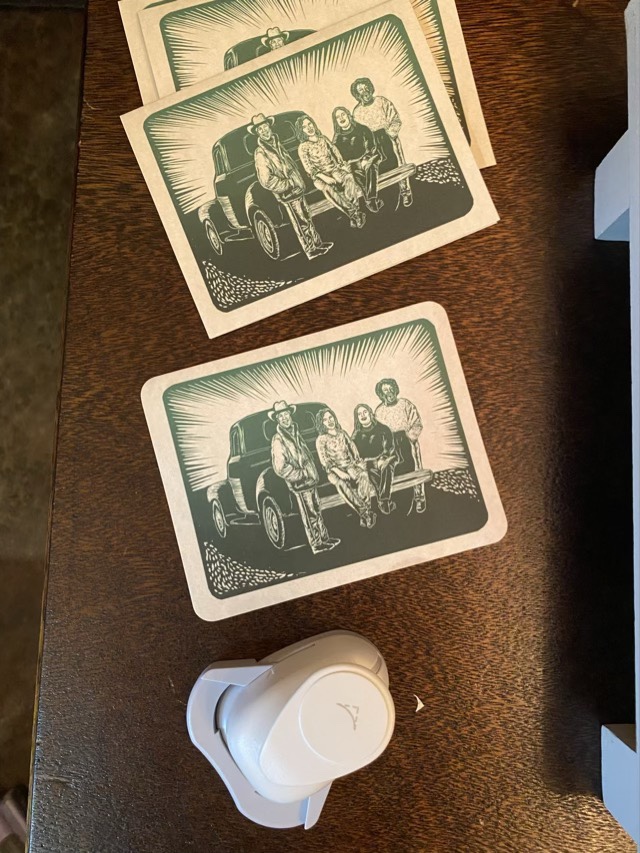
I had fun making a new holiday card design. My intention was to imitate a linocut technique, but in Adobe Illustrator, so instead of building shapes, I erased bits from the shapes. Then I applied a gradient color to the left over parts to imitate hand painting a stamp, and printed on recycled card stock. To finish off the cards, I used a rounded corner punch, and hand-stamped the greeting inside.
Photo description: Linocut-like design showing a quartet casually dressed singing around the tailgate of an old truck, corner punch shown in foreground.Photo description: Two cards, one showing the front, the other open to show “Happy Holidays“ stamped inside, stamp and ink pad on the right.
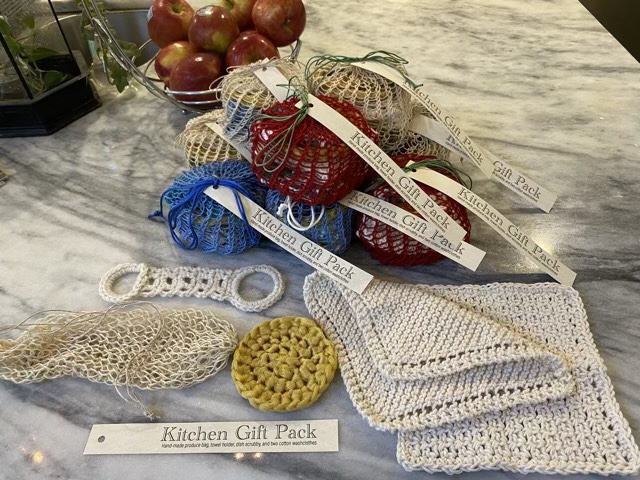
I combined all the kitchen aids I’ve been making into a bundle to sell at a local craft fair. The produce bag is the packaging, and inside are two cotton washcloths, a dish scrubby, and a towel holder. I even did them in a variety of color combinations.
Photo description: Stack of filled and labeled hand-made produce bags, with the contents of one bag displayed in front, all sitting on a kitchen counter with a basket of apples in the background.
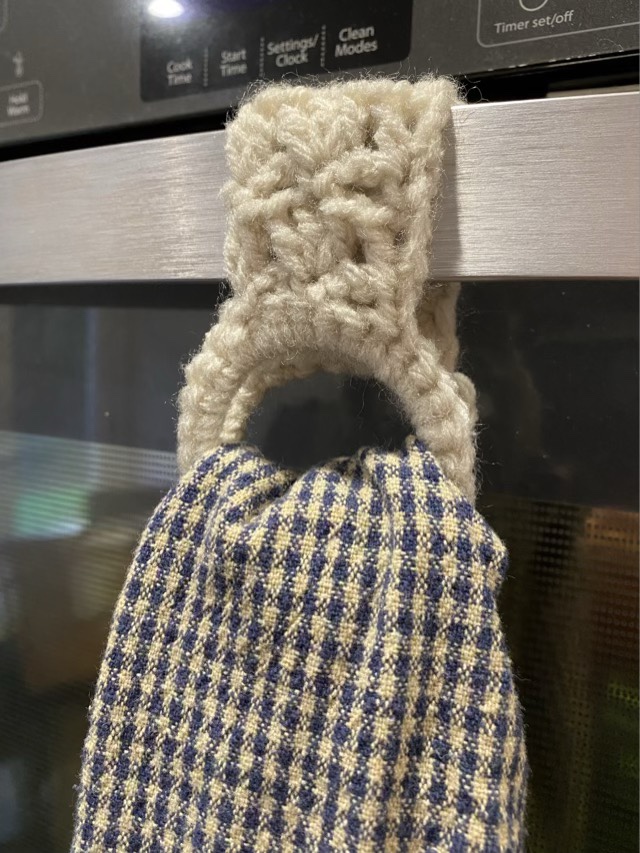
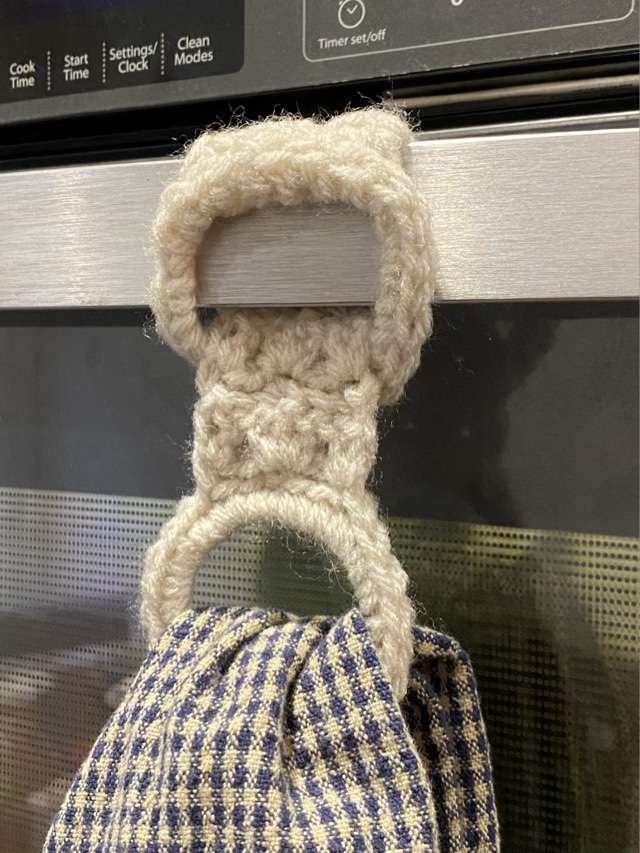
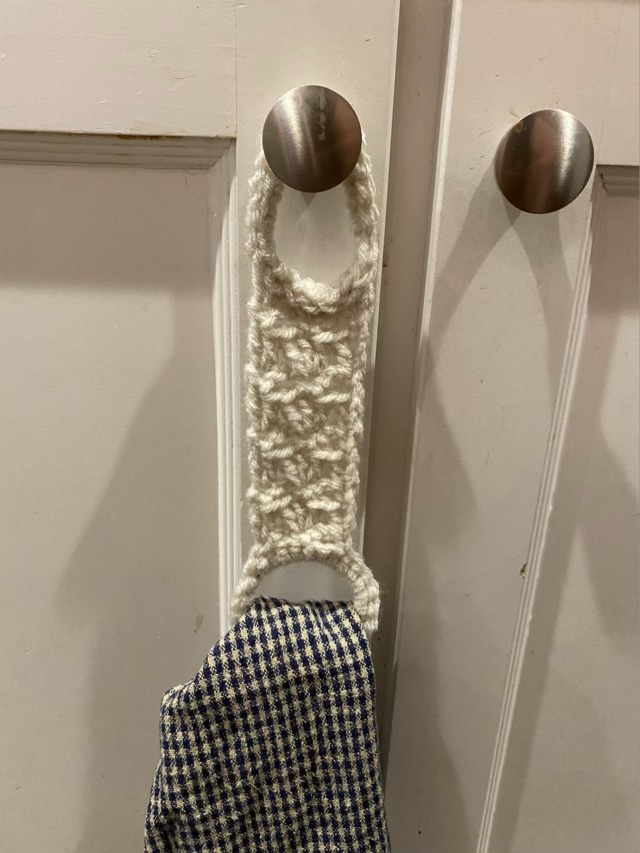
Here is a versatile little towel holder! It uses one metal ring, which is covered with single crochet stitches, a band that can be any pattern of stitches with a 2-4 repeat, and a soft loop made by making a chain long enough to go around the metal loop, then is also covered in single crochet stitches.
Photo description: crocheted towel holder hung over an oven handle with a cotton hand towel threaded through both loops.Photo description: Same towel holder, but with the hard loop through the soft loop over the oven handle. This configuration is nice because the towel holder will stay on the handle even without a towel.Photo description: Same towel holder hung from a cupboard knob.
On the holder pictured, row 1 is a single crochet (sc), chain 2 (ch2), sc, ch2, sc. Then row 2 is ch2, double crochet (dc) in first sc, 3dc in next sc, 2dc in last sc. Row 1 and 2 are repeated. After making the soft loop, I like to sc across the top of the band as well, then tack the edge down to make the circle a little neater. These can be made with any yarn, and different bands. They are quick and useful!
I have a new favorite way of making washcloths. Although I love the diagonal knit cloths, I really am a slow knitter. It takes me literally hours to knit one washcloth. Crochet however takes half the time for the same size cloth, and a simple single crochet, chain one pattern is easy to remember and makes cloth with a nice texture that is not so thick that it takes days to dry.
Photo description: Natural white cotton crocheted washcloth with loop.
I use a hook one size bigger than what is recommended on the label, then chain 30. In the second stitch from the hook, single crochet (sc), then chain (ch) 1. Skip a chain loop, and repeat the sc ch1 across. Turn the work, sc in the previous sc, ch1, repeat across. Continue rows until the fabric is square (test by folding it diagonally.) Sc around the outside, making a ch7 loop at one corner. I find 2sc in the other corners is sufficient to turn the corners.
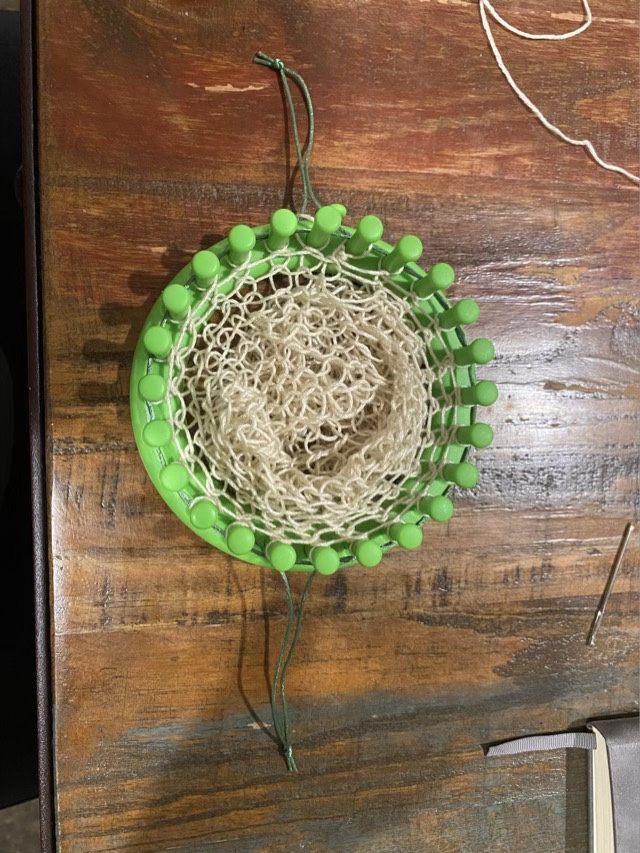
I have found a use for my knitting looms: string bags. I had some acrylic Luster Sheen yarn by Coats and Clark in my stash, and I probably inherited it since the price tag is from Woolworth for $1.49! It is strong and thin, which is great for string bags. I follow the included instructions to start knitting. These looms recommend a twisted stitch, which also works better for bags as they retain their spacing better. After the first pass, I run the tail through the first round to close off the bag. The end won’t completely close until the fifth round or so, but it is easiest to find the loops after that first yarn over. I then continue to knit until I have about 12 inches of fabric, pulled straight. To finish the bag, I run two lengths of satin cord through the last round to make drawstrings.
Photo description: Small round plastic knitting loom with string bag attached and satin cord hooked through each loop on the pegs.Photo description: Same loom shown from the top, with two knotted loops coming off opposite sides of the bag.Photo description: Finished empty string bag with drawstrings closed sitting on a table.Photo description: String bag filled with four large apples, showing how the twisted loop structure stretches.