Two to one

I have Frankenstein’d my shirts before, where I have two shirts with opposite positive attributes, so I combine them. Mostly it involves ripping seams, cutting, and sewing back together. I’m at it again. I found a printed tee that I liked the print and the message: “Keep going, just to see what happens” with singing dancing skeletons. But it is a “women’s” shirt, so has cap sleeves and a snug fit. Bah. I have an old shirt with lovely full sleeves, but a high neck and short body. Also Bah.

Photo description: Peach t-shirt with skeleton print and an olive green shirt with butterfly sleeves.

I like peach and olive green together, so I selected these shirts for tailor surgery. I ripped out the seams on the peach shirt, except for the shoulders, and cut a larger neck hole. I cut the sleeves and the hem off the olive shirt, and a two inch section of the body. I sewed the olive green strips into the side seams of the peach shirt to give it more ease, sewed the butterfly sleeves in, then used the olive green hem to edge the neckline.
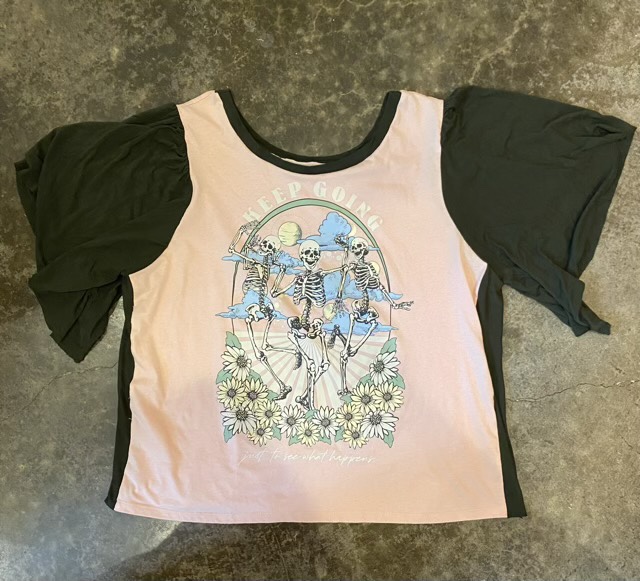
Photo description: Printed peach tee with olive green butterfly sleeves, side gussets, and new scoop neckline.

I like how it came out. Before I had two shirts I would not wear, now I have one shirt I will.
Knitting WIP

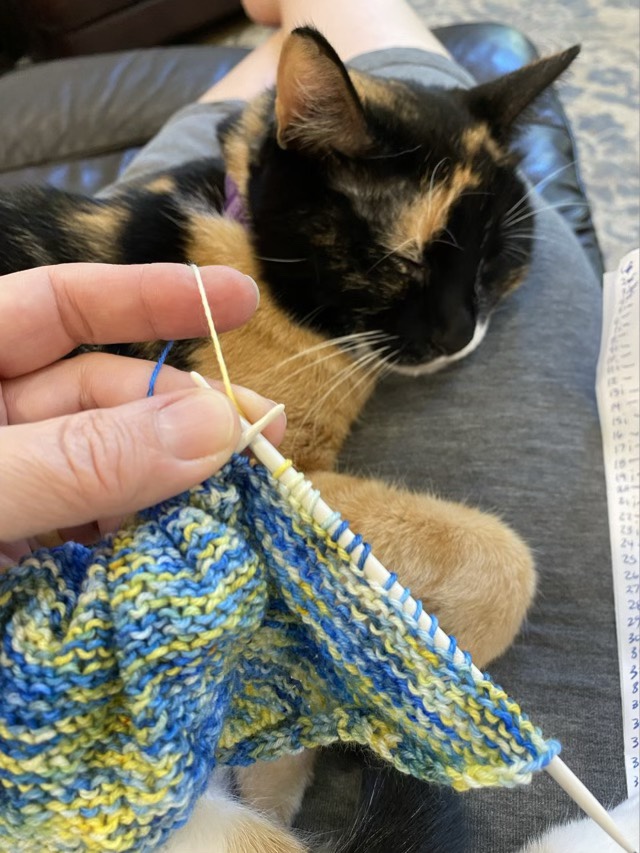
I have two knitting works in progress. One needs a section ripped out, so is resting until I have the courage to tackle it, and the other I cast on several months ago, and am now circling back around to work on it. This is a fingering weight sweater (right? Crazy.) that I bought the yarn to support a cause, and determined I wanted to make my youngest an actual garment. The knitting isn’t hard, but it does take a long time. Izzy the cat appreciates it when I knit; I provide a long-term nap space.

Photo description: Yellow and Blue fingering weight yarn on Prym circular needles in the foreground; in the background a sleeping calico cat laying on my lap.

I am acknowledging that this will be an on-again off-again project as other shiny things distract me.

Testing

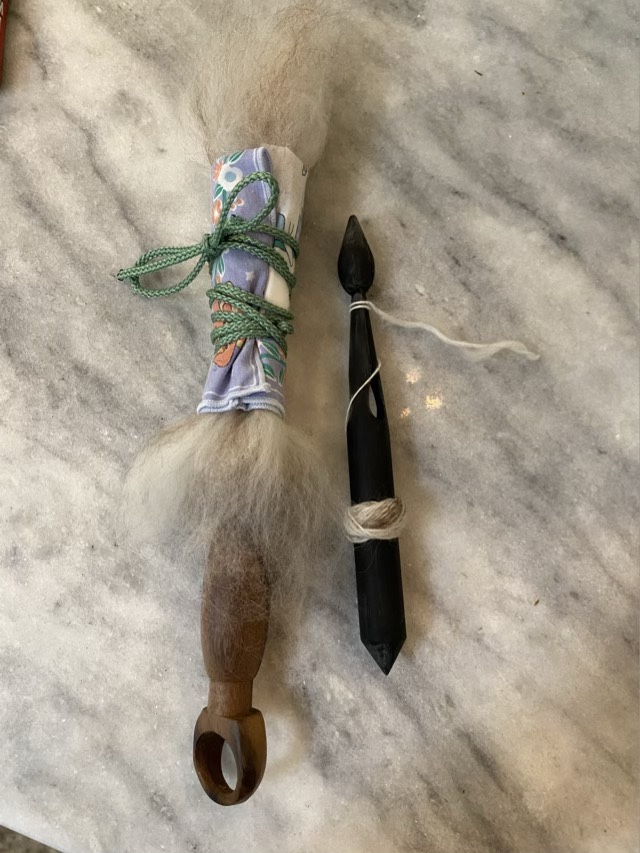
Photo description: One the left a rosewood ring distaff dressed with blended wool and a handkerchief, on the right a custom 3D printed drop spindle with a small amount of spun yarn.

The test of the new 3D printed spindle went well. I dressed my distaff with a locally obtained wool blend and took my new spindle for a walk. I dropped it twice on the asphalt to no ill effect. Hurray! This is the first time I’ve used this distaff for wool; I figured out how to use it when I needed to control flax roving, and it works just as well for wool. I’ve seen others wrap their wool roving around the distaff, which for me is maddening. As I draft, the fibers pull tight and lock in a spiral. By laying the wool out parallel to the distaff in small sections, and securing it with a handkerchief and cord, the fibers drafted easily off the bottom of the bundle. Nice.

Cleaning

I’m still picking away at the model 27 sewing machine, removing small bits of dried on oil and dirt.

Photo description: Singer Manufacturing Company trademark in bronze, covered with a thick patina of oil
Photo description: Same seal after cleaning with a bamboo stick and sewing machine oil, with only a slight patina left in the crevices. Photo also shows a shiny stitch regulator knob.

My friends and family are probably getting tired of hearing a “scritch, scritch” noise when I’m on the phone. But it helps me focus. I’m not cleaning all the patina off; getting it back on in artful amounts can take years. I did figure out that I can clean the parts that are stuck in place, and continue to soak them in oil until the threads release. A thin strip of nylon netting is great for getting into the screw threads.

Photo description: Top of the machine, one hand is holding a dirty length of nylon netting along the threads of the pressure foot tension knob.

I’m not sure what I am going to do about the gold decals. They are quite delicate and are already flaked off to the silver base, or rubbed off entirely in areas. I do feel I need to remove all the loose paint, because I don’t want it flaking off onto my fabric. Experiments continue.

Bamboo page

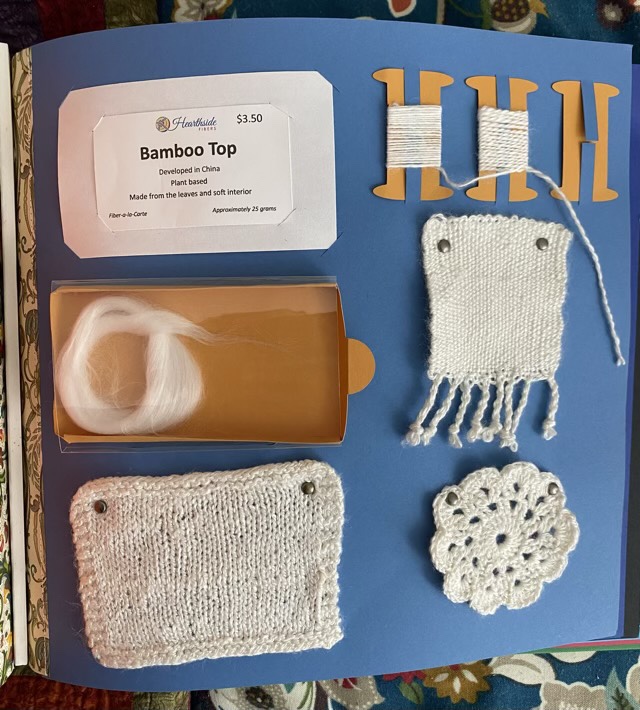
Photo description: Clockwise from top left: “Bamboo Top” card which reads “Developed in China, plant based, made from the leaves and interior”, single spun yarn on a paper bobbin, 2-ply yarn, swatch woven on a Clover mini loom with 3 selvages, crocheted lace round, knitted rectangle, unspun fiber in a paper box.

Spinning my bamboo sample was very enjoyable. The fiber is soft, and the staple is a nice length. I did have some static issues, but those that were resolved with a spritz of water. I spun the singles on a drop spindle, and I kept the fiber and spindle in my purse to spin during waiting times. I made the two ply yarn from a center-pull ball using the same spindle. The fiber has a beautiful luster.

Photo description: A hand holding a single spun bamboo yarn wrapped nostepinne style on a 3D printed spindle.