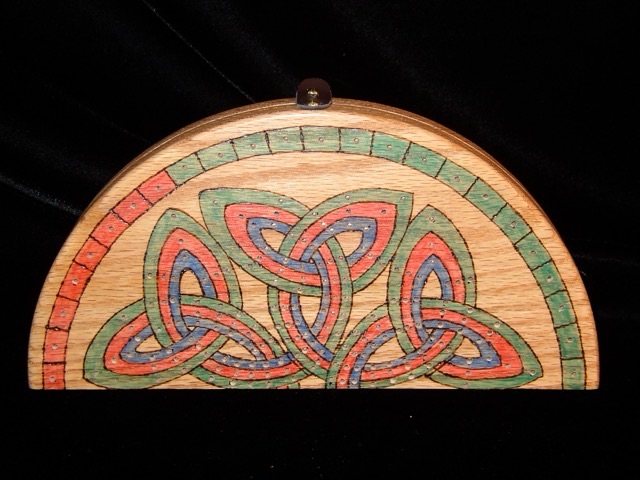
I went all out on this custom cribbage board back in December of 2004. I designed the Celtic knot triple path, shaped the oak board, carved storage recesses, installed hinges and a custom leather clasp, and even handmade the pins from twisted wire capped with blown glass.
Photo description: cribbage board shown paying side up, with three colors of glass pins, red, green, and blue to match the paths of the Celtic knotPhoto description: cribbage board shown closed, with half the pyrography design visiblePhoto description: cribbage board shown open with storage compartments
Decembers before kids are a treasure trove of throwbacks. This board is pretty, but it hard to actually use, especially when there is alcohol involved. Those loops and whorls make counting a dizzy prospect.
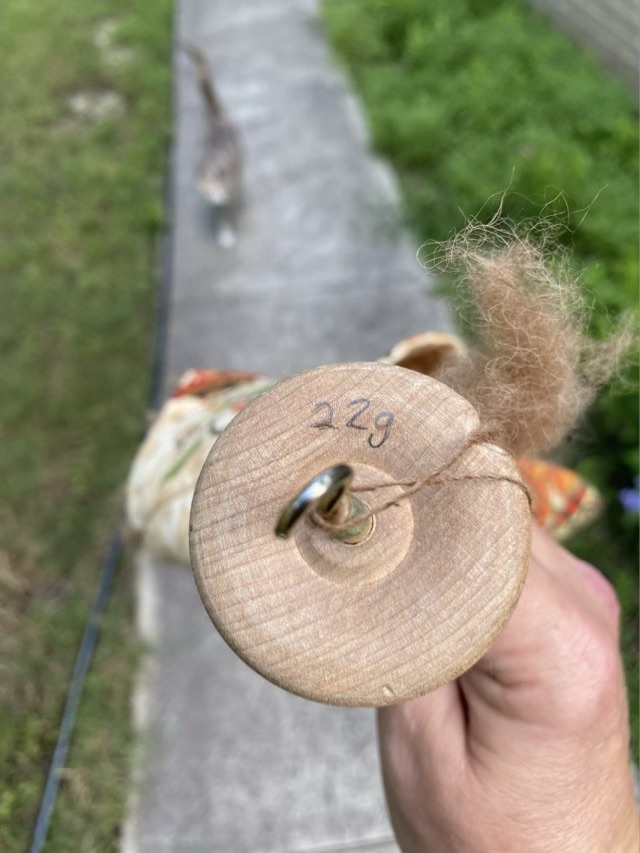
I wrote down the tare weight of my spindle so I could track the amount of yarn I’m building up.
Photo description: 22g written on the whorl of a hand made drop spindle, camel fiber and arm bag visible behind the whorl, calico cat on the sidewalk in the background
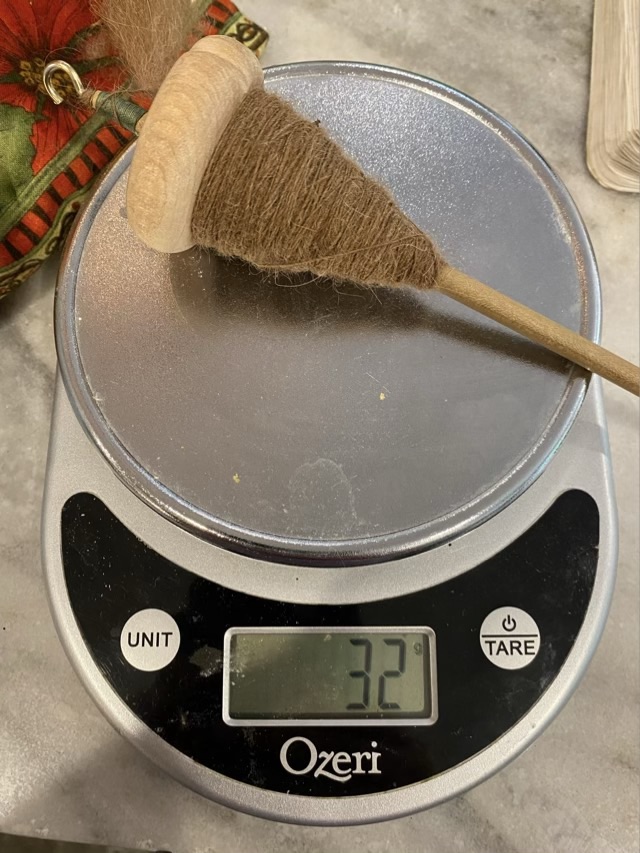
I’m working on a camel bump, which amuses me. Camel fiber is quite soft, and the mill processed it into a “bump”, which is roving wrapped into an oblong, much like how yarn is sold in the big box stores. I’m spinning it on my daily walks, then recording the weight.
Photo description: drop spindle with brown camel single spun yarn in a cop below the whorl, sitting on a digital scale that reads 26gPhoto description: same spindle the next day, and the scale reads 32g
My efficiency is improving, or I’m walking longer, which are both valuable outcomes. I spun 4g of fiber the first walk, and 6g on the second walk.
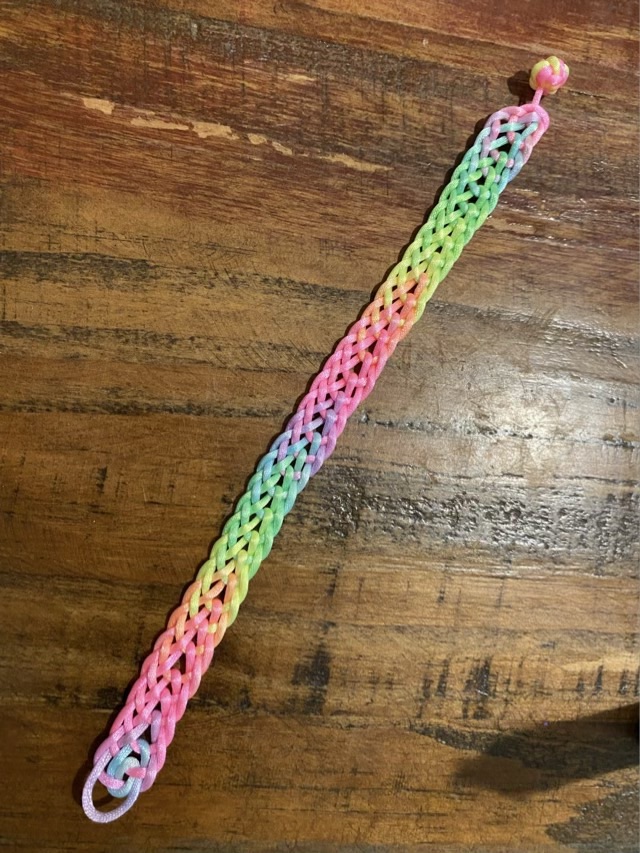
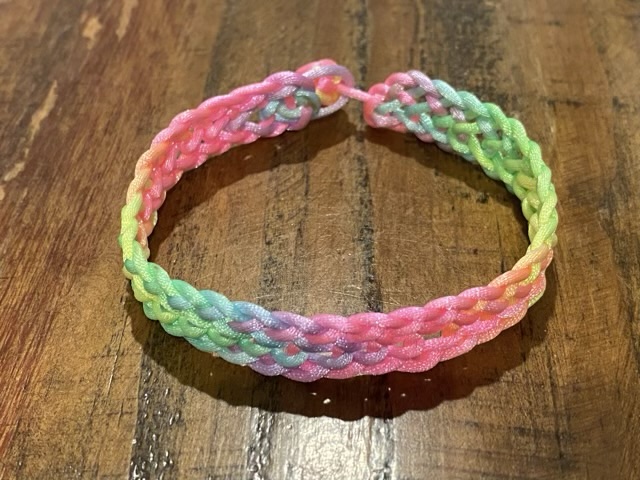
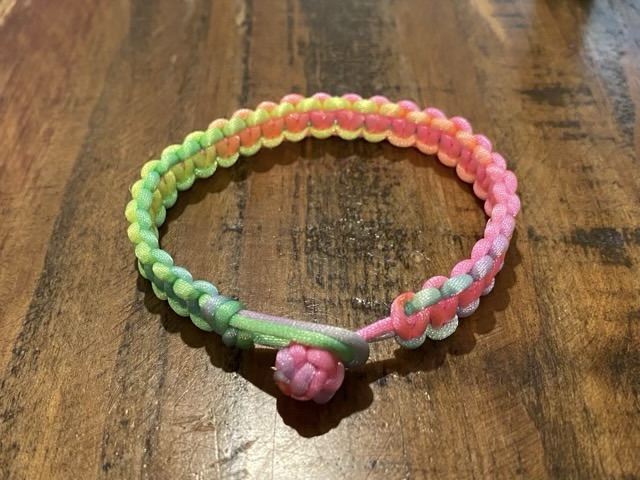
The colored bracelet experiments continue, and this one is a winner. I tried a nålbinding stitch with the neon rainbow satin cord, specifically the Telemark stitch in the Russian stitch family. It works beautifully. Not only do the interwoven loops look pretty, the color transitions are aesthetically pleasing.
Photo description: neon rainbow satin cord looped into a wide woven band using a Telemark nålbinding stitch, finished with a loop on one end and a celtic button knot on the other
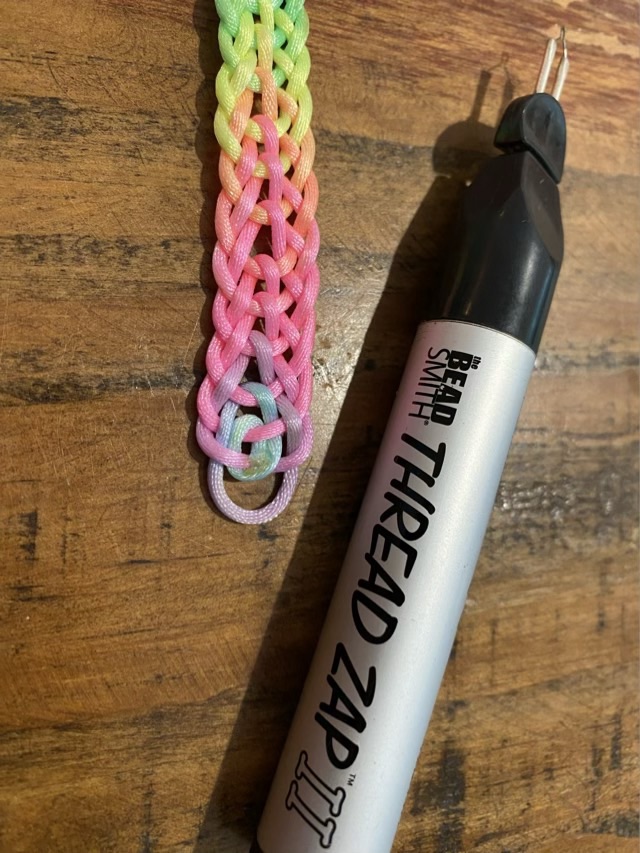
The nature of nålbinding also makes finishing the ends less awkward. For the looped end, I pulled out the beginning stitches (which for me are always weird), and spiraled the end into the weave, securing it by melting with the hot wire Thread Zap.
Photo description: loop end of the bracelet showing the end of the cord melted to the neighboring cord and the Thread Zap II tool
The other end I pulled the loops closed, leaving a tail end which I tied into a button knot. The loops are stable, the clasp mechanism elegant, and I’m already planning additional projects!
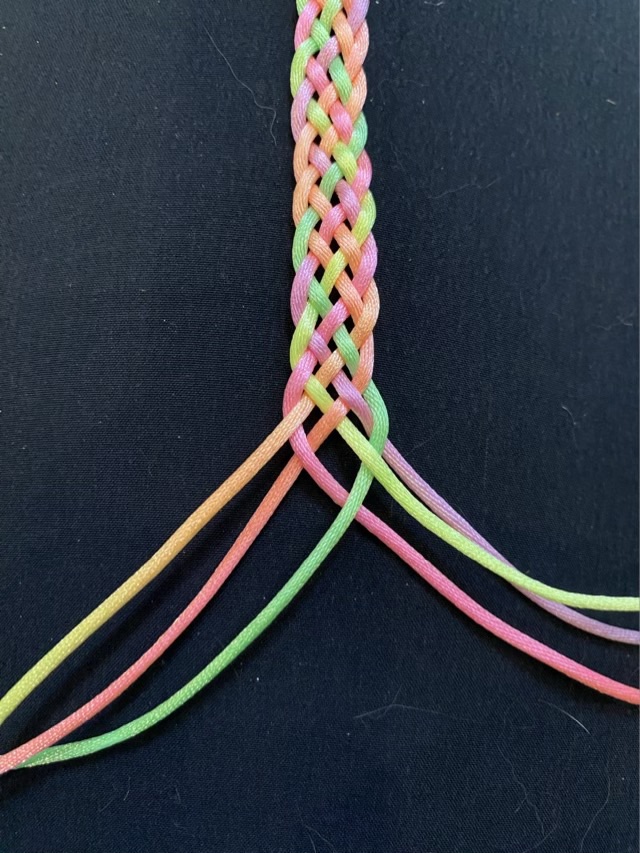
Not all color experiments come out well, which is why we call them experiments. I thought a six strand braid might be pretty and cut six long pieces of the neon rainbow satin cord, but didn’t pay attention to color layout, just randomly snipped.
Photo description: six strand braid in process with neon rainbow satin cord
Closeup you can see the individual colors wondering through the braid. Move back and it becomes a solid mass of easter confetti, like the easter bunny ate a bad egg or twelve.
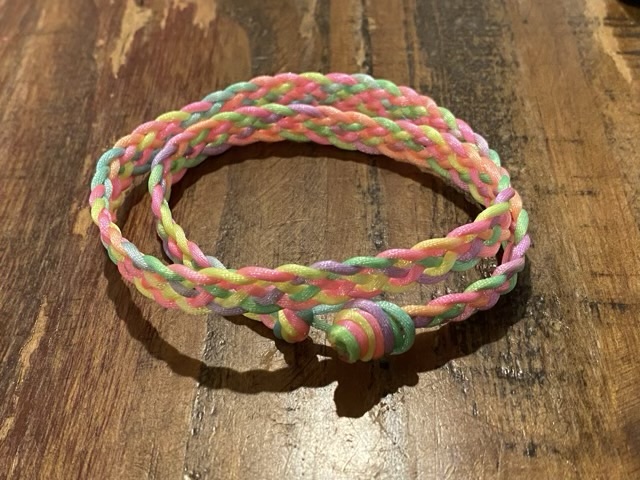
Photo description: finished braided double bracelet with loop and overhand knot
I had cut the strands so long I was able to braid the bracelet enough to be doubled, which didn’t improve the impression of… confetti.
So that gets filed in the “try it differently next time” bin.
I enjoy the way the variegated color satin cord interacts with knotting, so I am continuing my bracelet series with an experiment with macrame. This is a four strand bracelet with the outer two strands tied with macrame square knots around the inner two.
Photo description: macrame bracelet with a double loop and Celtic button knot closure made from neon rainbow satin cordPhoto description: same bracelet shown in a closed loop
The color play in this piece also pleases me. The way the color shifts in each strand and how it transitions in relationship to the other strands is attractive.
I realized today that I am a curator of rabbit holes. My posts are the tiny plaques in a museum of potential deep dives. I am OK with this.