Flashback: chicken bench

The fold down benches that I installed in the chicken coop are still high on my recommended list. I used 2x4s, heavy duty hinges, two lengths of chain with lockable links, screw eyes, and a hook and eye to keep it in the upright position. It folds up so the chickens can’t poop on the surface, but is easy to fold down. It makes a great work bench for filling water, and is fantastic when I need to sit when I’m not feeling well but still need to tend the chickens.

Photo description: Fold down bench held up with chain, with an empty large poultry waterer and two chickens looking for grubblies underneath.

Ice blocks

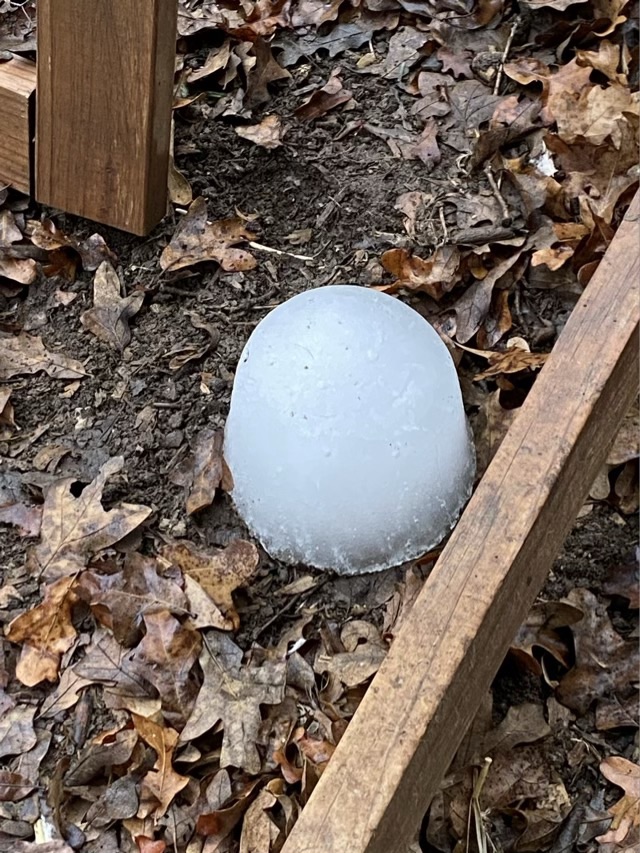
After our hard freeze a bit ago, I decided to empty out and refill the hanging chicken water when the temperatures rose back above 40. The chickens do have access to unfrozen water in a heated dog dish, but I’m glad I dumped out the ice blocks that had formed in the chambers.

Photo description: 5 quart chicken water container open with the block of ice next to it on the ground of the run.
Photo description: block of ice from the 3.5 gallon poultry waterer.
Photo description: block of ice from the 3.5 gallon poultry waterer 5 days later.

Even though our temperatures were above freezing the week after, it still took over five days for the big block of ice to melt.

Change

I have a hen, Seashell, sleeping in the nest box at night. Historically when this happens I take the hen off the nest and put her back on the roost with her sisters, which helps break the broody cycle, but this hen isn’t broody. There are no eggs in the nest, and haven’t been since September. They won’t start laying again until February, if they follow the same pattern as the previous three years. She started this behavior after we lost the last chicken, so I’m wondering if the hen that passed was her buddy and she would rather sleep alone than with the flock. Or the other hen offered her protection that is absent with the rest. The flock is quite clicky.

Photo description: Night vision photo of four nest boxes built in under a work bench, with curtains pulled aside, the back of a hen visible in the top right box. Pine shavings cover the floor, and there is a inverted wine bottle with dispenser for grit.

I have another hen sleeping off the roost, but that is Magic, who has periodic leg issues that impede her jumping up to the roost. She sleeps on her pedestal of pine in the left corner of the coop.

Photo description: Night vision photo of the inside of our coop, with three hens on the roost, one in the corner, and one in the nest boxes.

Slow ideas

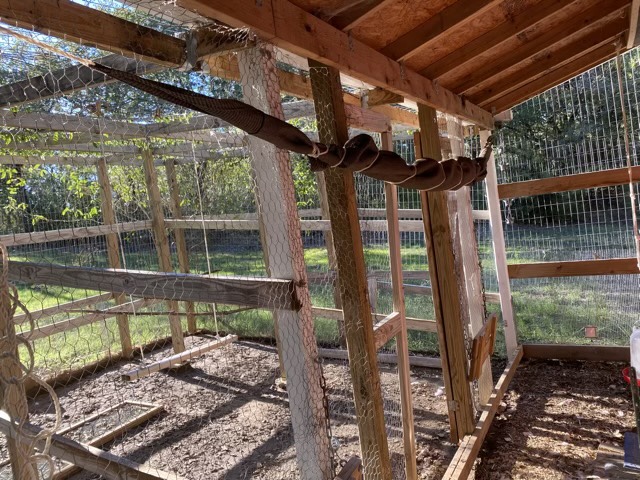
Each summer I put up a sunscreen in the coop runs to keep the afternoon sun off the feeder and the side of the coop. Each winter I take it down so the sun can warm the coop. Both operations are a pain, wrestling with the large triangle of fabric. Until this year, when one of those slow ideas finally bubbled to the surface and I thought to just roll up the sunscreen. It took a few moments to secure the roll, but should only take a few moments again in the summer to deploy the screen.

Photo description: View inside the chicken runs, under an awning, with a roll of fabric stretched across the upright posts.

I do believe that there are many ways to accomplish any task, and find it interesting how often the thought “why didn’t I think of that earlier” happens.

Raccoons

We’ve known that raccoons live in our woods since shortly after we moved in, thanks to our trail cam. They are one of the reasons that my husband built the chicken coop like Fort Knox. It is more effective to design to keep predators out, than to relocate or kill them. More predators will just move back into the area. I regularly check the perimeter for predator incursion and this week found that the back door had been broken.

Photo description: Split screen door made of two layers of wire mesh and 2×4 wood, with the left joint broken open.

I made a screen door from 2x4s a hardware cloth so during our hot summers I could let a breeze from the cooler woods pass through the coop. It really helps. A regular screen door wouldn’t hold up to raccoons, and neither would poultry wire, which is why, when I decided to leave solid door open at night, I added hardware cloth. The door halves are secured with latches and locks, but the raccoons have been pushing at the bottom right corner of the door until the opposite joint gave way. The chickens are fine, the raccoons still couldn’t get in, but I needed to reinforce the door. I fixed the joint with two new screws, added a new latch on the inside top, replaced a couple of the hinge screws with longer screws, and put a big rock inside at the bottom of the door.

Photo description: Sliding latch installed on the inside of the screen door.
Photo description: Door hinge with upper right screw replaced.

The raccoons have been hanging around the back of the coop. I have a large water dish back there for the neighborhood cats, and I was perplexed when I would clean and fill the dish, and the next morning it would be nearly empty and filthy.

Photo description: Large blue water bowl with about an inch of brown water sitting on a wood table.

I set up our trail cam and obtained a photo confirming raccoon activity.

Photo description: Gray and white night photo with a raccoon in the foreground on the wooden table with the water dish, and a raccoon on the stairs to the back door with the bottom of the door pushed in.