Plethora of Potholders

So I admit, I didn’t just get one set of potholder loops, but several, and experimented with color and weave pattern for weeks using a Pro Friendly Loom. This isn’t the smaller sized loom usually given to kids (which, if you want to give your kid the experience of weaving, wrap yarn around some cardboard and give them a blunt needle, then go to potholders). The Pro Loom produces large thick squares that are ideal in the kitchen. A nice touch is adding a metal or wood ring to the final loop, which is aesthetically pleasing and secure. Piglet’s Potholder Patterns has more ideas than you can make with 10 bags of loops, and is a lovely rabbit hole. Since the potholders are cotton, they are washable. Friendly Loom recommends washing them in a washing machine and hanging them up to dry.

Photo description: eleven pro sized potholders in purples and oranges with various patterns
Photo description; three more potholders in different colors

I still have a few odd loops left, which is OK, they might find their way into a potholder eventually, or be used in a different way.

Angora rabbit fur

My next spin-and-walk project is with angora rabbit fur. I didn’t card it, comb it, or wash it, I just grabbed handfuls straight out of the bag where the farmer placed the shorn fibers. I wasn’t expecting the short second cuts, but I’m rolling with it and making it into an experiment.

Photo description: handful of white angora rabbit fur with short second cuts (where the shears passed over already cut fur and cut short sections) and guard hairs (thicker longer hairs in the fur)
Photo description: single spun yarn with the second cuts caught in the twist sideways, making it very fluffy

Some of the shorter lengths of fiber get caught sideways when I’m spinning, like a bottle brush. I don’t think all of these will stay embedded in the yarn, but it will be interesting to see what does. It does make the yarn fluffy in a sporadic way.

Photo description: first walk’s worth of spun Angora rabbit fur

Angora is usually blended with other fibers so this is also an experiment on how pure rabbit fur behaves both in the spinning and in fabric.

Throwback Thursday: ring frame

In March 2011 I made a shadow box into a ring holder for my sister. I sewed tubes of velvet and inserted foam rods, covered panels of paper board with velvet to line the sides, and bottom, then glued the velvet cushions tightly in place.

Photo description: velvet lined ring box built in a purchased shadow box
Photo description: shadow box with frame reinstalled and two new silver rings added, one spiraled wire, the other made from silver clay

I designed it with the idea that it could hang on a wall and still keep the rings in place. I gave it to my sister with two new rings. I checked in with her and it is still in use over 13 years later!

Toe beans and feetsies

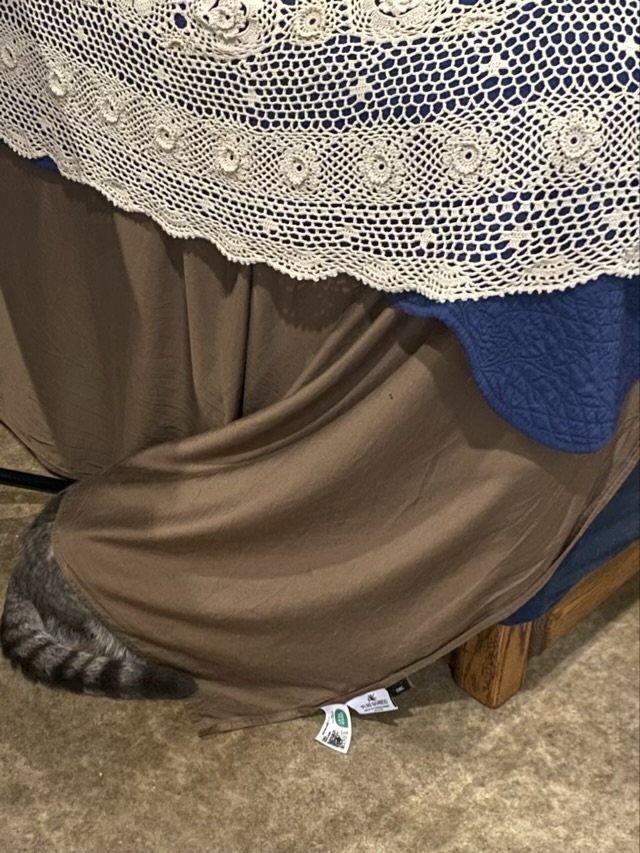
Today I present to you the toe beans of feetsies of the mighty Thor the gray tabby cat in two of his favorite spots.

Photo description: gray tabby cat with all four feet at the edge of a cat tunnel on top of a well loved cat tree
Photo description: same tabby cat curled up on his side on a homemade cat box showing all four feet

You’re welcome.

Plying rose

I have two plied my rose top. I spun the single a little thicker, so a two ply is sufficient to make a nice yarn. The rose fiber is harvested from the stems and leaves of the rose plant, processed in a similar way to Tencel, extracted from plant waste. I like the feel of the rose fiber and it spins up nicely. I plied from a center pull ball, then wrapped the plied yarn into a nostepinne style ball (my favorite kind of center pull ball).

Photo description: two ply rose fiber yarn on a drop spindle, asphalt in the background
Photo description: nostepinne style ball wound on a roll of card stock, drop spindle empty, asphalt in the background

I’m not going to wet block this yarn. I have time to let it sit while I finish up other projects, which will set the twist.