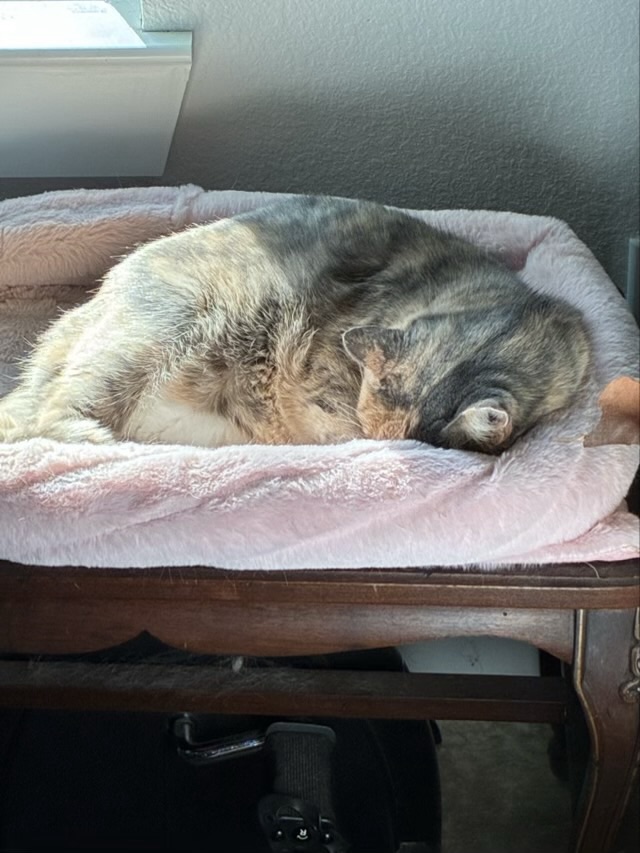
The fancy cat bed that I made from a repaired stool was finally deemed an acceptable offering, mostly by Sophie the dilute calico.
Photo description: dilute calico curled up in a pink fuzzy handmade cat bed mounted on an old ornate wood base
Lately Thor the gray tabby has also taken to lying in what we’ve been calling “the princess bed.”
Photo description: large gray tabby filling up the same cat bed in the colored lights from the tree
He’s a big boy. 18 pounds at his last weighing and he takes up the whole bed. Little Sophie only takes up half, weighing in at a round 11 pounds. (She has a small frame and is a little rolly polly.)
This isn’t much of a story about two cats, but the title of the post amused me.
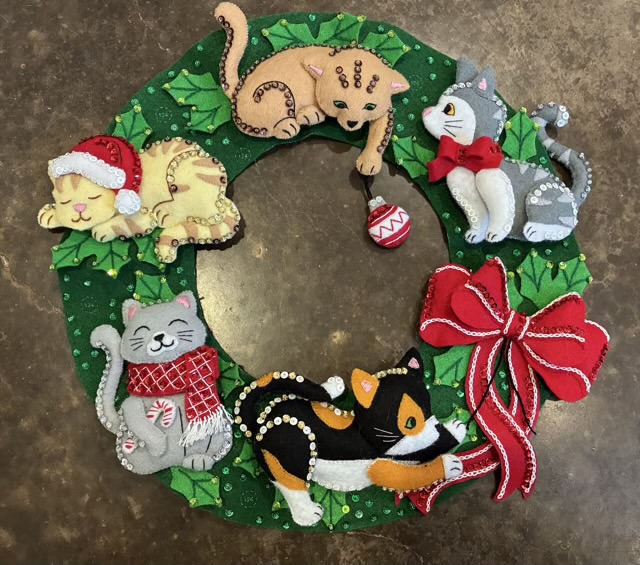
After the felt cats, the next step of the Bucilla wreath kit is a large red bow. This post almost had a different title, because as I put the bow together I realized that there weren’t enough red sequins left. Hm. I had a choice, do another deviation from pattern and use a different color sequin, or source more red sequins. I’ll admit that I raided my kid’s felt kits for the sequins (that have sat unused for two years, so there were no tears or admonishments).
Photo description: In process Bucilla felt wreath kit with five felt cats and a large red bow on a background of green and holly leaves
I was rather startled when I found an egg in the coop. The last time Wingding the Black Star hen laid an egg was in August. My two Faverolle hens haven’t laid any eggs since April. All three hens are about six years old and well past prime laying age.
Photo description: light brown egg in my hand in the foreground and a Black Star hen and a Faverolle hen in the background
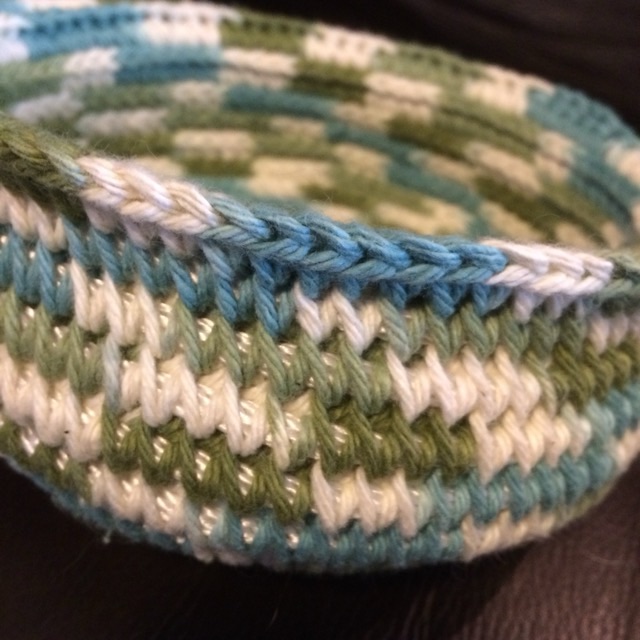
As I was scrolling through old photos I came across a mystery in May 2016. My memory is full of holes, which is why I take pictures and write in a journal. I found a picture that I had no memory of taking, or why. Here is what I think happened in April 2016. I crocheted a basket with cotton variegated yarn around a rope core as an experiment.
Photo description: olive, teal, and white variegated cotton crocheted basketPhoto description: closeup of basket showing a rope core under the crochet stitches
Two weeks later I have a picture of this same basket lashed to a branch as a makeshift nest for baby birds.
Photo description: baby birds in a nest inside the same crocheted basket
I don’t recognize the car in the background. The tree is not a live oak, which was the only kind of tree we had at the time in our yard, but the grass is St Augustine which was common in our neighborhood. The side walk configuration suggests a front yard. I did not write about the basket or the birds in my journal. What? So maybe it is not my story. I’m thinking a neighbor had a bird nest fall down and I offered my basket as a substitute nest. Maybe?
I do wonder what happened to those young birds and if the nest repair was accepted by the parents. Hm.
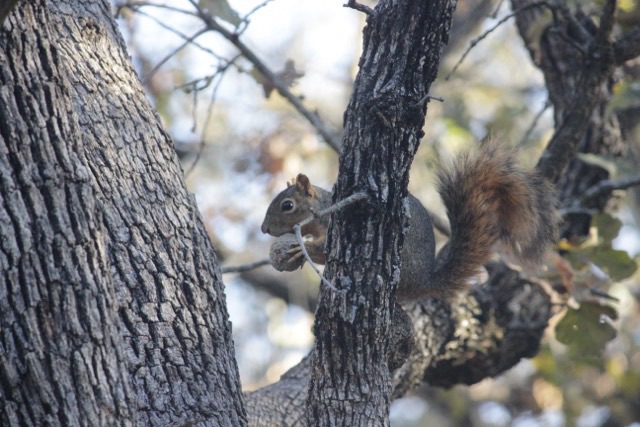
I was out and about and came across large white acorns fallen from a tree in a parking lot. I picked up a few and brought them home to the squirrels. It didn’t take long before the nuts were discovered and carried off. I love the enthusiasm the squirrels have when I give them white acorns. We have post oak in the yard and the white oak acorns are ten times the size of the post oak acorns.
Photo description: squirrel resting on a knot on a post oak tree carrying a white acorns with cap in its mouthPhoto description: same squirrel higher in the tree stripping off the acorn cap by holding it in its front paws and using its teeth