Rabbit holes

I love Spin-off magazine, but it does send me down rabbit holes! After reading an article, I usually look up the author’s blog, which is almost always full of more interesting things. Melvenea Hodges of traditionsincloth.com had a lovely shawl pattern in the magazine, then in her blog talked about spinning cotton directly onto little wooden spools. Well, of course I had to try. I did not have any spools that fit my tahkli spindle (yet), so I took an empty spool and used rubber bands to hold it in place on the button whorl (reaching new Frankenstein levels here). I’m not spinning gorgeously prepared cotton sliver (as far as I can tell, cotton sliver is similar in appearance to wool roving, anyway, it is prepped fiber ready to spin), in fact, I’m spinning cotton packaging from vitamin bottles, but the spool idea is fabulous. Enough so, that obtaining some prepped cotton and making some proper spools is tempting. Maybe after practicing some more with the bonus stuff.
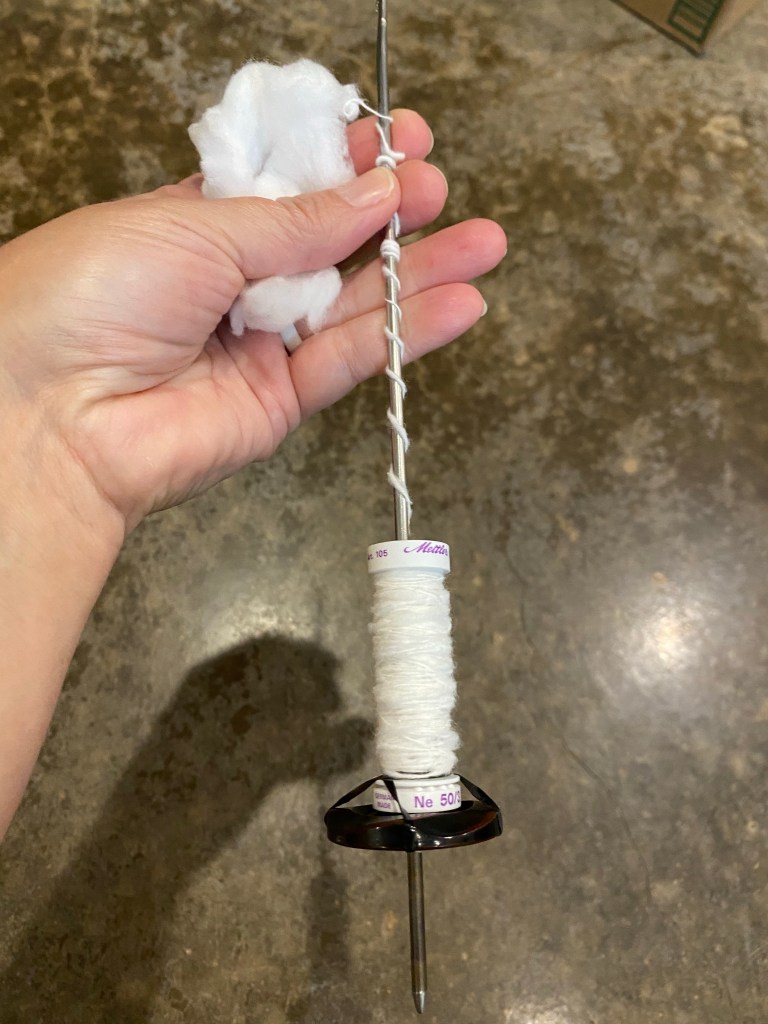
Using a thread spool to hold the spun cotton singles (not my idea)

Wheat-sheaf loaf

Well, I made a wheat-sheaf loaf. In Paul Hollywood’s book “100 Great Breads”, he says that if you can make a wheat-sheaf, you can make any of the loaves in the book. I’m not sure mine counts as a success. It looks slightly like it is supposed to, (although at a certain angle it looks a bit like a sperm swimming up the tube toward the egg), but wasn’t edible. I’m not sure it is meant to be eaten. Some people varnish theirs. Hm.

Harvest wheatsheaf with bonus wreath and snail (because I had left-over dough)

Hibiscus bloom!

Hibiscus bloom, about 8” in diameter

Our hibiscus is happy and blooming! Great big gorgeous flowers! And so many more buds. Hurray!

Hibiscus about to bloom

Lake weaving

Spent another couple hours out at the lake. I spotted a different variety of grass by the edge and selected a few long strands near the mowed part to see how they behaved when woven. My weaving skills are still very rudimentary, however I’m learning so much about construction in experimentation. The basket started off as I’ve seen in pictures for twined baskets, but then when I started up the sides my spacing narrowed into more of a rough vase than a basket. (I will say that it was laid down many times for the baiting of the youngest’s hook.) I made fair progress and decided to continue the study at home.

Experimental weaving with lake grass

Since the weaving wanted to narrow, I went with it, changing the uprights to weavers, thus narrowing the number of uprights. When I was down to five uprights, I braided them to end the sculpture. (We are going to call it a sculpture since I tucked all the ends inside and it is non-functional as a vessel.) I also don’t speak basket, so my terminology leans to descriptive. (Even when I know the proper terms, though, they don’t always surface appropriately, so there we go.)

Woven lake grass sculpture study