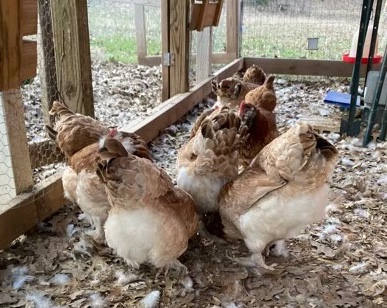
The crossvine we planted at the corner of the chicken runs has come into its own. It has happily spread vines across the welded wire and is in bloom. My eldest even spotted a hummingbird flitting from flower to flower! We chose this location because it gets the most sun of anywhere in the yard, and to provide shade for the chickens in the hot summer. The vine is performing admirably.
I’ve spun up my mohair from Rutabega the Angora goat, then plied it using a drop spindle.
2-ply hand-spun un-dyed mohair
I transferred the yarn to my PVC niddy noddy, wet it down and let it dry. I then had a hank of spun mohair.
2-ply mohair hank
Since working from a hank is a recipe for tangles unless you keep it stretched out on a swift, I then used my swift and ball winder to make a yarn cake. The inside of my cake went askew; I think I might have had too much tension as I wound.
2-ply mohair yarn cake
I am now ready to make swatches for my fiber page!
“What?” you say, “you have never been to a fiber festival? How is that possible?” Well, you might not say it, but the woman in the elevator did. I must say that she said it after cheering that it was my first visit. Yes, I have been working with yarn for around 40 years, but I only took up spinning just before the pandemic, and during the pandemic all the festivals were shut down. I have been searching out fibers to spin locally and online. Walking into a convention center with a huge room full of fiber was mind blowing.
Panoramic photo of the convention area, which really does not give justice to the amount of fiber that was really there
Probably 90% of the fibers at the festival were already spun and dyed, ready for the eager knitters that lined the aisles. But there were pockets of un-spun fiber in various preparations. I found bamboo, hemp, nettle, and yak (!) spinning fibers, all of which I have not yet attempted to spin. There were a few raw fleeces as well: mohair and Rambouillet. I caved on some white mohair (it was the first time the seller was offering raw fleece and it looked like she did a nice job skirting and labeling). Rambouillet is now on my wish list; I couldn’t quite face a whole fleece right now, but the processed yarn and blankets were divine.
Fiber Festival haul
I did find myself some wool combs, which appeared to be the last pair in the room. I also found an intriguing Turkish spindle 3D printed from flexible filament (more on those another day). The booths did cater mostly to the knitter, but there was representation for weavers, crocheters, felters, spinners, and there were even some nålbinding needles! After about an hour and a half, my brain shut down. It appears that I will have to work up my festival stamina!
The convention center was yarn bombed, which is fabulous
I’ve continued to make sourdough bread about every other week. Mostly I stick to rye since it has a lower glycemic index than white bread, even using heritage wheat, but the kids like the white sourdough, so it is still in rotation. My recipes don’t change, but I have been trying to perfect a leaf cut for scoring the bread.
White sourdough scored in a leaf patternRye sourdough scored in a leaf pattern
I’ve found that if I make a deeper large sinusoidal cut, then shallower cuts for leaf veins, the leaves sometimes lift up from the surface and look more like actual leaves. If I can manage to free the leaf tip, but leave the other end connected, I get a neat “stem” effect too. Neither of the pictured loaves have all my desired elements. I need to keep practicing.
I found this massive shelf fungus on one of my trees out back. It is about the size of both of my hands cupped together. iNaturalist has trouble with fungi, which is understandable since so many look so similar and to properly identify one a naturalist must do additional tests. I will not be taking this fungus through tests as I am not a trained fungi expert, but I will share the intriguing photo. If you want a laugh, Google “shelf fungi on post oak tree” and check out some of the suggested names in “About the image” for the fungus in the photos. Google images also has an abysmal time matching fungi.