I had been keeping the left over moss I purchased for my mossarium in the plastic container it shipped in, but I noticed some mold growing in there, so introduced the moss to an empty glass jar. I put some orchid substrate on the bottom, formed a loose ball with the moss, and tucked it i to the jar. Because it is a patterned jar, it doesn’t show the moss clearly, so looks… questionable.
Photo description: moss and substrate in an old glass jar with glass lid
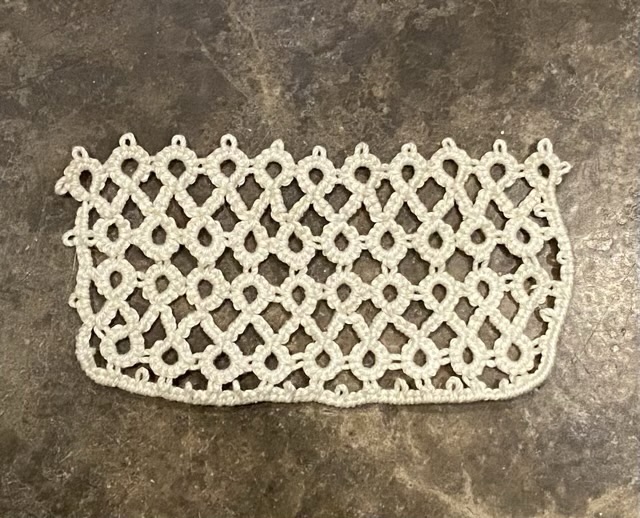
I tried a rectangular tatting experiment, connecting lines of opposite loops (there might be a name for it?) The picots line up well, but I need to work on my end turning techniques. I ran a solid edge around three sides, just for something to use up thread, and it helped me realize that tatting is a double edged craft. I need to be thinking of two sides as I knot. Knitting, crochet, and nålbinding in general work in single rows, making stitches that connect to previous stitches. Tatting “rows” are really connected motifs.
Photo description: rectangle experiment tatted with number 3 cotton, with many learning moments
I did block the piece, but it didn’t even out the wonkiness. It is an odd bit of lace, but I might find a use for it, and it certainly helped me understand tatting construction better.
P.S. This is actually a variation on a Josephine knot; it just puts a closed loop in place of a picot in the middle of the chain.
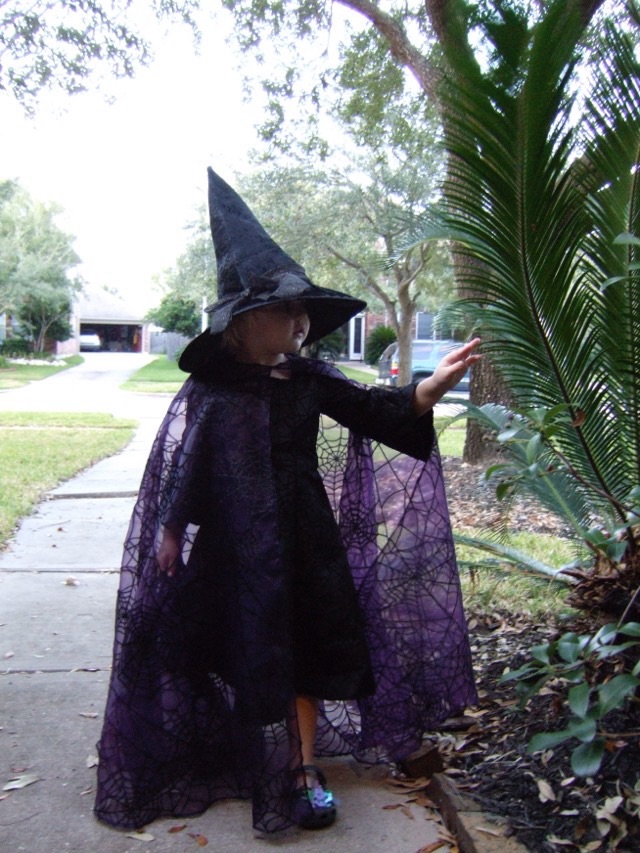
Photo description: witch’s costume with purple spiderweb cape, dress and cape hand sewn, hat purchased
I don’t know what possessed me to sew a kid’s costume when I had a new born, but I did in October 2008. This is the costume that made me realize that it is more expensive to buy fabric than to buy premade costumes. Was it well made and amazing? Yes, it was. Was the spiderweb themed purple sheer and coordinating black fabric so cool? Oh yes. Was it worn more than once? No. The dress was too small within a month, although the cape lived in the dress-up box for years. Was it worth the time and money? No, not for a growing kid. For an adult? Maybe, especially if it will be worn year after year.
Molting is not a pretty time for chickens. My Faverolles (hatchery quality) usually have a very slow molt so while there are feathers everywhere, they usually just look a little disheveled. Except for one hen that in the last couple molts has lost all her neck feathers at once. It is very disconcerting to walk into the coop and it looks like the chicken has been strangled. She is fine, though, and now the feathers are coming back in.
Photo description: Faverolle hen mid molt looking quite tattered
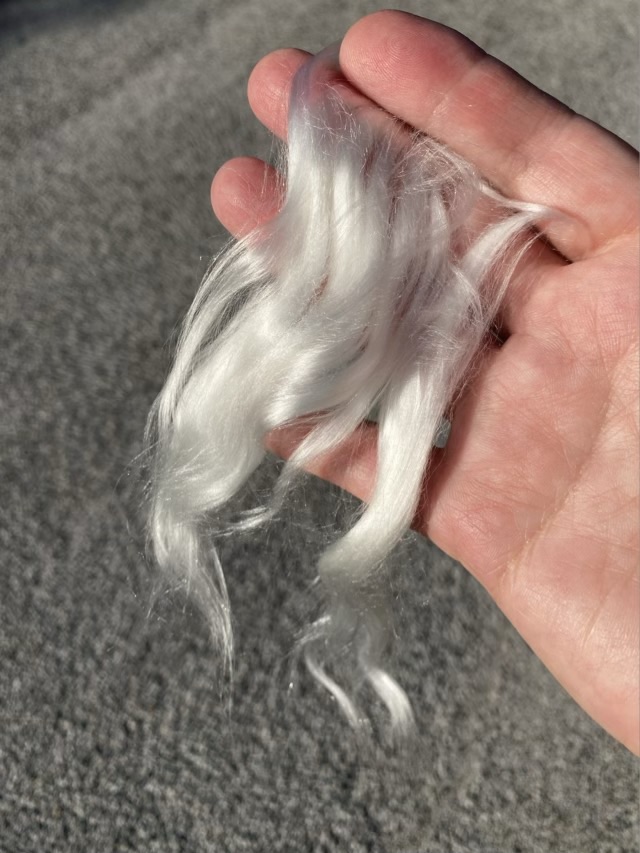
I started on a new fiber sample from my stash: Tencel. Tencel is derived from wood pulp, and the manufacture is reported as an “environmentally friendly closed loop process”. To save you some googling, I looked up what closed loop manufacturing means, and it is essentially that an item can be recycled over and over again. The Tencel sample I have from Hearthside Fibers has a long staple length and a high luster.
Photo description: unspun Tencel fiber held fanned out in my hand in the sun showing a high shine
The fibers are almost slippery, and I’m having trouble spinning consistently. I’m dropping the spindle even more than usual.
Photo description: the beginning of a cop of Tencel single spun yarn on a drop spindle held in the sun to show off the sheen
This sample is going to take me awhile to spin. Not only is it tricky, it is horribly hot outside still, with highs over 100 all week and lows over 80. Yuck.
Oh and yeah, the hook came off my spindle again. Next step is to epoxy the thing in.




 Critters and Craft