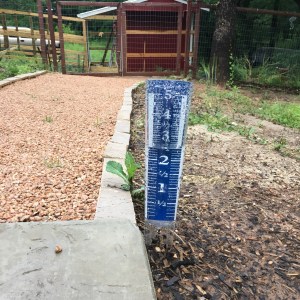
We’ve been getting quite the down pours this spring. We had 2.5 inches last night. Last night.
New rain gauge filled with last night’s rain
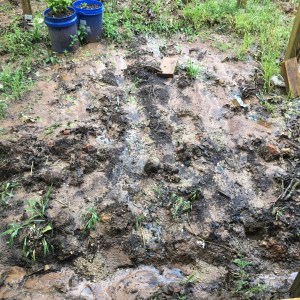
I had already decided that the garden in the middle chicken run wasn’t going to work (mainly because it is quite shady in spring), and had moved the basil plants to pots. Last night’s rain finished washing away the garden area.
Washed out garden
So now the plan is to sow some rye for the chickens and to help hold the soil. We’ll see how that goes.
In a pinch, or if you need a bunch of needles for teaching a class, you can make knitting needles from dowels you can find in a hardware store. Making your own needles not only gives you a greater connection to your knitting, it is a much cheaper way to have wood needles, which I find more pleasing than plastic or aluminum when knitting (these are cheaper than those too).
To make these needles I picked up 3/8″ poplar dowels, which are about 68 cents each, at my local hardware store. I also used 120 and 320 grit sand paper. I cut the dowels to 14.5″ (I used a chop saw, but a hand saw would also work). You can use the 120 grit sandpaper to sharpen one end of the dowel. Make a slightly more slanted angle than a sharpened pencil. Blunt the end slightly, so that it is still easy to pick up a stitch, but is harder to split the yarn.
Sharpening the dowel using sandpaper
Sand the whole needle with 320 grit paper so the yarn slides nicely, but isn’t slick. Rub your hands along the needle; the oils from your skin will help the yarn slide on the needle, and the needles with continue to improve with use.
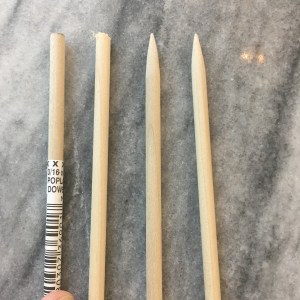
From left to right: 3/8” dowel, cut dowel, shaped end, sanded end
I used wooden beads with a 3/8″ hole to put a stop on the end of my needle. Alternatively you could use a fancier large hole bead, air dry clay, or Sculpy clay on the end to make a stop. A drop of glue will help keep the stop in place.
Wood bead with 3/8“ holeEnd stop
If you knit with a tight tension on your yarn, you may break the needle, but you can always make more needles. And learn to ease up the tension without breaking one of the fancy turned needles from the specialty yarn shop (ouch).
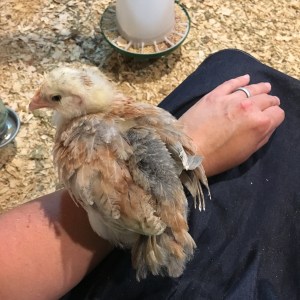
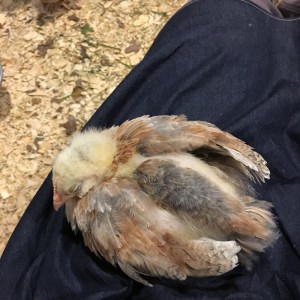
Say what? Yup. Poop aprons. My eldest and I both want to have the chickens be lap chickens, but we don’t want to have to change clothes afterwards. We tried laying a cloth across our lap, but it was difficult to handle both the fabric and the chick. Hence we need poop aprons. I used some scrap blue cotton and blanket binding to make two simple aprons we can wear in the coop.
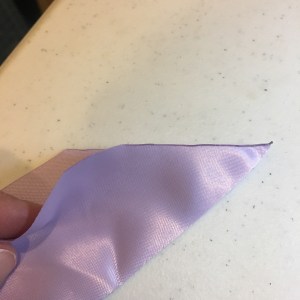
I had blanket binding in my ribbon stash, which makes a very quick, rather fancy sash. I cut the ends at an angle and used a match to melt the edges so they don’t fray.
End of blanket binding cut at an angle and sealed
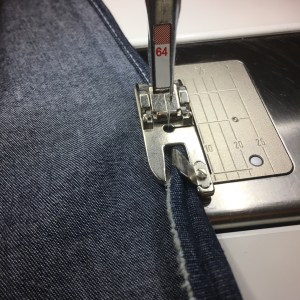
Then I put a small hem on three sides of the fabric. (My hem foot is my favorite accessory ever; it makes it so easy to do tiny hems!)
Hem foot
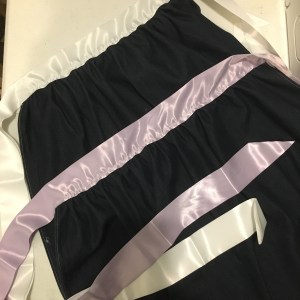
I then ran a basting stitch across the top edge and pulled one thread to gather the top of the apron. Matching centers, I sewed the fabric between the layers of the blanket binding.
Sewing on the sashFinished aprons
The aprons do their job! Although I may make longer versions later. These don’t quite cover my eldest’s knees. But hey, not bad for using scrap cloth and an hour of time.
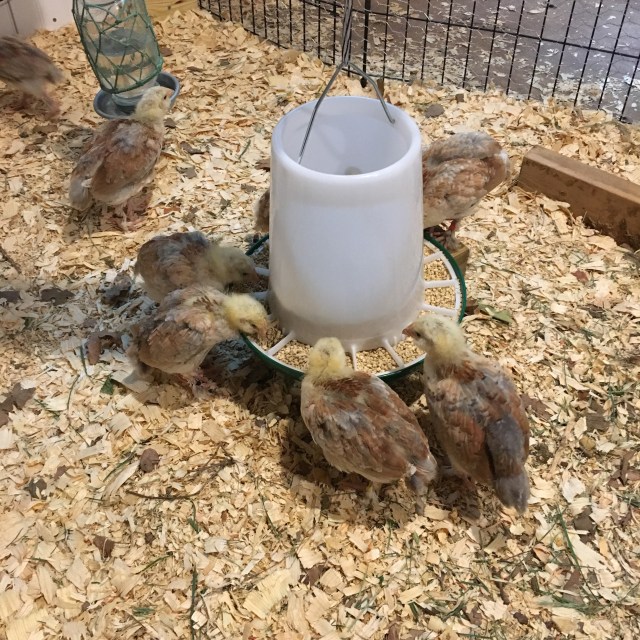
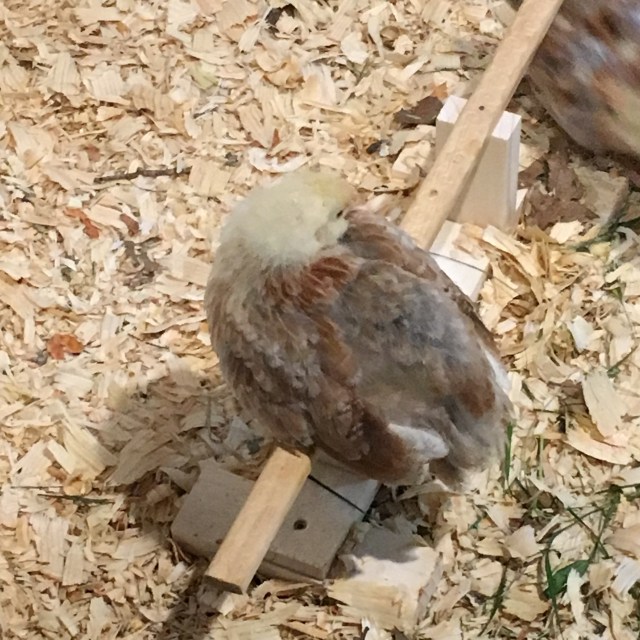
It took a couple days, but the chicks figured out the new feeder. It is a hanging feeder, but I needed to put a block underneath it to keep it from perpetually spinning.






 Critters and Craft