I finished knitting my Helix scarf! It has lovely ripples when laid out, but is a bit short. I used all my hand spun blended wool and silk yarn, so if I need to add on, it would have to be a different color. Hm. I think I will block it (get it wet and lay it out) before making rash decisions.
Photo description: Helix scarf made with hand spun fingering weight 2-ply yarn, showing opposing ripples along a central spine.Photo description: same scarf, but folded in half and laid out in a circle.
I really love this pattern, and the way they do the short rows. It really is a wonderful way to show off hand spun yarn, and I like the subtle variation in color that the blended fiber produced.
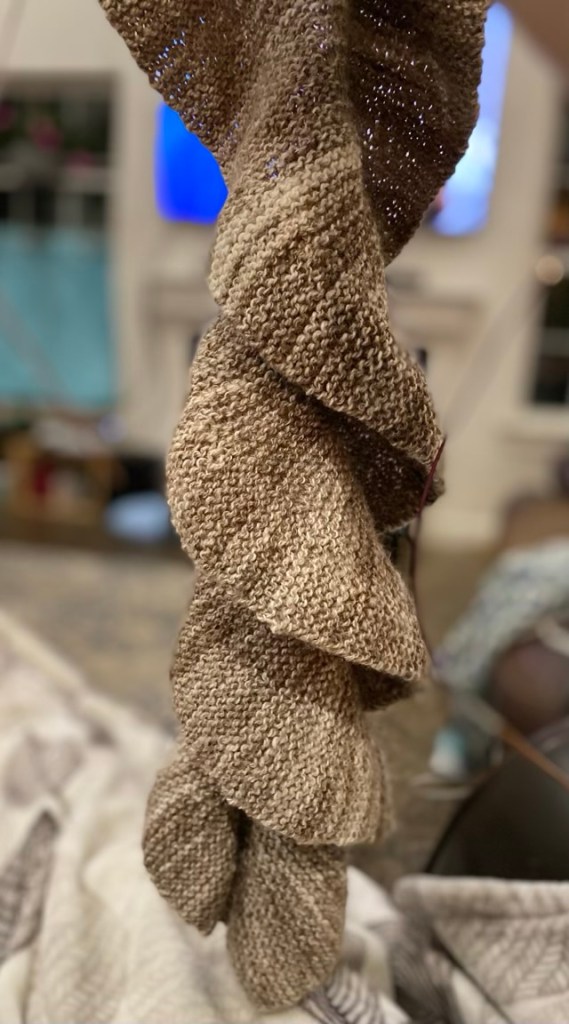
Photo description: garter knit scarf held up vertically showing a helix twist.
The pictures that accompanied the scarf pattern showed a lovely wide double-sided ruffle, but the title was helix scarf, which caused me to wonder, until I had knit awhile. So cool that the short rows on each side make this twisted effect. I really like short rows, and I like this pattern because it is a three-row repeat, which is easy to remember.
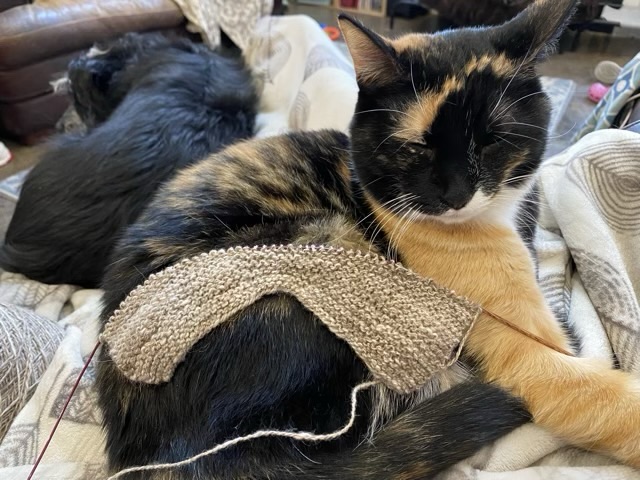
Photo description: beginning of a knitted scarf with short rows lying on a calico cat with a small black dog in the background.
I have cast on the Helix scarf from Spin Off magazine! I did make a modification, casting on thirty seemed very narrow, so I ripped out (only a couple rows) and cast on 50 instead. I adjusted the short rows to alternating 20 and 10. It turns out that I really like short rows, and the wrap and turn method. Izzy the cat doesn’t mind being on my lap as I knit, but Thor the cat thinks the yarn smells really good and keeps trying to take off with it, or chew on my circular needle.
I have spun and plied all my blended fiber from Anniewhere. The blend is Merino wool, Blue-faced Leicester, Alpaca, Tussah silk, and Finn wool. I bought 6 oz and have been using it to test different spindles, so I’m frankly amazed that it turned out somewhat consistent. I joined the skeins with a braided join: split each end in two, then remove one of the four resulting ends, braid those three together, then moisten and roll between your palm. Here is a video.
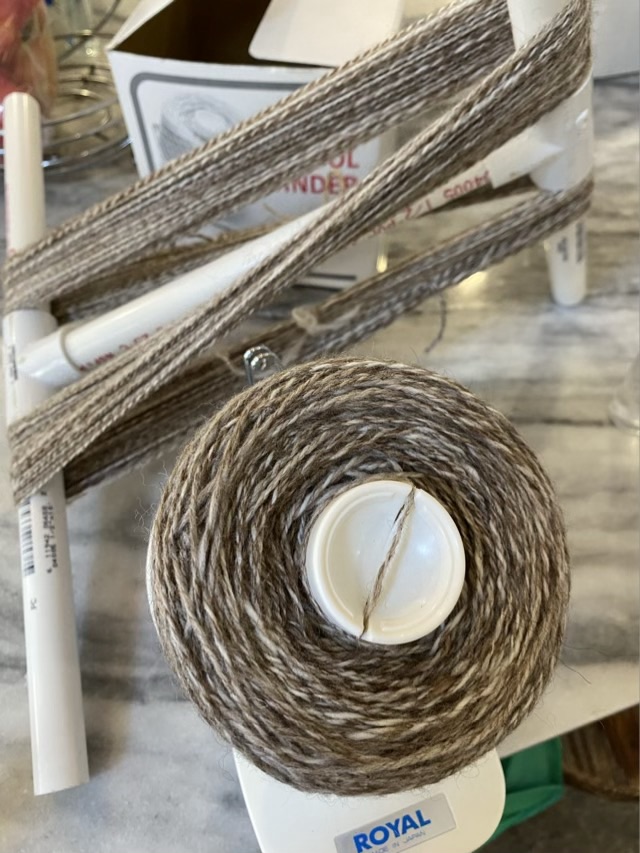
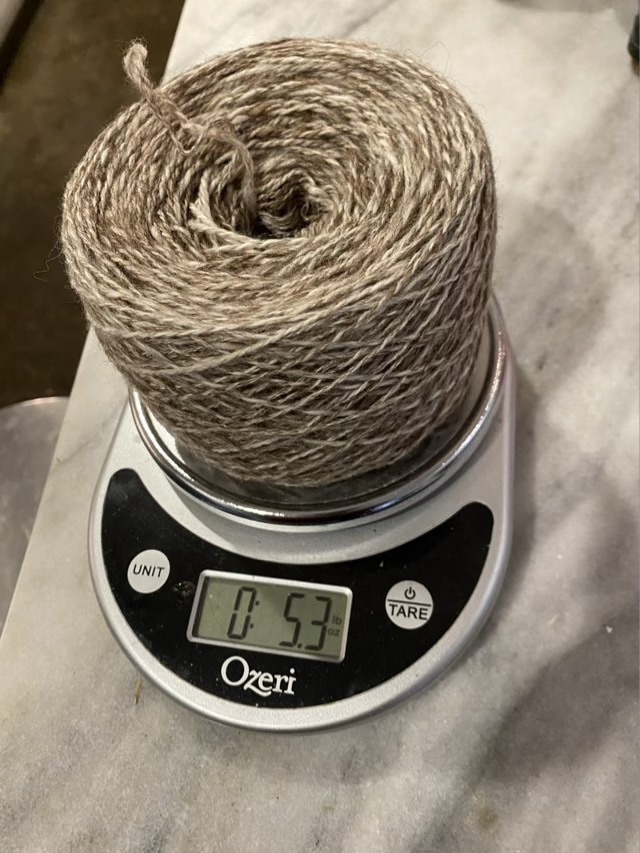
Photo description: yarn cake on a yarn winder with two additional skeins on a PVC niddy noddy in the background.Photo description: finished yarn cake sitting on a scale reading 5.3 oz.
I joined all the skeins together because I intend yo do a knitted project. I spotted a free ruffled scarf pattern while I was spinning, and knew that it would be great for my yarn, so the pattern has been sitting with the fiber. I’m excited to cast on. (I’m might have to admit that I could be a knitter.)
Plying on a Turkish spindle is satisfying, especially now that I’ve figured out how to get the geometric wrap pattern, but it is not fast. I took the other turtle of yarn and pied it with a top whorl drop spindle.
Photo description: Top whorl drop spindle filled with 2-ply mixed wool yarn, my foot and asphalt in the background because I took the picture while walking.
I plied nearly twice as much yarn in half the time with the top whorl spindle versus the Turkish spindle. I can really get the top whorl spindle going by rolling the shaft along the outside of my leg. The Turkish spindle I have to get spinning with a flick of my fingertips.
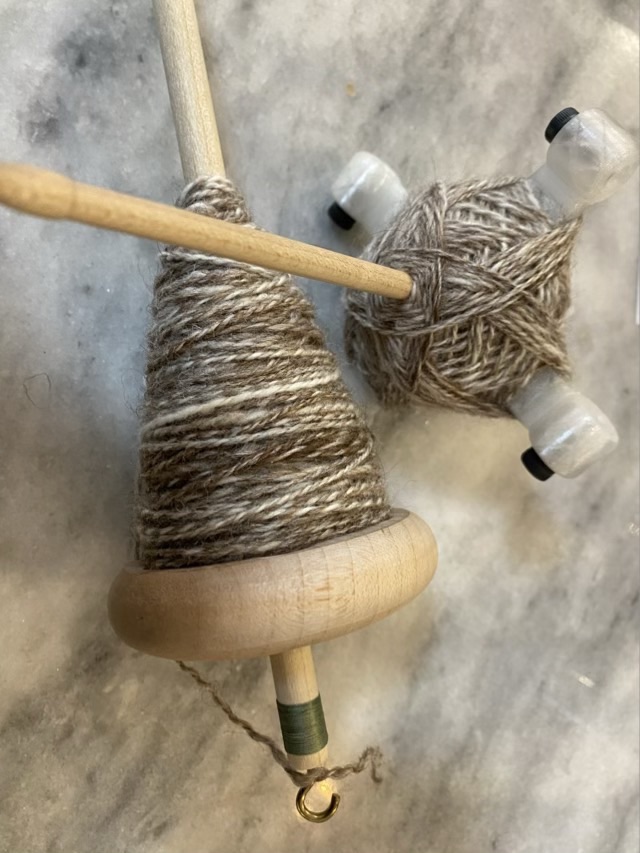
Photo description: Top whorl spindle on left, Turkish spindle on right, both wound with 2-ply blended wool yarn.
Now there is a difference after plying between the two spindles. The top whorl spindle has to be unwound from the shaft and wound into a ball or cake before it can be used. The Turkish spindle shaft and arms pull out of the yarn turtle and leave a center-pull ball of yarn that doesn’t need rewinding. I like to wind my yarn on a niddy noddy and wet set the twist, so did not save time in that area on this project. If I didn’t want to use the yarn right away, and wanted to let time set my twist, and marvel at the pretty geometric wrapping, a Turkish spindle is a way to go.



 Critters and Craft