Found!

I knew I had another box of blended fiber by Anniewhere, and I found it while looking for what to spin next in my prepped fiber box! Yay! I think I’ve spun 4 oz of this blend so far, which consists of Merino wool, Blue Faced Leichtester, Alpaca, Tussah Silk, and Finn Wool. I’ve been using it to test out different spindles, so I continued that and dug out a 3D printed Turkish spindle that I bought at a fiber festival. It spins beautifully and even though I have to use a half hitch at the top, rather than a hook or notch, I haven’t been dropping it as much as I feared.

Photo description: From the top, a rosewood ring distaff with cord and handkerchief, a 3D printed Turkish spindle with turned wood shaft and the start of a yarn turtle, bakery box full of carded and blended fiber.

I even used a small ball of a single spun from the same fiber that was left over from plying to start the yarn turtle, and in so doing had a gauge for how thin to spin, and saved more yarn from the scrap bin!
Cat’s in the cradle

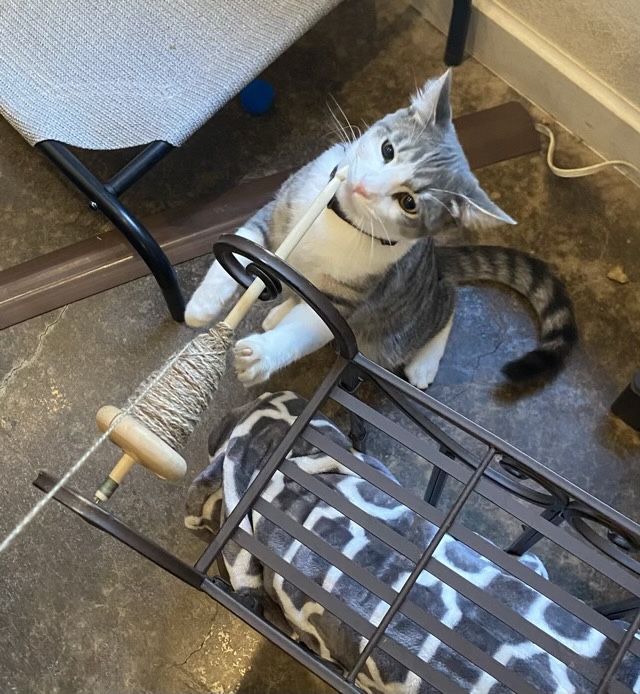
Ok, not a baby cradle, but the cat is definitely interested in what is going on when my spindle is in the makeshift cradle formed by an upside down side table. I put my spindle there because it makes it easier to wind the yarn onto my niddy noddy. As I unwind the yarn, the spindle skips and jumps and makes interesting scritchy noises against the metal.

Photo description: Wooden drop spindle set into the curved legs of an upside down metal side table. Gray tabby sniffing the end of the spindle with one claw caught in the yarn.

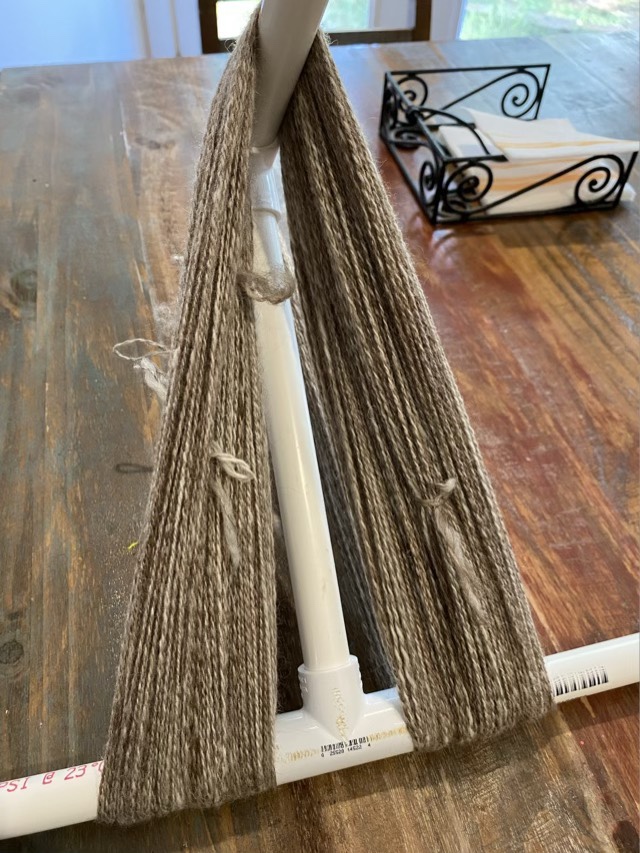
Despite the extra “assistance,” I did manage to get all the yarn onto my niddy noddy. This is the multi-fiber blend from Anniewhere. I’ve wet down the fibers and set them to dry out of the cat’s reach.

Photo description: Several bundles of 2-ply yarn wrapped onto a PVC niddy noddy.

Cats and fiber arts really don’t mix, but it is remarkable how often they do anyway.

Wool nests

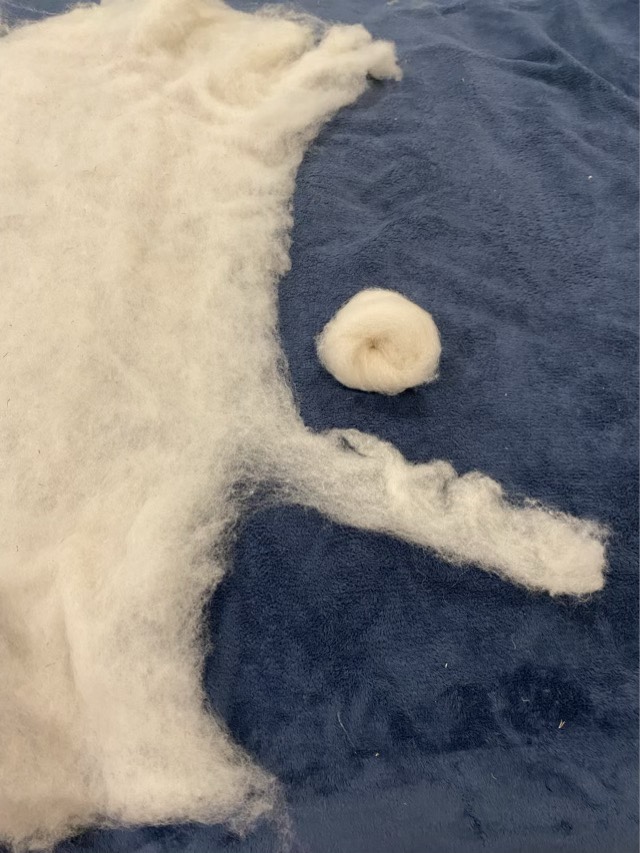
I have some Baize Shetland wool that came as large batts. I’ve been tearing off strips to spin, but decided that it was inefficient to unroll the batts every time, so separated all of the batts into strips and wound them into loose “nests”.

Photo description: Separating a strip of near white Shetland wool from a batt, showing the approximately two inch strip coming away from the main batt, with a hand wrapped nest above.

To wrap the nest, I loosely wrap the wool strip around four fingers, then tuck the end in the middle. The nests stay together, and are easy to grab when it is time to spin.

Photo description: Eleven visible wool nests in a pile.

Needle felting

I took a needle felting class! So cool, and much easier than I imagined. The instructor, Joyce Hazlerig, is phenomenal, and I came away with pockets overflowing with tips and tricks. In class we made cute little bearded gnomes.

My felted gnome from class

The neatest thing about needle felting is that it combines with all my other fiber crafts. I can add needle felted embellishments to anything felt-able. (Insert maniacal mad inventor laugh here. Do picture both hands raised in triumph as well.)

Peachy keychains

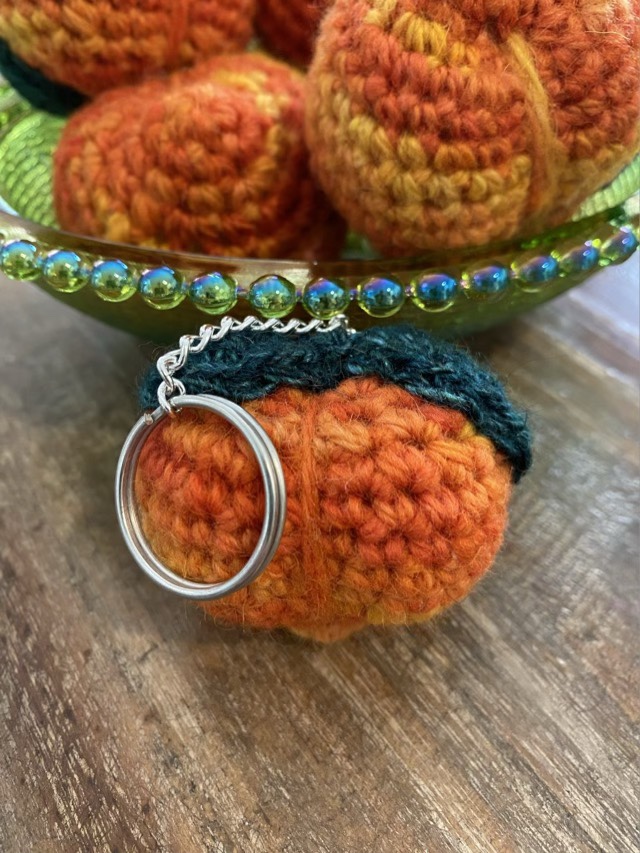
I recently created a PDF pattern for a local yarn shop. It is the owner’s pattern, but they needed it taken from written shorthand to a sharable PDF. It is a cute little peachy amigurumi, and in testing the pattern, I made up 6 little peaches.

Peach amigurumi

The pattern is by Anniewhere at NerdCraft. I’m very excited about the wool yarn I used for the body of the peach, because it was locally spun and dyed by Texas Prairie Fiber Co. I love using locally produced supplies! The leaves I made from my own handspun yarn, that I spun from Blue Faced Leicester and silk blended roving dyed by Frabjous Fibers. This turned out to be quite the collaborative project.

Keychain peach amigurumi

I did make each one into a keychain by sewing on some chain and attaching a split ring. I used hand-spun alpaca scraps from a naturally brown alpaca (Aimee) to sew on the chain. So each peach has a little brown stem.