Grapevine handrail stage 2

At my Dad’s suggestion, I used a draw knife to take the bark off the grapevine we are using as a handrail.

Photo description: BeaverCraft draw knife shown with partially debarked grape vine

The draw knife is held by both handles and pulled along the wood. It is truly excellent for removing bark. I waited until after a rain so the bark was softened, which also helped. It wasn’t quite able to get all the bark off. I was working by myself and didn’t want to unscrew the vine from the supports because it took three of us to wrestle it in place. When I have help, I’ll take the vine off the brackets, finish removing the bark, and give it a good sanding. Then we’ll let it dry before putting on a protective finish.

Grape vine hand rail, stage 1

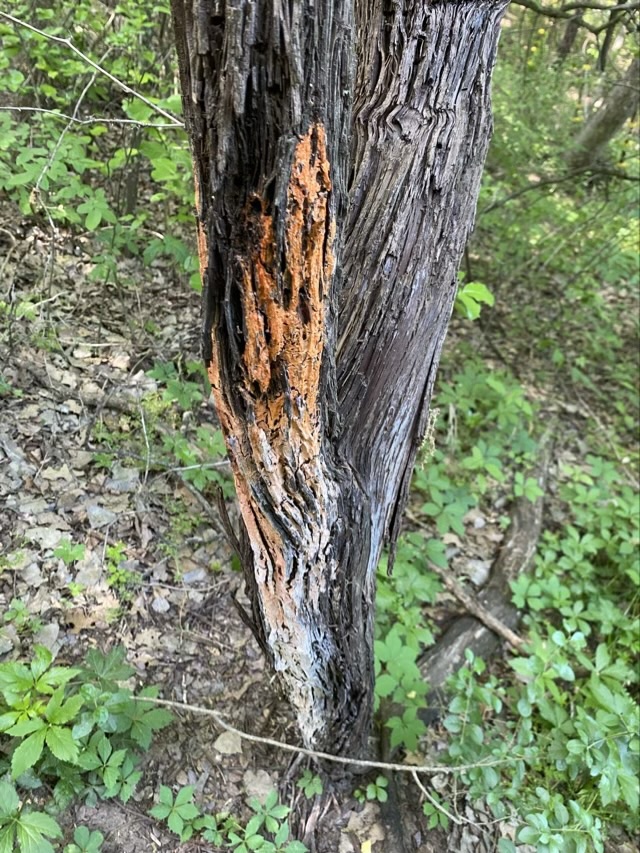
My husband built a beautiful rustic style curved stone staircase off our back porch. Our challenge has been getting a handrail to match the curve without throwing a lump of money at it. The first attempt involved cedar sapling trunks, but we didn’t have one long enough, and splicing two together was tricky. When I was wandering our woods looking for hand rail candidates, I saw a grape vine that I’ve been meaning to trim because fungus has started into the side of the bark.

Photo description: orange and white fungus on a large muscadine grape branch

I cut off the vine above the fungal damage, and since that vine was a nice diameter for a hand rail, freed it from the canopy. I then cut away the diseased tissue from the main vine and sealed it with pruning spray.

Photo description: sealed main vine, approximately 7-8 inches in diameter
Photo description: muscadine grape vine freed from the woods and dragged to the back yard

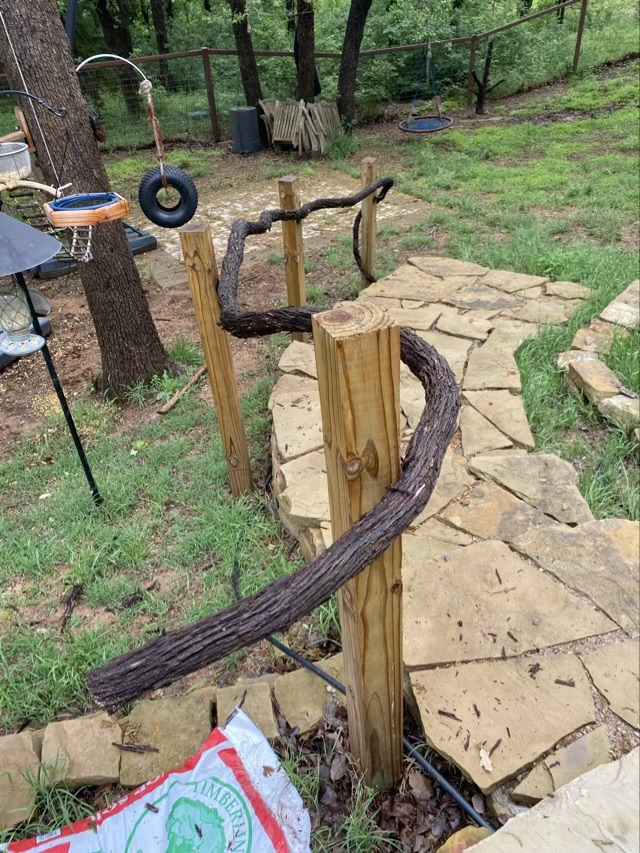
It took three of us to wrestle the vine into place as a hand rail, but because the vine is supple and we waited until the rain gave it a good soak, it was possible.

Photo description: grape vine installed as a hand rail on a curved stone staircase

We secured the vine with screws. The next step is to strip off the bark and seal the vine core so it lasts a little longer in the Texas weather.

Thorn experiment

I found this wicked looking thorn laying in a parking lot. Most likely it stuck to a tire and fell off in route, and I’d like to say I picked it up so no one impaled their foot, but the was a secondary benefit. Really I wanted to see what I could make with it.

Photo description: approximately 4” thorn cluster with opposing spikes 1-2” long held lightly in my hand

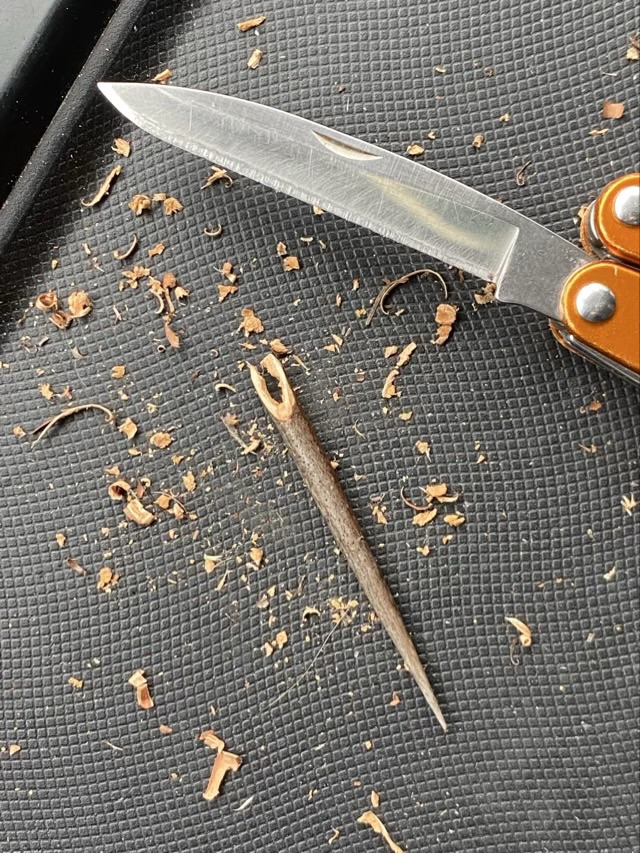
I used my pocket knife to cut the side thorns off. The tips are wickedly sharp and hard, so I wanted to try to make a needle. I approached it as I would for carving solid wood. The center of the spikes are soft though, so the needle hole didn’t have enough support when I whittled both sides down.

Photo description: single thorn with the end carved into a needle eye, which broke, pocket knife on the side of the picture

If I were to make the attempt again, I would put the needle hole in the outer bark, and not reduce the integrity of the thorn by cutting the bark away.

Giving it a whorl

I made this spindle whorl awhile back using a laser cutter. The dragonfly design is my own.

Photo description: plywood whorl with dragonfly design and six extended circle shaped spokes

I had an empty shaft and decided to give the whorl a whirl while I was spinning my Black Welsh Mountain fiber.

Photo description: single spun yarn wrapped on a spindle shaft

I should have sanded down the shaft some, the top hook did not stick up far enough which made it difficult to wind yarn on and off. The single layer whorl also didn’t feel substantial, and although the size was large enough to keep momentum, I struggled with it bumping into me. It is slightly better than using a CD as a whorl, but only because it has dragonflies. Back to the design board.

Masking tape

Some people who use laser cutters advocate for using masking tape to reduce the smoke stains on the surface of the wood. I tried it as I redesign my dishwasher magnet. I don’t like it.

Photo description: after the laser cut project using blue masking tape, small areas of tape are left behind, and the image didn’t fully burn

With the addition of the tape, the laser settings have to be increased because of the thickness of the tape. After burning a design there are also small bits of tape left behind that need to be picked off, and in the fill areas the obliterated tape leaves a sticky residue. Yuck.

So how to deal with those smoke marks? A little bit of sanding with 400 grit sandpaper works wonders and takes less time than removing sticky tape.

Back to the beginning: Why am I redesigning? I didn’t like how the bit map engrave of the previous design was a little messy and took a long time to engrave, so I redrew the art and made an SVG file, which cut the processing time almost in half. Depending on settings, the previous bit map design took 11 minutes, where the new SVG takes 6.