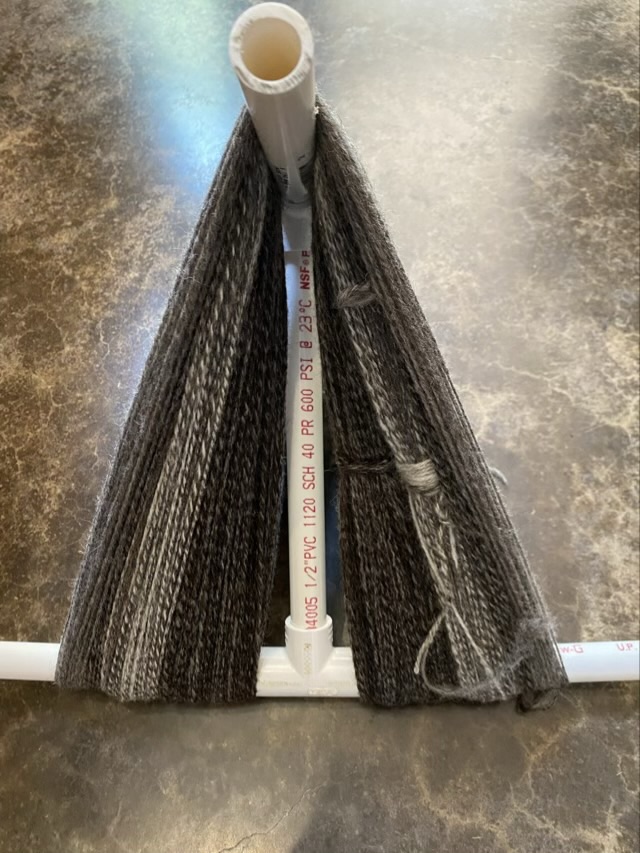
I transferred all my three-ply hand spun Jacob’s sheep yarn to my PVC niddy noddy.
Photo description: four shades of three-ply yarn on a very full PVC niddy noddy
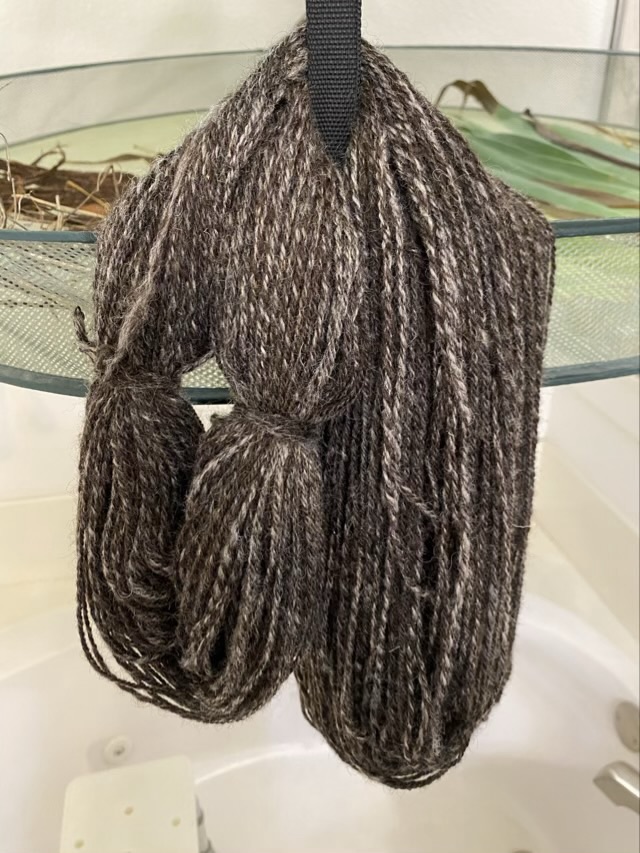
I like the PVC niddy noddy because I can rinse the hanks while still on the niddy noddy. I usually let them dry there too, but I put too much yarn on and the noddy niddy came apart when I twisted it to dry, so I had to hang the hanks instead.
Photo description: large hank of hand spun yarn hanging on a circular drying rack
I am pleased that the yarn is well balanced. There are no kinks or twists, it is all laying nice and straight.
Photo description: closeup of hanks of all four shades after drying
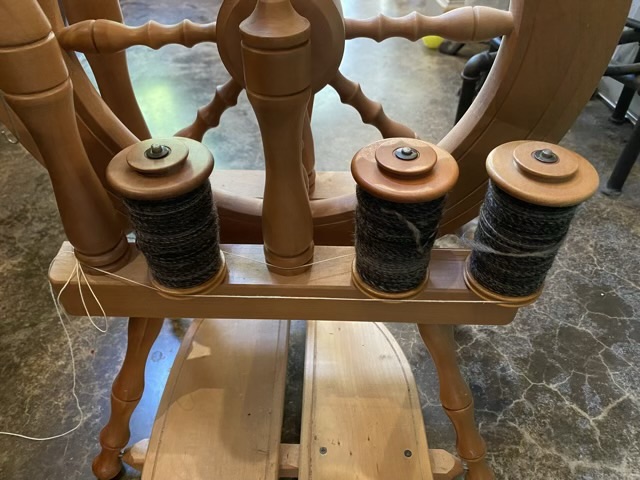
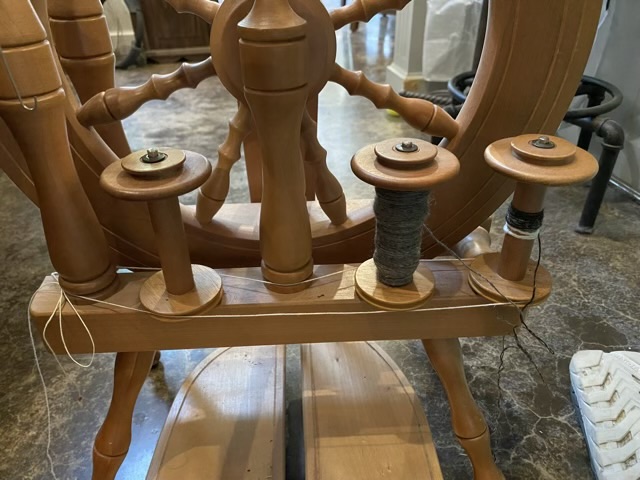
All the singles I spun with my Jacob’s wool from Sweetgrass farms had sat on their bobbins for a few days, so it was time to ply! I put a makeshift brake on the bobbins on their stands on the wheel. I used a cotton string and applied enough tension so that the bobbins will turn, but not spin freely. This saves me from future tangles.
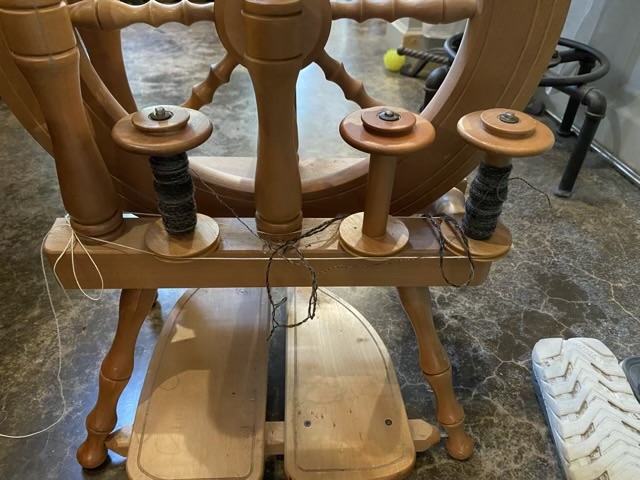
Photo description: three bobbins full of spun singles on an Ashford Traveller spinning wheelPhoto description: jumbo Ashford bobbin full of three-ply Jacob’s wool yarnPhoto description: left over dark and silver marled yarn with the middle bobbin emptyPhoto description: three-ply yarn made with two dark singles and one silver single Photo description: left over yarn from round two of plyingPhoto description: four bobbins of three-plied Jacob’s wool yarn in four colors
I used the silver single spun with the remaining two bobbins of dark colored singles, then when the dark ran out, chain plied the silver. I ended up with two jumbo bobbins full of three-ply yarn, and two regular bobbins half-full of yarn.
I need my bobbins free, so this yarn doesn’t get to let time set the twist. Next up is the niddy noddy.
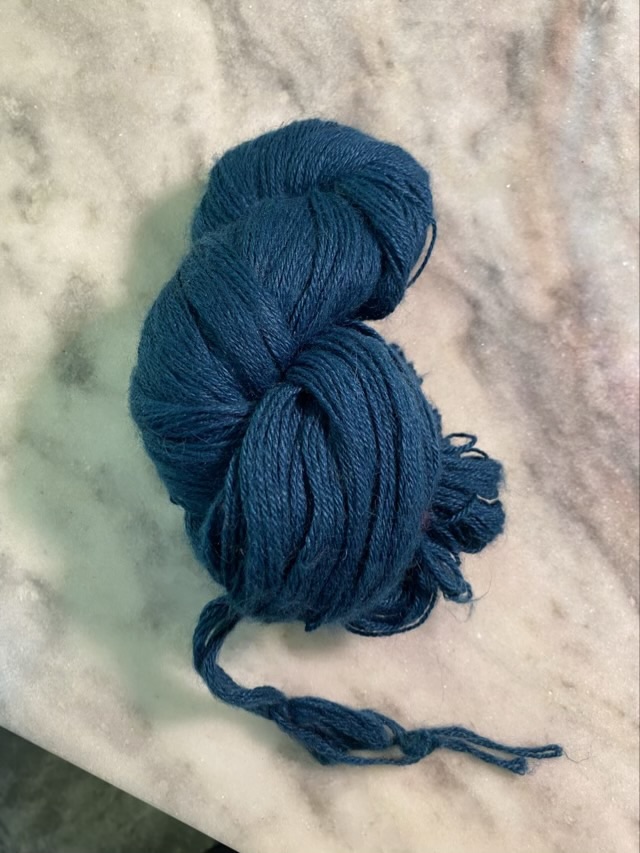
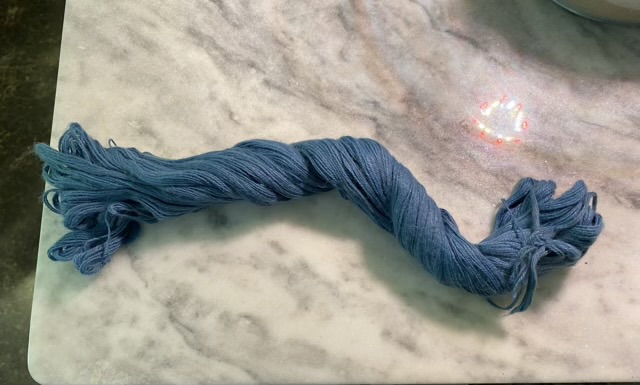
My parents-in-law recently took a trip to South America and brought me back three hanks of beautifully spun and dyed alpaca yarn. I immediately set to opening up the hank to put on my yarn swift and use my ball winder to make a center pull ball, which is easier to use for knitting and crochet. I was met with resistance.
Photo description: beautiful teal twisted hank of alpaca yarn in a familiar twist and tuck storage configurationPhoto description: gray-blue hank of yarn opened up from the storage twist with familiar strands of yarn tying the loops of the skein together at the ends
The hanks looked like what I was familiar with buying in the States, a large circle of wrapped yarn, twisted and tucked end in end for storage, but when I opened up the skein I did not find a continuous circle and it dawned on me that the wrap was different. I employed the arm power of my eldest to investigate.
Photo description: olive green alpaca yarn held on two arms showing figure 8 wrapping
The hanks were not wrapped in a loop, but instead used a figure 8 style wrap. Easy enough to handle with an extra pair of arms, but definitely not compatible with my yarn swift. My eldest obliged me by holding the yarn while I wound onto a wool winder.
Photo description: Wool winder mounted on the back of a chair (I’ve never tried this before, and it actually worked very well)
Once I figured out how the hanks were wrapped, I was impressed with the way the figure 8 kept the strands in decent order. I am a firm believer that there are many ways, and I love finding out about other methods.
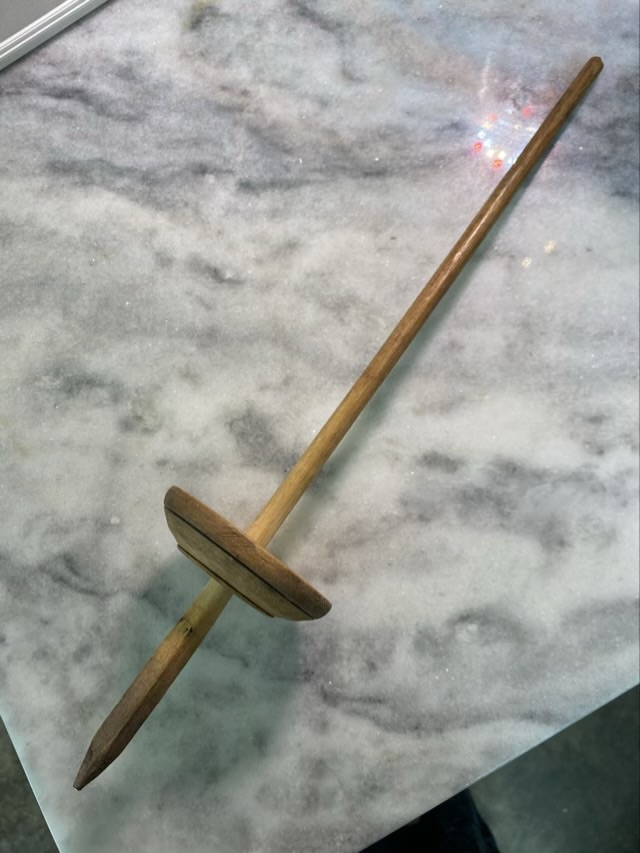
My mother-in-law also brought me a spindle; the spin on it is beautiful and it also is slightly different than what I’ve seen.
Photo description: working spindle with bottom whorl. The shaft is square below the whorl but rounded and long above the shaft. The shaft shines where it has been rubbed smooth by fingers turning the spindle.
P.S. Sometimes I get my terminology swapped. The original post used the word “skein” in place of “hank”. I think I have fixed all instances.
I spun two spindles of Black Welsh Mountain fiber then moved on to other fibers, because with a 40 gram bag, that is about all I get. I actually had 4 ounces, and had tucked the bag up on a shelf and forgot. Finding it again (a black shadow at the top of a shelf) was better than finding money in the wash! So I wound the singles off of one spindle and into a center pull ball.
Photo description: nostepinne style ball of yarn on a card stock tube, empty spindle to the right, small intent black dog in the background with her red ball
I had actually spun about 2 ounces (about 50 grams, so my estimate wasn’t far off), and since I had 2 ounces remaining I decided to spin some singles the opposite way. This challenges my brain and hands, but doesn’t result in the smoothest yarn, yet. The idea is that I can do some experiments with the opposite twists.









 Critters and Craft