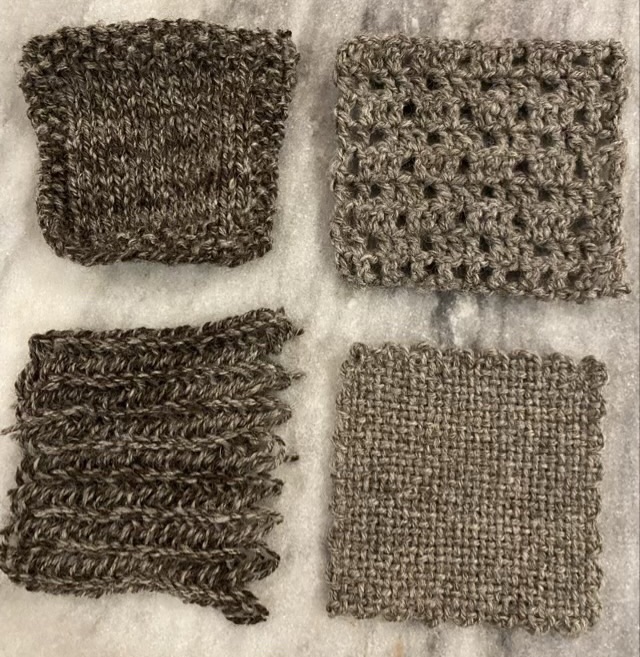
I started on the swatches for Jacob’s wool, and then finished them all in a day, even the nålbinding. I must have thirty other projects I’m not working on. Hm.
Photo description: four squares made from hand spun Jacob’s wool: knit (top left), crochet (top right), cut open nålbinding (bottom left), woven (bottom right)
I had two large cakes of yarn, and two small nostepinne balls, so I used the smaller amounts to make the swatches. I hope to make something wearable out of the larger cakes of yarn.
As a Thank You to Sugar the Samoyed’s family for sharing Sugar’s fur for my fiber study, I sent them a crocheted heart and the remainder of the yarn.
Photo description: small hank of Samoyed yarn and a crocheted heart with a leather center with the name “Sugar”
I designed the leather heart using Adobe Illustrator, then cut it from vegetable tanned tooling leather. Having precision cut holes was awesome to make a blanket stitch around the edge. I then crocheted into the stitches using a single crochet in the back loop.
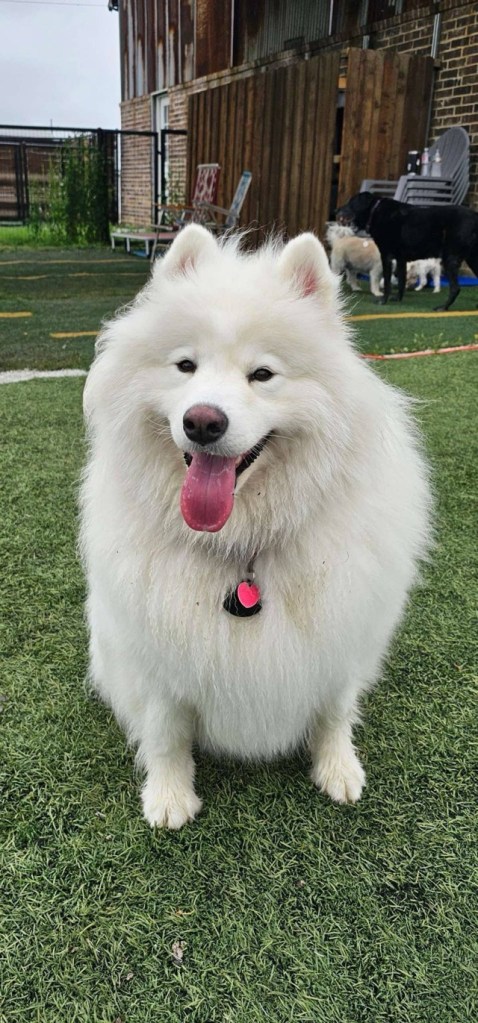
In May I received a mysterious fiber package. There was a tickle in the back of my brain, a shadow of a memory from the previous summer, when I talked with a woman who said her dog’s fur looked just like the Shetland sheep roving I was using for a spinning demonstration. She said she would send me some dog fur, and I gave her my address. I reached out to confirm, and yes! My mysterious package did contain the results of numerous brushings of her Samoyed dog, Sugar.
Photo description: Ziplock gallon bag full of Samoyed dog furPhoto description: Sugar the Samoyed photo from her owner
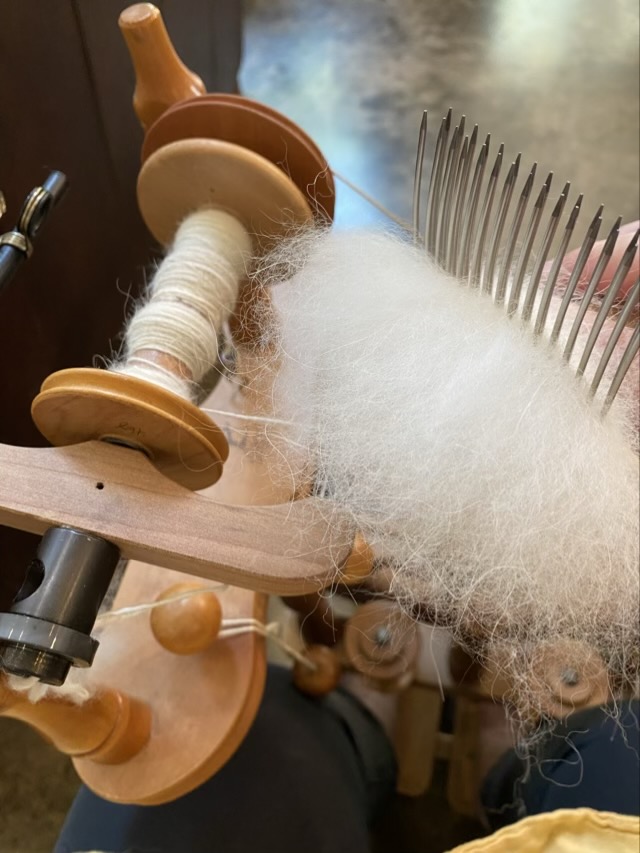
Samoyed dogs have a thick double coat that is usually white and naturally dirt repellant with very little smell. The fiber was very clean, and did not have much VM (vegetable matter), so I decided to comb and spin it straight from the bag, without washing or scouring. The staple length of the undercoat wool is about 2-3 inches, but the guard hairs can be much longer, I measured one guard hair at 9 inches long. I did not attempt to de-hair the wool.
Photo description: using wool combs to align the fibers for spinning on my Ashford Traveller spinning wheelPhoto description: Missy the dog is very interested in the smell of the dog wool, she can smell what I cannot!
The Samoyed wool was very easy to spin, and I was able to get a relatively consistent single. Combing produces more waste than carding, but the results are worth it. The waste fiber goes outside for the birds and squirrels as nesting material.
Photo description: single spun Samoyed dog wool
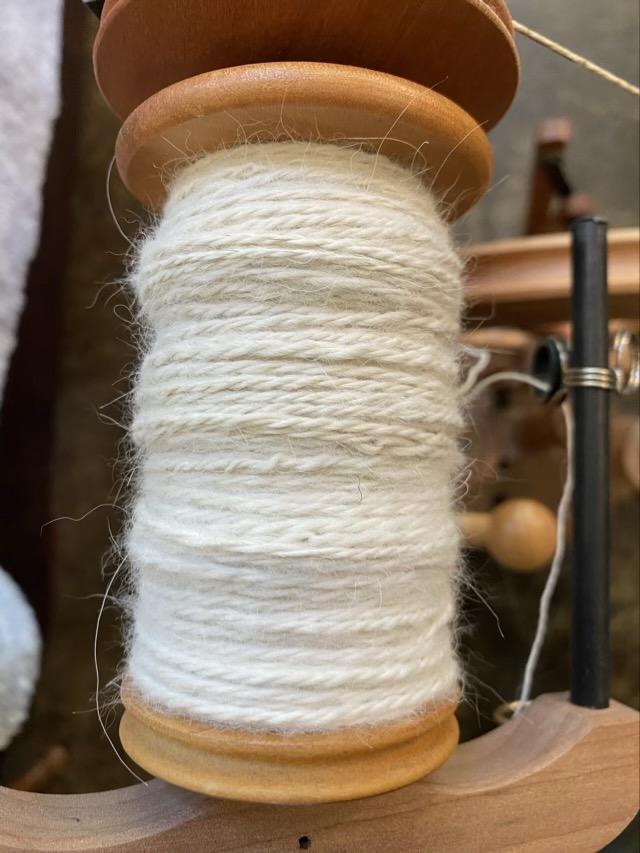
I chose to chain ply my singles to make a three ply yarn. The Samoyed wool also performed well in plying and I didn’t have any breakage.
Photo description: Samoyed dog wool three-ply yarn on the spinning wheel bobbin
I’m going to give the three ply yarn a gentle wash and hang it up to dry!
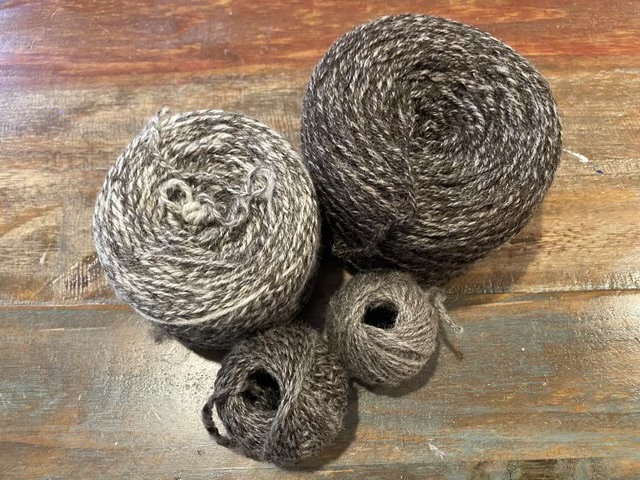
I’ve wound my handspun 3-ply Jacob’s wool yarn into center pull balls. But how much do I really have?
Photo description: two cakes of yarn and two center pull balls of yarn in different shades
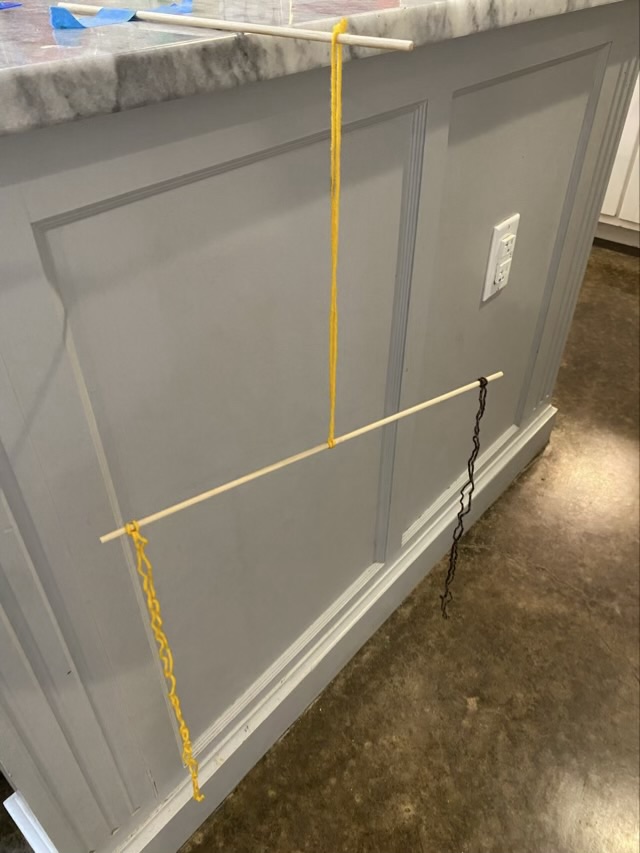
Hand woven magazine published an article about yarn balances. I followed their instructions to make a balance and used acrylic yarn of a known weight per yard.
Photo description: yarn balance with known acrylic yarn on the left and unknown yarn on the right
Because of my scientific background, I have to do my math by using the factor-label method (here is an explanatory video). I know that the yarn on the left is 142 grams per 241 meters, so my 120 cm weighs 0.071g, a weight I would not be able to measure with a kitchen scale. My hand-spun yarn that balances measures 97 cm. I now have the weight per length and can calculate yardage. (Oh yes, I completely mix my metric and standard measurements, but as long as all the labels cancel properly, we’re golden.)
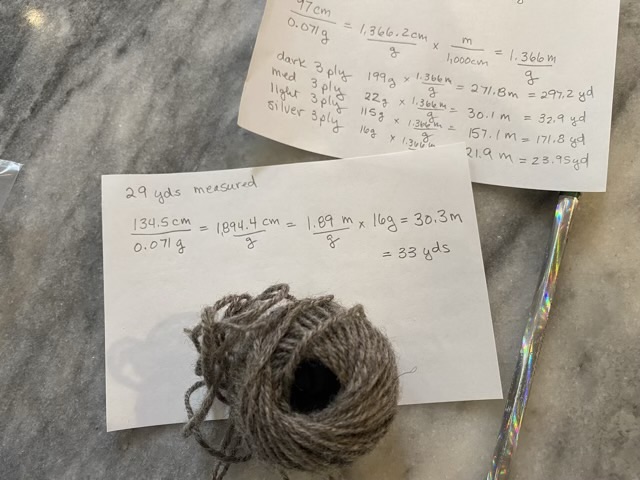
Photo description: scratch pad with hand written yarn math for all four shades of yarn
To see how accurate the calculations are, I measured the lightest ball of yarn by laying out a yard with tape on a counter. I measured 29 yards. I put a section of the yarn on the balance, did my calculations and predicted 33 yards. This is a 12% difference in weight, which I find an acceptable margin for error. When planning a pattern, you should have at least 10% more yarn than what is called for. In the case of my hand spun yarn, I will pick a pattern that needs at least 12% less than 530 yards I have.
Photo description: silver ball of yarn with scrap paper hand written math
This was an interesting exercise, and confirmed what I felt when looking at the yarn: it isn’t enough to make a vest. It may be enough the make a hat or two.
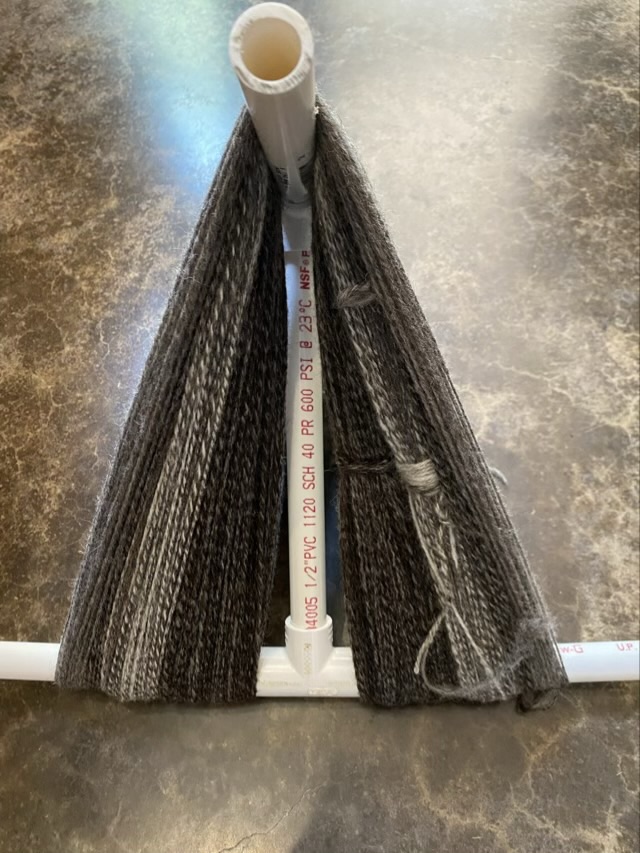
I transferred all my three-ply hand spun Jacob’s sheep yarn to my PVC niddy noddy.
Photo description: four shades of three-ply yarn on a very full PVC niddy noddy
I like the PVC niddy noddy because I can rinse the hanks while still on the niddy noddy. I usually let them dry there too, but I put too much yarn on and the noddy niddy came apart when I twisted it to dry, so I had to hang the hanks instead.
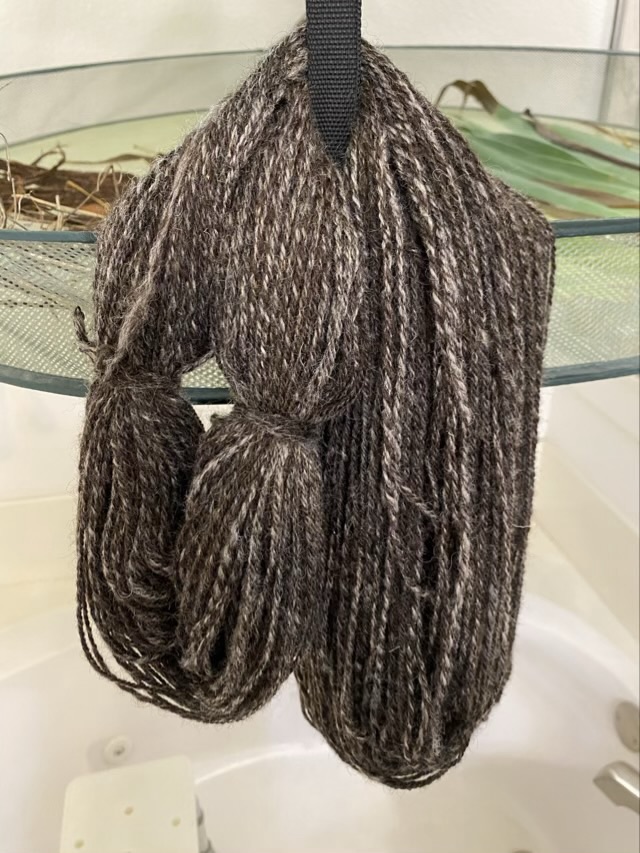
Photo description: large hank of hand spun yarn hanging on a circular drying rack
I am pleased that the yarn is well balanced. There are no kinks or twists, it is all laying nice and straight.
Photo description: closeup of hanks of all four shades after drying







 Critters and Craft