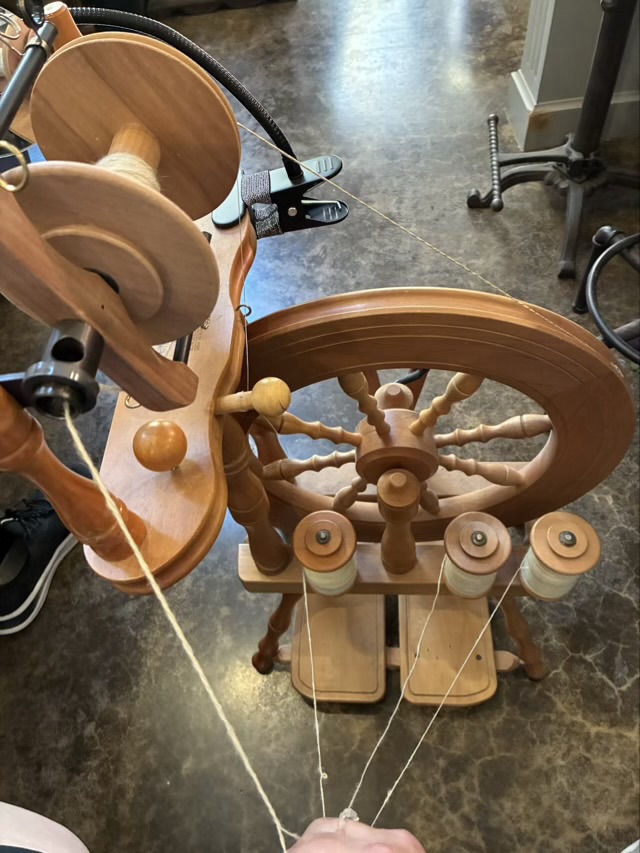
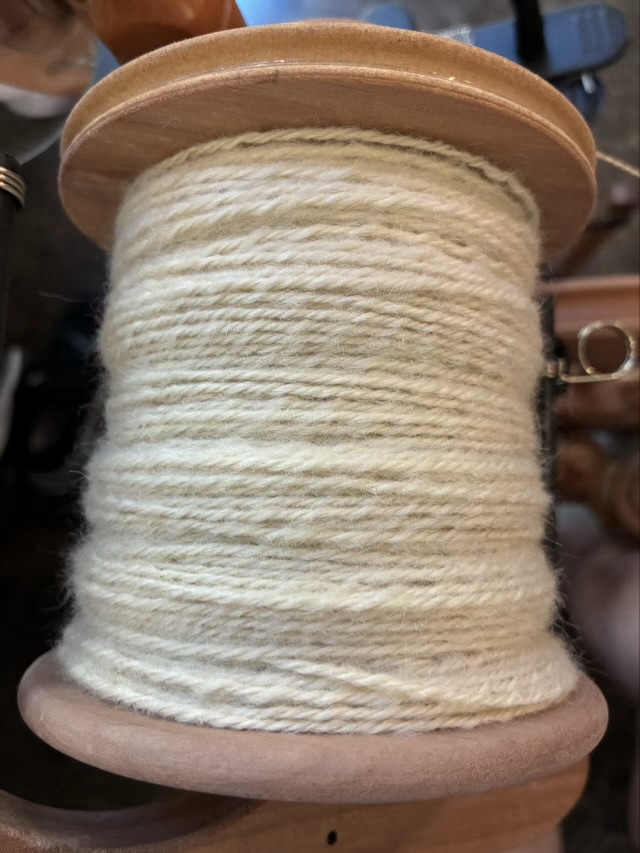
I’ve spun up three bobbins of my Teeswater wool, so it is time to ply. I use the built-in bobbin holders on my Ashford Traveller spinning wheel and have two points of control. My right hand holds the three strands apart by putting each strand between different fingers, and my left hand slowly lets in the twist, then feeds it onto the jumbo bobbin. I’ve found that with slow and steady progress I don’t need to put a brake on the bobbins because they don’t spin out of control.
Photo description: looking down at my three bobbins of single spun Teeswater woolPhoto description: three ply Teeswater wool yarn on a jumbo bobbin
I have more Teeswater roving, so I’ll go back to spinning singles. I also have another jumbo bobbin, so I can leave the three ply on this bobbin to rest.
Missy the dog tries to lay right behind my feet when I’m spinning, which makes it hard to treadle. So I put her bed to the side, which was an acceptable offering.
Photo description: Ashford Traveller spinning wheel, Svaha Genetic plants dress, small black dog on a blue round bed
I’m currently spinning Teeswater wool on my Ashford Traveller spinning wheel. Teeswater is listed as a critical in the Livestock Conservancy’s list of Heritage Sheep Breeds. I purchased roving from a rancher in Michigan, and I am enjoying spinning the fiber.
I spun and plied angora rabbit hair back in March. I stuck the small ball of yarn in a project bag and promptly forgot about it. I found it again 8 months later and this time made the swatches from it that I intended to do in March.
Photo description: four ply angora rabbit yarn swatches. Top left: nälbound circle, top right: knit, bottom left: double crochet, bottom right: zoom loom weave
These swatches are made from unprocessed 100% angora rabbit fur. I took what was in the bag I bought from the breeder and spun it, no washing, carding, or combing. The yarn does shed a bit, but not significantly, and did fine especially with the abrasive nature of weaving and nälbinding.
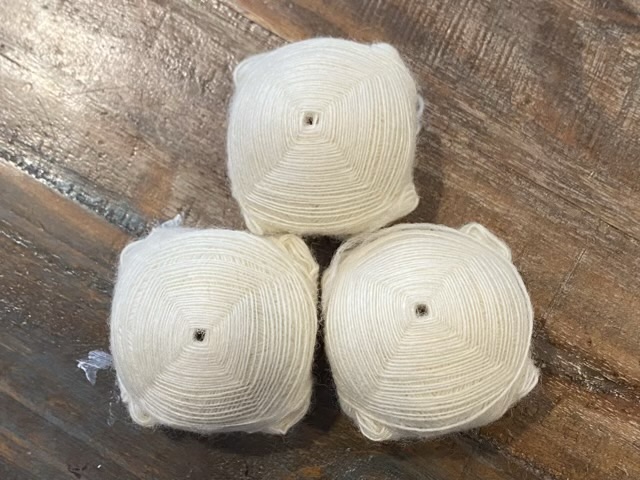
The cop of yarn built up on a Turkish style spindle is called a turtle. In the photo below, you can see why. The balls of yarn look like turtle shells. I now have three single spun Southdown wool turtles from spinning as I walk. The next step is to ply the three together, but for that I will use a treadle spinning wheel and a secure way to hold the turtles.
Photo description: three turtles of single spun white Southdown wool
Turtles of yarn are center pull balls of yarn, and it is possible to ply the inside end and the outside end to make a two-ply yarn. It is even possible to walk and ply, but since I want a three ply, and don’t want to chain ply, my best option is to sit at a spinning wheel so I can closely monitor the turtles. I may see if my yarn bowl will be helpful.
When I’m going to spin on a new-to-me wheel, I like to have a field kit of things I might need to adjust the wheel.
Photo description: clockwise from the right, tanned leather, cotton string, bamboo skewers, light machine oil, pure beeswax (not pictured, scissors)
Cotton string is useful if the drive band is missing or needs to be replaced. It can also be used to tie up loose parts, or slow the spin on a bobbin (for a Lazy Kate). It is always a good idea to have some string.
The leather scrap is there for making parts. Most often I need a washer to improve the fit, especially on older wheels whose wooden parts have sagged. A heavy pair of scissors and a scrap of leather can make many, many things.
Beeswax is used on the drive band to give it some grip. The most important thing to do with an unfamiliar wheel is to check the alignment of the wheel with the whorl. Then check the tension. A little bit of wax along the string can then give more advantage. Beeswax is good for wood, so will cause no damage.
Oil is for the bearings and places friction occurs, like the connections of the flyer, or bobbin, or spindle. I used it sparingly, usually just one drop is enough.
The bamboo skewers or toothpicks can replace a missing post pin, or be used as a wedge. They were an unexpected bonus to have when I was working with a Great Wheel. I think I will add tissue paper to my next kit, as a bit of tissue paper around a post end can tighten up the fit.
A scrap of cloth for wiping away dust and old oil would be a good idea too.