Walking and plying

So I finished my single ply over two walks, then was left with a question: can I walk and ply? With the double ended cop method I can! Not really surprising; it is easier to do a two ply than spin a single. There is no drafting and less dropping (yup, I’ve dropped the drop spindle a couple times on the walk!) The cop fits well in my left hand, and I keep one finger between the strands to keep the twist from running down into the wad of yarn. I draw out an arm length of two strands, then flick the spindle clockwise to ply. When the twist is where I want it, I wrap the yarn around the spindle, do a half hitch at the top, and go again.

Picture taken mid-step while the twist worked into the ply

I do need to be careful with my hand position. I tend to let the spindle hang from my longest finger because it is convenient. I have to consciously add some fingers, since walking through the neighborhood with my middle finger raised high sends the wrong message. Although as I approach the middle of the yarn, it does get a bit knotty.

Cop of two ply merino wool, completed in two walks

Not just sitting and spinning

I can walk and spin! I’m beyond excited. I took my merino wool roving and my bottom whorl drop spindle and headed off through the neighborhood. For fiber management, I wrapped the roving around my wrist, which works really well. I really expected the spindle to swing, but it stays mostly straight down, and I didn’t kick it even once. The psychology also worked, because I walked longer than I would have without spinning.

Bottom whorl drop spindle with “sage” merino roving blends into the pavement

One of my neighbors who was also out walking commented that from a distance it just looks like I’m waving my hands in the air. My fiber is rather road colored!

Plying from a cop

So many esoteric terms in spinning! (Here is a funny article from Spin-off magazine on hand spinning terms.) In this case, plying is spinning singles together to make a thicker stronger yarn. A cop is the yarn wound upon a spindle. I took the end from the inside and the outside of the cop and plied them together, essentially working from both ends of the single.

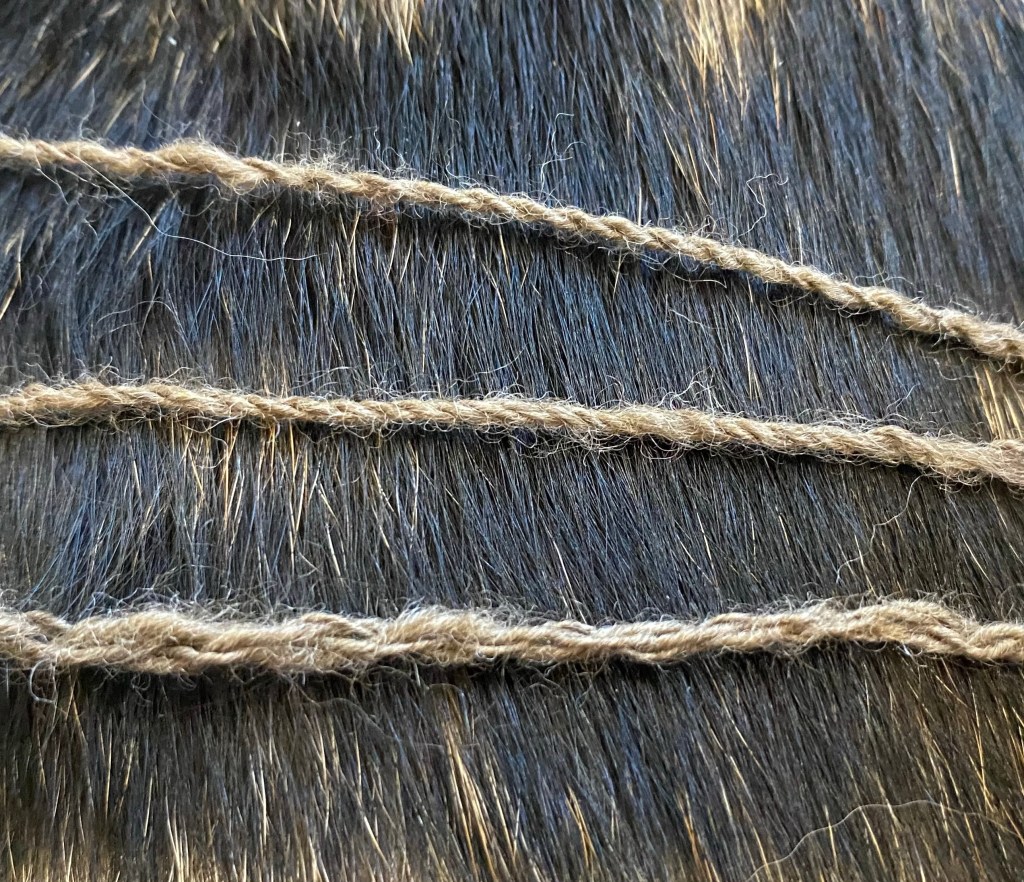
Cop on the left, two ply yarn on the right
Plied yarn completing a new cop

I’m still working on consistency, but it is the process I enjoy. It is meditative.

Supported spindle

I continue my Frankenstein method of using drop spindles. The shaft is from a Turkish style drop spindle that I made, the whorl is a wooden toy wheel because it was lighter than the arms of the Turkish spindle, and the support is from my original experiments and made from the base of two aluminum cans. Why? Why do I keep piecing and parting? Well, because I want to walk and spin. However it is cold outside and my cat wanted a lap. Drop spinning in my recliner so my very long cat has enough lap room was awkward, then I remembered that cotton spinners use a supported spindle set up, so I dug out the aluminum can contraption. I did not care for supported spinning in the beginning, but it was just the trick this time.

Spinning merino wool with a supported spindle

I am able to mix and match because of the shape of the shaft. It tapers sharply to a point at the bottom, which allows it to spin in a rounded support, and has a long taper from the base to the top, which allows the accommodation of various hole sizes in whorls. As a bonus, the cop of spun yarn slides up and off the shaft, without having to rewind!

Cop of yarn removed from the shaft of the spindle

So, if you are new to drop spindle spinning and want the flexibility to try different methods, I recommend looking closely at the shaft of prospective spindles. Or making your own.

One step at a time

I thought I would be at the park and draft stage of spindle spinning forever. There I would sit forever, spinning the spindle to build twist, then catching the spindle between my knees, or under one leg, or arm, and only then letting the twist run into my fiber as I drafted. Managing both spin and drafting seemed unattainable. I was actually OK with it, except for the lure of an idea. The idea to spin and walk.

So I grabbed my Turkish spindle and some prepared merino roving and tried again. The spindle seemed too heavy, so I took off the arms and slid a light wood whorl down the shaft to make a bottom whorl spindle. (With park and draft I preferred a top whorl.) Oh my goodness, something clicked. Yes, I dropped the spindle a few times as I figured out which direction I was spinning (I couldn’t think S or Z, I had to think counterclockwise or clockwise). I tried using my distaff, but kept getting the fibers wrapped tight around it, so instead wrapped some roving around my arm. The fiber was bunching up, so I divided the roving in half. That seemed to do the trick! I was spinning while standing! Missy the pup helped me with the next step because when I am standing that means I can kick her ball, right? And if I can kick her ball, maybe I can walk and spin. For now, spinning will continue indoors, as it is cold outside. But when it warms up, it will be time to try to walk!

Missy helping me with the spinning goals by asking me to kick her ball while I spin.