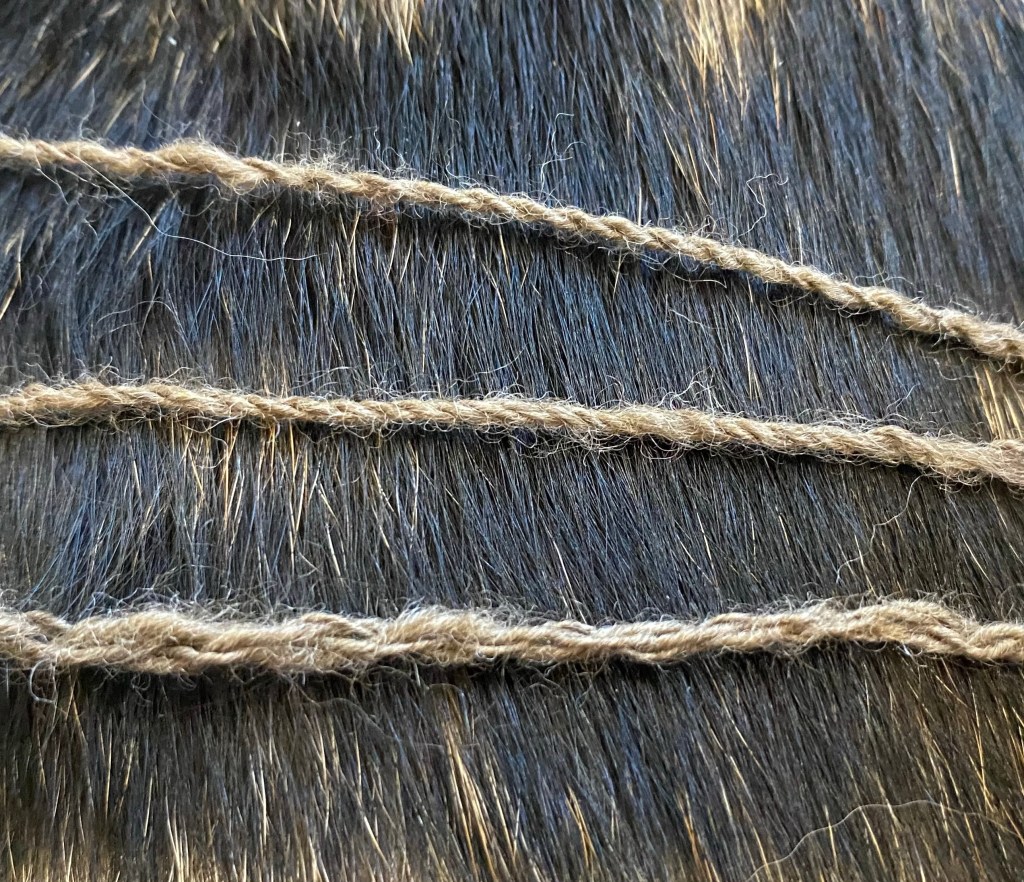
With my spinning experiments I ended up having three different plys of yarn from the same merino fiber, a two ply, a three ply (chain ply). and a four ply (cable ply).
From the top down, two ply, three ply, and four ply yarn from similar sized single ply (calico cat background)
I still don’t think the cable ply has enough twist, and I have trouble telling the two ply from the three, but it was an interesting experiment. Now, what to do with these wee balls of yarn?
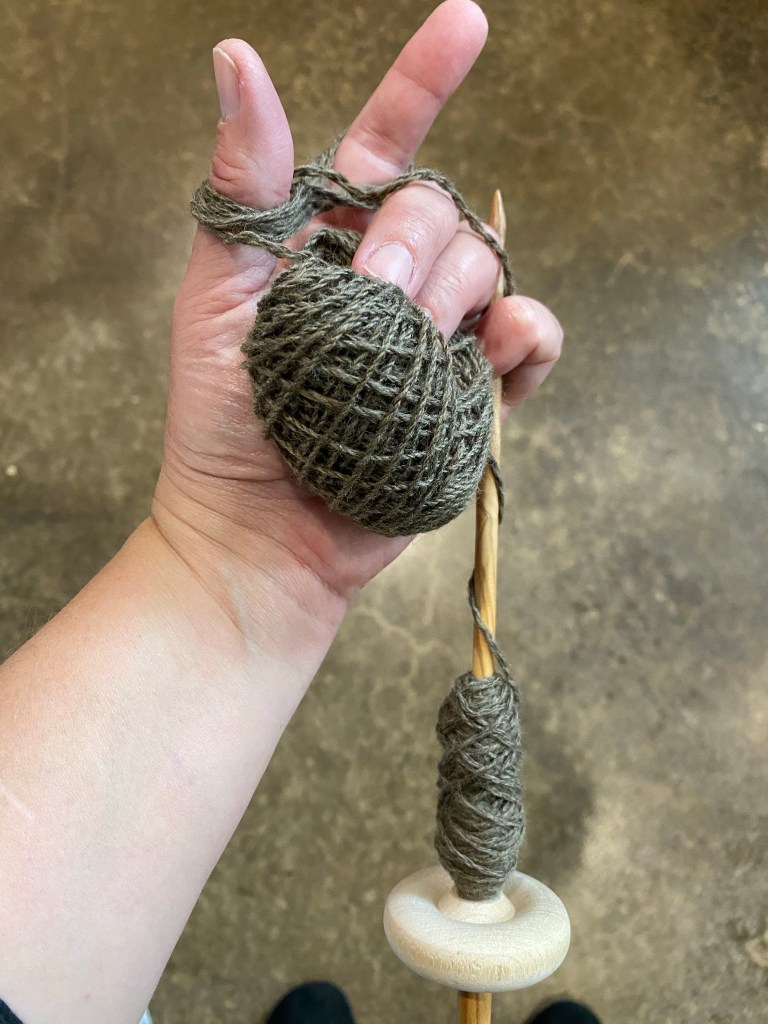
So exciting! Another way to ply! I was scrolling through a spinner’s group and found reference to cable plying, in which you take a two ply yarn and ply it again with two strands to get a four strand yarn. I had an extra cop of two ply that I could easily use to try the technique. I was able to ply from both ends of the cop (inside and outside ends), just as I did for the first round of plying. As a bonus, I’m almost positive that I can walk and do this! (I was way too enthused about it to wait until daylight, so finished the plying just standing inside). I definitely need practice, however, I’m not sure I added enough twist.
Two-ply cop being plied into a four-ply yarn
The most exciting thing is that this makes my fiber last for more walks! Spinning, plying, then plying again!
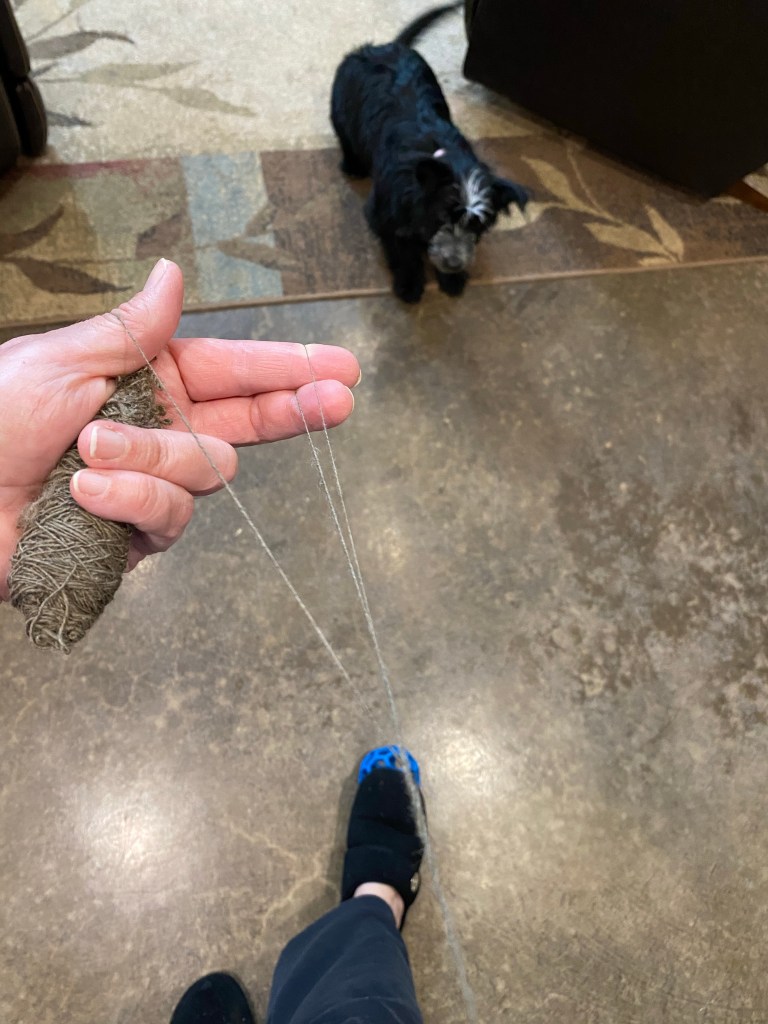
I say “standing” because it will take more practice before I can walk and chain ply. Chain plying is a way to make a three-ply yarn from one single, much like making a foundation chain in crochet with very long loops. If my single ply is supported I like to make loops as long as my arms can reach, but if I’m holding the source yarn in one hand and the spindle in the other, I have to shorten the loops to maybe half an arm span. And it takes more concentration to keep the three strands under tension and unkinked, so standing (with an occasional ball kick) is about all I can currently manage.
Missy is helping me practice chain plying by providing footwork
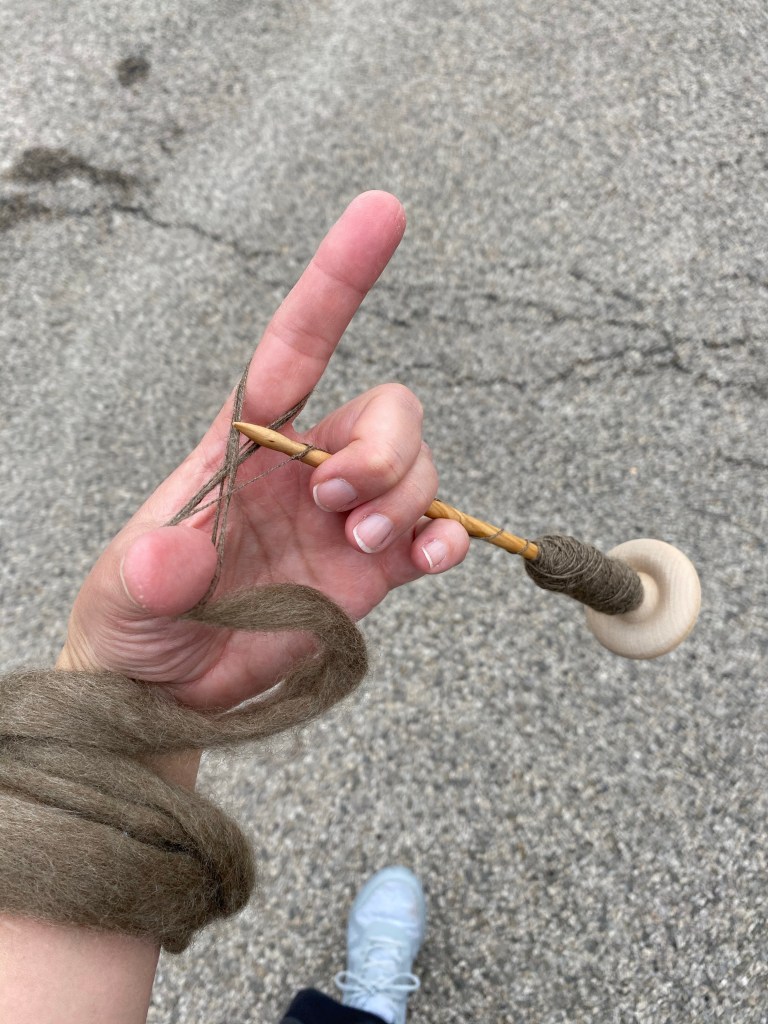
There are many butterflies in my life right now. Butterflies of weft yarn for weaving, and now butterflies of spun yarn while spinning. I haven’t seen the living kind yet, and it will be interesting to see what the deep freeze did to our insect population.
Butterflying spun single around thumb and forefinger while walking (holding the spindle for the picture only)
I think this is another advancement in my spinning. Before, I didn’t understand the why of the butterfly. I would spun an arm length, then wrap it up on my spindle. I was able to keep tension on the yarn the whole time to keep it from kinking. The butterfly comes in when you are able to spin more than an arm length. As the spindle nears the ground, and my hand is high in the air, wrapping the yarn around two fingers takes up the extra length under tension and allows me to wrap more around the spindle without troublesome twists.
So I finished my single ply over two walks, then was left with a question: can I walk and ply? With the double ended cop method I can! Not really surprising; it is easier to do a two ply than spin a single. There is no drafting and less dropping (yup, I’ve dropped the drop spindle a couple times on the walk!) The cop fits well in my left hand, and I keep one finger between the strands to keep the twist from running down into the wad of yarn. I draw out an arm length of two strands, then flick the spindle clockwise to ply. When the twist is where I want it, I wrap the yarn around the spindle, do a half hitch at the top, and go again.
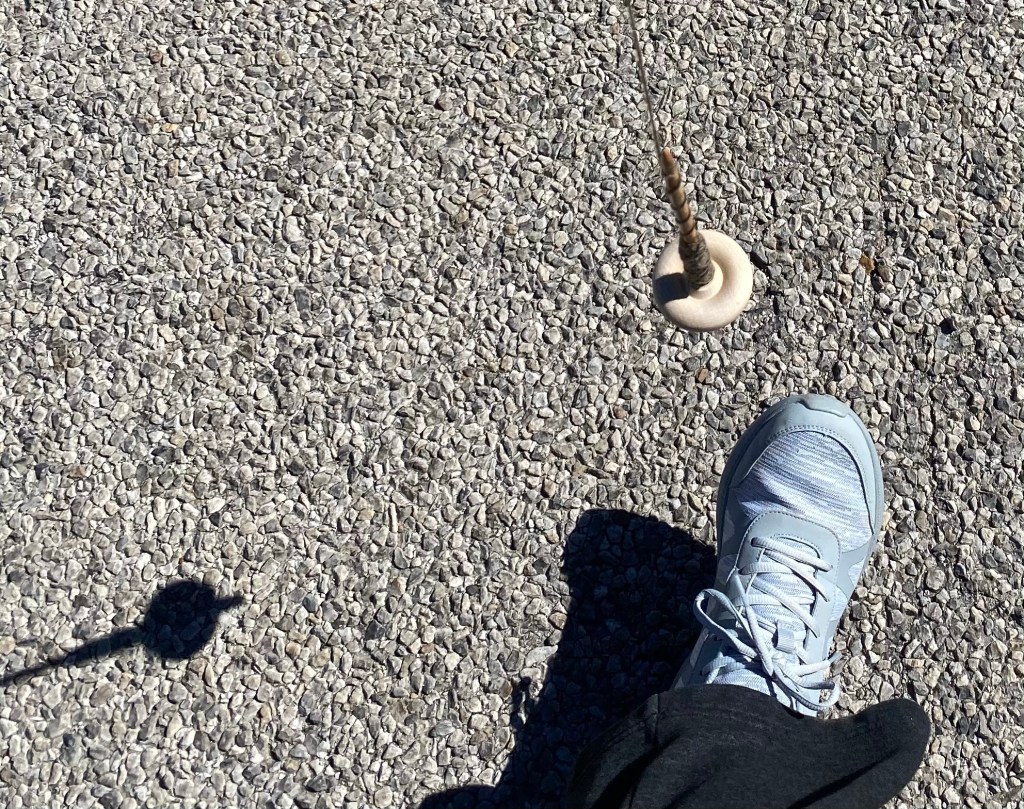
Picture taken mid-step while the twist worked into the ply
I do need to be careful with my hand position. I tend to let the spindle hang from my longest finger because it is convenient. I have to consciously add some fingers, since walking through the neighborhood with my middle finger raised high sends the wrong message. Although as I approach the middle of the yarn, it does get a bit knotty.
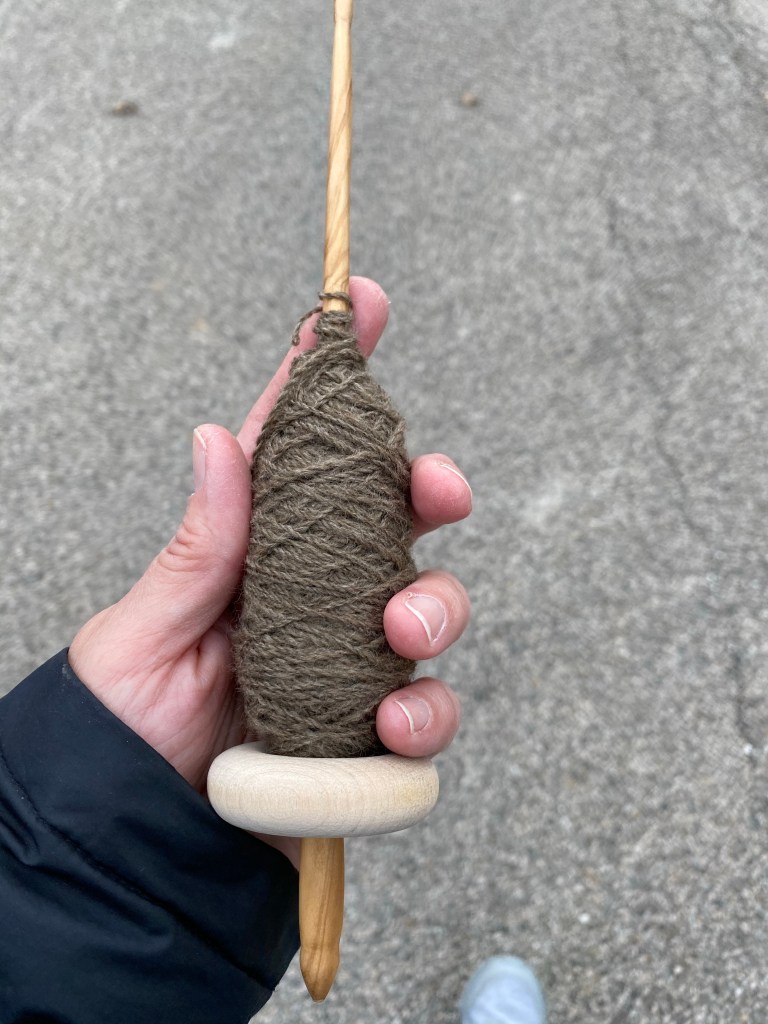
Cop of two ply merino wool, completed in two walks

 Critters and Craft