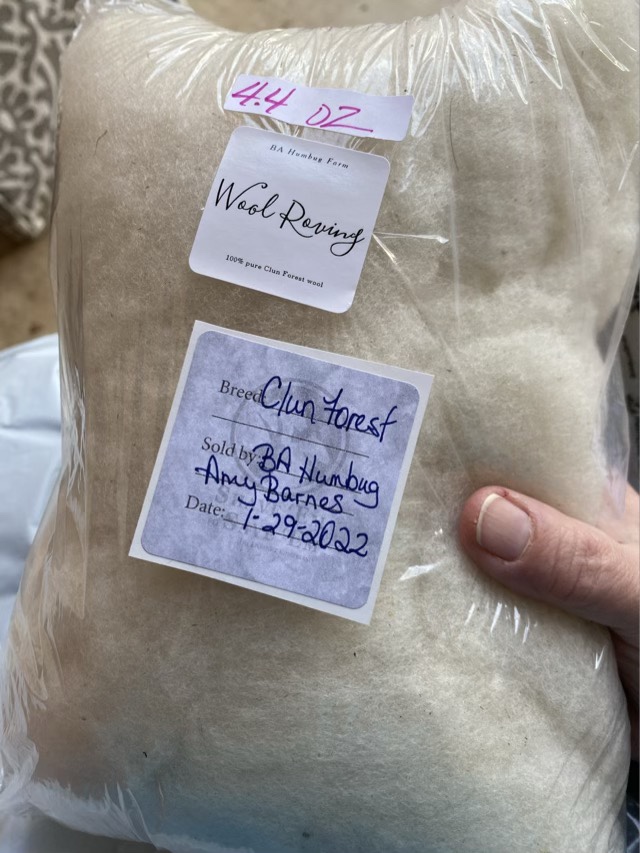
Ah, I bought more wool. I saw that one of the breeders participating in Shave ‘Em to Save ‘Em had four ounce bags of Clun Forest Roving ready to ship. I haven’t spun any of that kind of wool. I caved. Even though it has been washed and carded, it is still spending a couple weeks in the freezer, just in case something hitched a ride. Along with the whole alpaca fleece I haven’t yet processed. Hm.
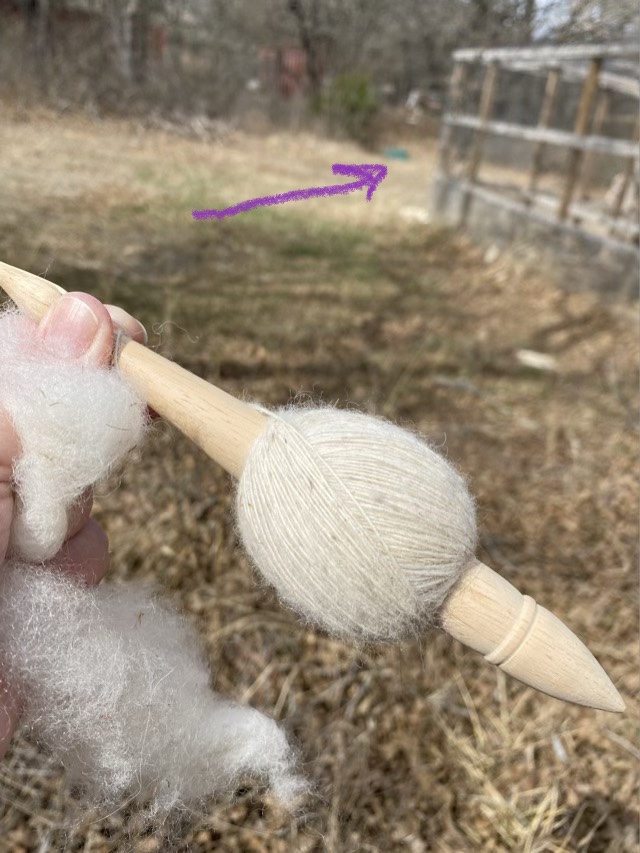
I’ve added a notch to the whorl of my student spindle. I make these from a 5/8” hardwood dowel, a cup hook, and a toy wooden wheel. Using a belt sander, I shape the ends of the dowel slightly; the top to accommodate the screw-in cup hook and whorl, and the bottom to make a point so it can be used also as a bottom whorl spindle. I read that beginners should also look for a spindle with a notch in the whorl to help hold the spun yarn in place. That is easy enough to add with two quick cuts with a small saw and some progressive sanding starting with 120 grit and working down to 400 grit. I had to test the new feature, as you do, so spun up some Shetland wool. The notch lines up to the back of the hook to help prevent the yarn from spinning around the whorl. I am past that learning hurtle, but I can see how this might help a beginner, so I’ll continue to add the notch.
Small amount of two-plied Shetland wool made to test the notch in the whorl
When I was learning to knit and crochet, I was taught to roll up extra yarn into a ball. Generally, you started with a small nest of yarn and wrapped more yarn around, changing directions every so often so it came out more or less round. Inevitably, I would drop the ball, it would roll across the floor, the cat might help its progress, and I would have to wind it up again. When I was older, I obtained a “new wool winder” which winds yarn from a hank into a cake-like structure, but was wonderful because the cake sat still and yarn could be pulled from the center. It did not work so well with small amounts of yarn, and I had to go and find the machine and a place to secure it to use it. Fast forward many years (better just skip, because there is quite a lot of time from then to now), and I was learning about spinning on a dealgan (a Scottish type of drop spindle), and the presenter in the video said the newly made yarn was wrapped around the spindle in the same way as for a nostepinne. What? The resulting cop of yarn could come directly off the spindle and the yarn could be pulled from the center. Hm. New rabbit hole. Nostepinne is a word for a fancy stick. I used a 1” dowel, which worked just fine the first time, but you really don’t even need a stick. A rolled up piece of paper will also work (especially if the cat is comfy on your lap and you can’t reach your stick, but there is a handy piece of paper).
Wrapped yarn ball (left) versus center pull ball (right)
I’m sharing because I really found this way of winding to be life changing. And it is so simple.
On a separate note, Adobe Premier now will make captions from my audio automatically. So that saves me a bit of typing. It still needed editing because “nostepinne” is not in its transcription vocabulary. Shocking. The video isn’t fancy because I’m still learning the software.
It felt good to do a little spinning again. I’ve been busy making things with yarn, but haven’t spun any in over a month. My eldest recently used shades of green and white wool to fill a clear plastic cup for a “kelp-achino” prop for a play (it came out well, by the way. Did I take a picture? No, of course not, darn it.) There was left over wool. Hm. It found its way into my fiber bag, and onto a drop spindle. Then we wandered outside because the weather was nice. I prefer to spin standing up because there is more vertical space for the spindle to spin, which is a problem in an orthotic boot, at least for long periods of time. The doc told me to rest, and I’m trying, truly.
My father-in-law has tropical milkweed growing around his house, and when we were visiting, it was going to seed; putting out lovely fluffy seeds. Hm. Can I spin it?
Tropical milkweed seeds
We gathered the fluff and I separated out the seeds. I didn’t have a spindle or flicker or any fiber processing tools with me (what was I thinking?!?), so I hand teased out the fiber and borrowed a pencil to attempt to spin the fiber.
Milkweed down with seeds removed
I would have preferred to spin these short fibers with a supported spindle, but after many determined attempts using a pencil to hold the spun single, I was able to at least achieve the semblance of yarn. The single was very fragile, so I doubled it to make a 2-ply yarn. The bit of yarn is brittle, but very soft. It is a thing to spin milkweed down, as I researched later, but most of the resources I found blended the milkweed with other fibers to give it strength. As my strand stands, it is really just an exercise in attainability, to see if I could. The yarn isn’t suitable to much purpose, however, it was a very enjoyable experiment.
2-ply hand spun milkweed downButterflies visiting the tropical milkweeds