No yarn chicken

When I’m not sure how much yarn I have, I try to pick a pattern that is flexible. This circle vest from LazyTCrochet Designs fits the bill. It is crocheted from the inside out, and the circle can expand. One downside of the pattern is that it only has two sizes, s/m and l/xl. It has instructions for expanding the circle for coverage, but that only goes a few more rows. The idea is expandable though, and the pattern is inexpensive.

Photo description: in-process circle vest crocheted with hand spun Jacob’s wool, pattern by LazyTCrochet Designs

I used the darker of my hand spun Jacob’s wool yarn for the center, then the lighter color for the next band. This is as far as my Jacob’s wool could take me, aside from a few small scraps. The vest needs more rows, so I’ll add some hand spun Teeswater wool for the next row. I just need to finishing spinning it first. Both Jacob sheep and Teeswater sheep are on the endangered list and part of the “Shave ‘Em to Save ‘Em” initiative by the Livestock Conservancy. I’m considering calling this my “Shave ‘Em Two Save ‘Em” vest since it will have two breeds from the list. Unless I end up needing a third breed, then I’ll have to rethink the pun.

Toothpick spinning

I have a spinning demonstration coming up and I want to have small give aways that promote and encourage people to try spinning. While it is possible to spin without a spindle by rolling fiber along your thigh, tension management is more difficult. Tooth picks resemble small spindles, especially for cotton, and are inexpensive. Can I spin using a toothpick?

Photo description: combed cotton spun into thread using a 2.5 inch toothpick

I started with combed cotton, and was pleasantly surprised that while spinning the toothpick in one direction with my fingers I could spin. It isn’t fast, but it is possible. As the cop of thread built up, though, it was harder to spin the short toothpick.

Photo description: Teeswater long wool spun on a 4 inch toothpick

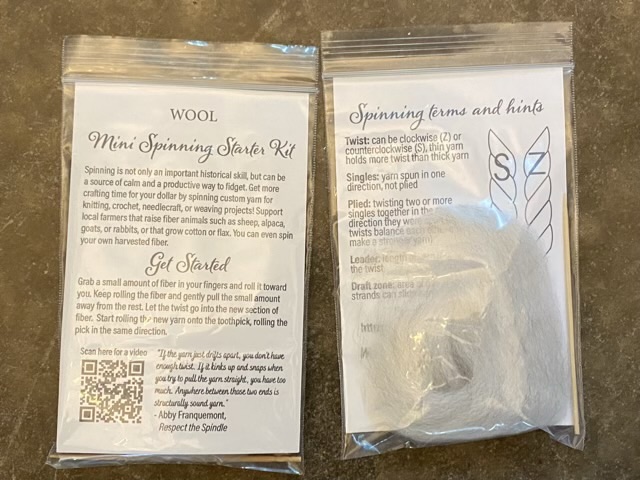
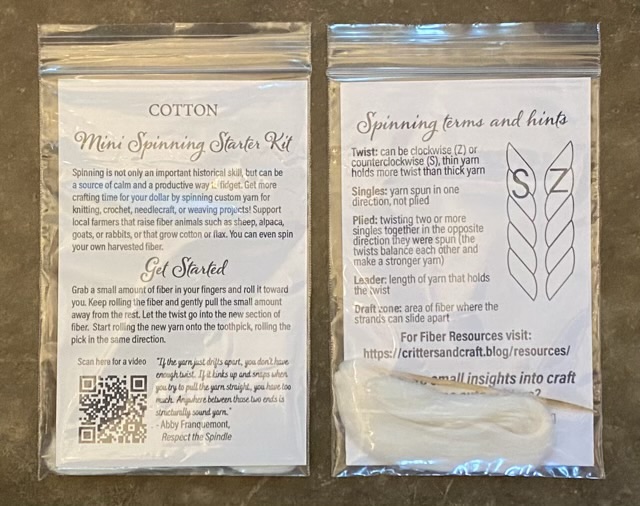
I tried a longer toothpick and some longer staple wool, and found spinning much easier. A small bit of wool also goes a long way when making thread! My plan is to make small bags with a fluff of wool or cotton, a 4 inch toothpick, and a small card with basic instructions and a link to a video.

Eye calibration off

Photo description: two yarn turtles from a Turkish style spindle, the one on the left weighs 22g, the one on the right weighs 26g.

I’m spinning Southdown wool on a 3D printed Turkish style spindle. My eyes aren’t quite calibrated to estimate same-sized turtles when one is on the spindle and the other is off. I had a difference of 4 grams. That may not seem significant, but I can visually tell the difference when they are both off the spindle and it means the one on the right has several yards more yarn. I’m planning a three ply yarn with the singles, so need to spin another turtle. I’m aiming for the 22 g size to minimize leftover single spun yarn. Even three turtles of my hand-spun yarn that weigh the same won’t have the exact same yardage because my spin has some variation, especially across different days, but it a reasonable estimate.

Spin walks

School is back in session, so I’ve started up my spin walks again. Really it is a matter of the temperature coming down and walks being pleasant in the morning, instead of a hot sticky mess.

Photo description: spinning Southdown wool on a 3D printed Turkish style spindle while walking a city park

I found two drop spindle projects in progress when I went to pick up my spindle. Hm. I decided to start with the Southdown, because this little Turkish style spindle is one of my favorites. If I drop it, the rubberized arms bounce, and the yarn is protected from contact with the ground due to the jacks like shape of the arms and shaft.

Great wheel

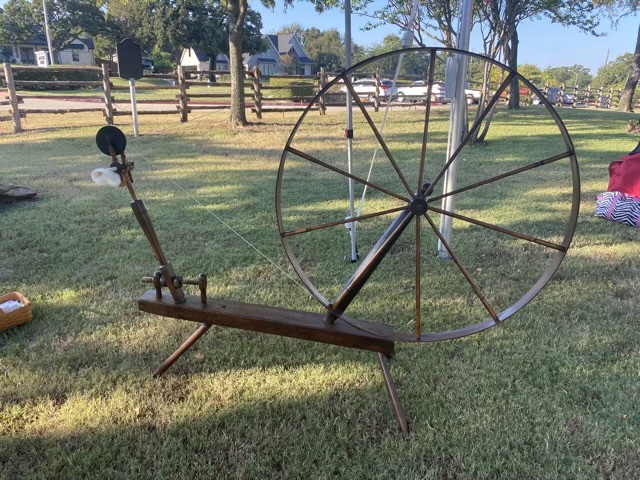
Photo description: 1800s Great Wheel at Man House in Mansfield, TX, yarn weasel in back corner, basket of raw cotton (bottom right)

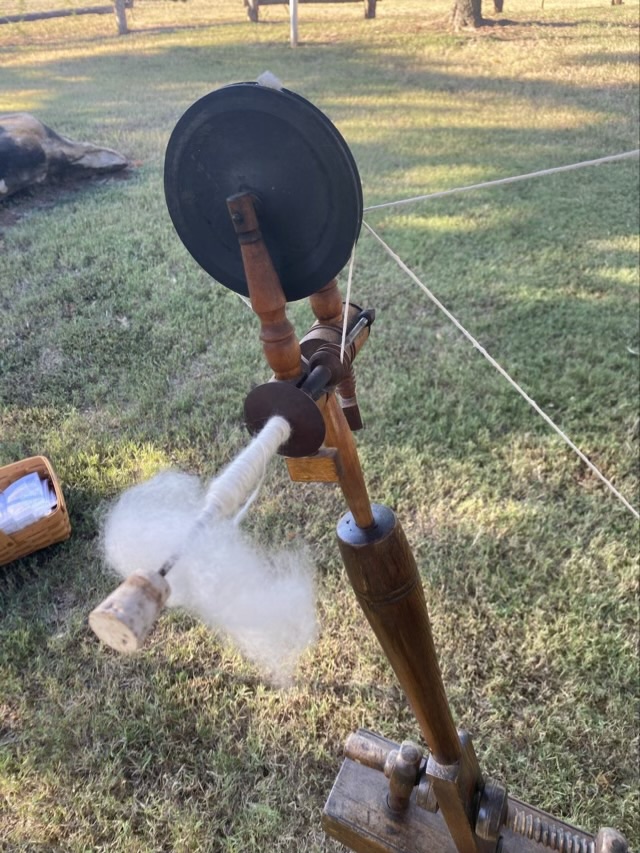
Y’all, I get to demonstrate spinning on a great wheel, also known as a walking wheel, in October. I recently took a drive out to meet the wheel and see if I could spin with her. We are compatible. I took some Teeswater wool roving to give her a spin, and she has been kept in good working order. There is a little slip in her drive band, but I have permission from the museum to use beeswax if necessary. She has an accelerator head, so was probably used mostly to spin cotton, especially since they were growing cotton in that area in the 1800s. I will take two kinds of local grown cotton sliver to spin in the demonstration. I’m so excited.

Photo description: close up of the spindle head showing the cotton drive bands, accelerator head, and spindle with 15 minutes worth of spun Teeswater wool, and a cork on the spindle tip for safety

The wheel is potentially 200 years old, or at least approaching her 200th birthday. It is a humbling experience and an honor to spin with her.